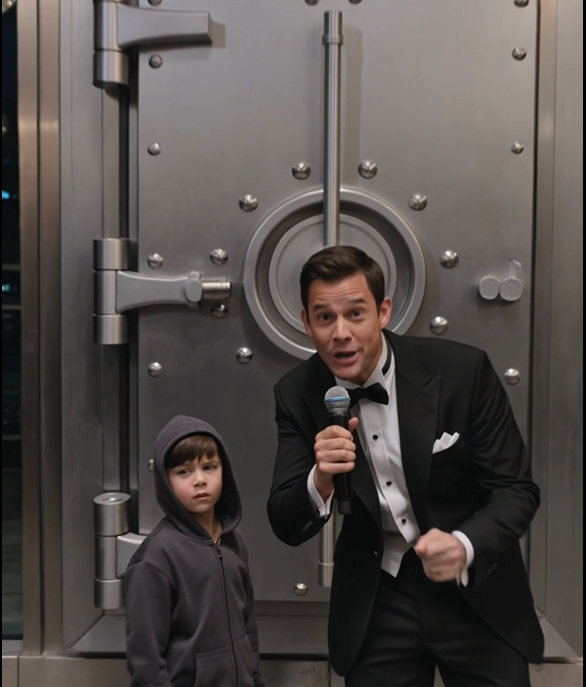
The Meridian Tower gala was the kind of event that required three forms of identification just to receive an invitation. Forty-seven floors above Fifth Avenue, the glass restaurant floated like a diamond suspended in black velvet, its walls nothing but floor-to-ceiling panels reflecting the city back at itself in infinite loops — chandeliers doubled, tripled, multiplied into constellations that competed with the skyline outside.
Eleanor Voss stood near the bar in a gown the color of champagne, watching the room with the practiced detachment of someone who had attended too many of these gatherings to be impressed by any of them. Senators. Tech founders. A former Secretary of State. Two Oscar winners. Old money and new money performing the ancient ritual of pretending they were the same thing.
She was on her second glass of Krug when the sound came.
CLANG.
Metallic. Enormous. Wrong.
Every conversation stopped. Every head turned toward the center of the room, where four men in dark uniforms were dragging something massive across the polished obsidian floor — a vault door, industrial and brutish, absurdly out of place among the orchid centerpieces and the hand-stitched tablecloths. It came to rest with a grinding finality that seemed to rattle the windows.
The safe itself was already there, Eleanor realized. It had been there all evening, positioned like a sculpture in the northeast corner, and she, like everyone else, had assumed it was art. That was the thing about billionaire galas — you stopped questioning the strange objects. You just accepted them as statements.
Their host stepped forward and seized the microphone.
Marcus Hale was sixty-one years old and looked forty-five through aggressive means. He had founded three companies, dissolved two marriages, and once purchased an island for the sole purpose of never visiting it. He smiled the way powerful men smile — with his teeth, not his eyes — and tapped the microphone twice.
“Ladies and gentlemen,” he said, his voice cutting through the lingering shock like a blade, “I have spent thirty years throwing parties. And I have decided that tonight—” he paused for effect, gesturing at the safe with one extended arm “—we do something worth remembering.“
Murmurs rippled through the crowd.
“Inside this safe,” Marcus continued, his voice rising with the particular electricity of a man who enjoyed attention the way other men enjoyed oxygen, “is one million dollars. Cash. Untouched. Real.”
Eleanor watched a hedge fund manager to her left actually set down his drink.
“The combination,” Marcus said, spreading his hands open like a preacher, “is known only to the safe’s manufacturer. It has been locked by a randomized algorithm. Even I don’t know it.” He smiled. “So here is the game. Anyone in this room who can open it—” he let the silence stretch “—keeps what’s inside.”
Nervous laughter. Skeptical applause. A woman in red near the window whispered something to her companion. Security personnel along the walls exchanged the kind of looks that meant they hadn’t been briefed on this portion of the evening.
And then Eleanor noticed the boy.
He was already standing in front of the safe.
He couldn’t have been older than seventeen. Maybe younger — it was difficult to tell because his face was partially obscured by the hood of a gray sweatshirt that had no business being in this room. He was thin. His sneakers were clean but worn. His hands hung loose at his sides with an eerie, preternatural calm that didn’t match his age, his clothes, or the situation.
No one knew how he had gotten in.
That, Eleanor would think later, should have been the first question. It wasn’t.
“Son,” Marcus said into the microphone, his smile tightening slightly, “you’re welcome to try.”
Laughter from the crowd — gentle, condescending, the laughter of people who were certain of the outcome.
The boy did not laugh. He did not smile. He did not look at Marcus Hale or at the crowd or at the chandeliers or at Manhattan blazing forty-seven floors below. He looked at the safe the way a person looks at something they have already finished thinking about.
He placed his hand flat against the steel door.
The laughter faded.
Eleanor felt the hairs rise on the back of her forearms.
The boy’s head tilted slightly, as if he were listening to something beneath the metal — a frequency, a rhythm, a secret the safe was whispering to him alone. His fingers moved in a slow, deliberate sequence across the surface, not toward the combination dial, but along the seam of the door itself. He pressed. He waited. He pressed again.
“Stop.”
The word arrived like a stone dropped into still water — quiet, but spreading instantly in every direction.
Every eye in the room moved.
A man was walking through the crowd. He moved slowly, with the composed deliberateness of someone who was in no hurry because he was confident the world would wait for him. He was perhaps fifty. Gray at the temples, a dark suit that was expensive without announcing itself. He wore no name tag. Eleanor had not noticed him all evening, which meant he was either a nobody or he was so important that he existed in a different category of visibility entirely.
The crowd parted for him without quite knowing why.
He stopped ten feet from the boy. He did not look at Marcus Hale. He did not look at the crowd. He looked only at the boy in the hoodie, and his expression was not angry — it was something colder and more complex than anger.
“That safe,” the man said, his voice low and precisely controlled, “does not belong to you.”
The silence in the room was the most complete silence Eleanor had ever experienced. She became aware of the ambient hum of the building’s ventilation system, of the distant murmur of the city forty-seven floors below, of her own heartbeat making itself known against her ribs.
Marcus Hale stood frozen with the microphone in his hand. The security personnel had straightened but hadn’t moved — they were waiting for someone to tell them which threat to address.
The boy’s hand was still on the safe.
Slowly, with the measured pace of someone who was choosing every movement intentionally, he turned his head toward the man.
His face came into the light.
Eleanor saw it clearly for the first time: not frightened, not defiant, not confused. Something quieter than all of those things. Recognition, maybe. Or something that preceded recognition — the expression of a person who has been waiting for an encounter and is now simply watching it arrive.
The man took one step forward.
“You know who I am,” he said. It was not a question.
The boy said nothing for a long moment. The chandeliers cast him in warm light, and in that light he looked, Eleanor thought, impossibly young and impossibly old at the same time — like someone who had been carrying something heavy for so long that the weight had become structural, had become part of how he held himself.
“I know what’s in the safe,” the boy said finally. His voice was quiet and even. “And it isn’t money.”
The sharp intake of breath from Marcus Hale was audible in the silence. His eyes moved to the vault and back to the man, and something in his face changed — not guilt, exactly, but the particular expression of a person calculating how much of a secret has just been exposed.
The man in the dark suit went very still.
“Take him,” he said quietly. Not to security. To two men who had detached from the wall near the east window — men Eleanor had assumed were guests, who now moved with a coordinated, practiced precision that had nothing to do with attending parties.
The crowd began to shift. Someone near Eleanor backed away from the center. A woman grabbed her companion’s arm.
The boy looked at the two approaching men. Then he looked back at the man in the dark suit. And then, slowly, he reached into the pocket of his gray hoodie and removed something small — a thumb drive, Eleanor thought, or a key, or something else entirely that she couldn’t identify from where she stood.
He held it up between two fingers.
“Then I suppose,” the boy said, “you’ll want this back, too.”
Everything happened at once.
The two men lunged. The crowd exploded backward. Someone knocked over a glass and it shattered across the obsidian floor like a gunshot. Marcus Hale dropped the microphone and it screeched and wailed. Security personnel surged from the walls and then stopped, uncertain, because they weren’t sure whose side anything was on.
And in the middle of all of it, the man in the dark suit stood completely still, looking at the boy, and for the first time all evening, he appeared to be the one who was afraid.
The lights went out.
Not all of them — just the overheads, leaving only the chandelier light and the blazing geometry of Manhattan pressing in through the glass walls. In the dimness, the room erupted into voices, movement, the scrape of furniture.
Eleanor pressed herself against the bar and looked toward the safe.
The boy was gone.
The two men were gone.
The man in the dark suit stood alone in the center of the room, in the amber light of the chandeliers, looking at his own open hand as if something he had been holding for a long time had simply ceased to exist.
The safe door was ajar.
Not open — not fully — but ajar, the seam of it fractured loose by some method Eleanor could not explain and would not be able to describe later when the investigators asked her. Just open enough to make clear that whatever had been inside it was no longer there.
Marcus Hale pushed through the crowd and stared at the door. His face had gone gray.
“Where—” he started.
“Quiet,” the man in the dark suit said. And Hale went quiet.
The city blazed on outside, indifferent, all those millions of lights reflecting back and forth between the glass walls, multiplying into infinity, the way all secrets do — doubling and doubling until they’re everywhere and nowhere at once, until no one can be sure what they originally saw.
Eleanor set her empty glass on the bar.
Somewhere below, forty-seven floors down, a door opened onto Fifth Avenue.
A boy in a gray hoodie walked into the city and disappeared.
