In a bank where the loudest sound was usually the soft percussion of a keyboard or the polite clearing of a throat, the sound cut through everything like a blade through silk. Three tellers looked up. A loan officer in the glass office paused mid-sentence. The security guard near the entrance shifted his weight from his left foot to his right.
Nobody moved.
The boy stood at the counter.
He was nine years old, maybe ten if you were being generous about his height. Dirt tracked along his jaw in thin brown lines, the kind that comes not from one bad afternoon but from days without a proper wash. His sneakers were wrong for the season — canvas in late October, the laces replaced with a single zip tie on the left shoe. His jacket was adult-sized, olive green, the kind sold in army surplus stores for eleven dollars.
He did not look around. He did not fidget. He did not do any of the things that children do when they find themselves somewhere unfamiliar.
He looked straight ahead, and his eyes were very calm, and that was the most unsettling thing in the room.
Amanda Reyes had worked the fourth window at First Meridian Bank on Crescent Boulevard for eleven years. She had seen people cry at her counter. She had seen a man faint during a wire transfer. She had once watched a woman attempt to deposit a check written on a paper plate — and had processed it, because technically the account number was correct.
She had never seen anything like this.
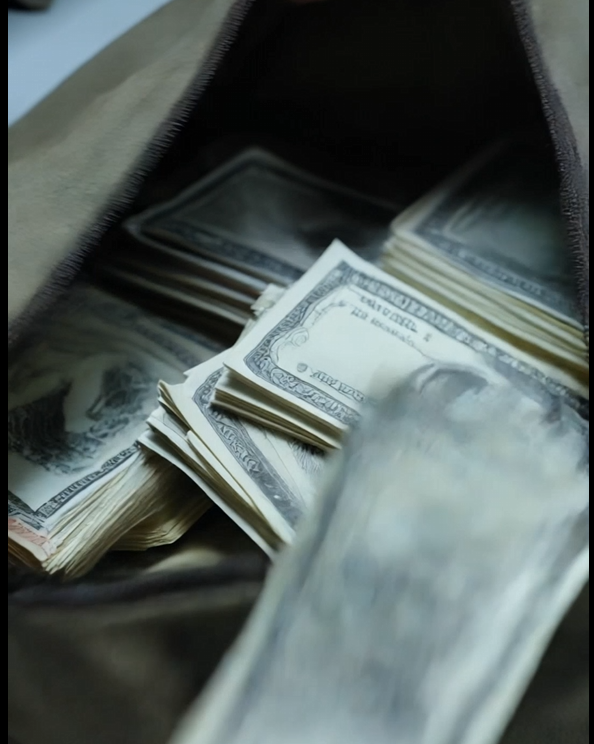
The duffel bag was worn canvas, military-adjacent, the kind that gets dragged through gravel and never quite recovers. The boy had placed it on the counter with both hands, the way you place something you’ve been carrying for a very long time and are finally ready to put down. Then he’d unzipped it — that sound, that tearing sound — and the bag had fallen open like something exhaling.
Cash.
Bound in rubber bands, not bank straps. Not the clean brick-shaped bundles that came from armored cars. These were thicker, uneven, the bills oriented in different directions. Twenties mostly, some fifties, a few hundreds near the bottom, visible only because the weight of the upper stacks had shifted the bag’s contents when he set it down.
Amanda’s eyes moved from the bag to the boy’s face.
His expression did not change.
The background noise of the bank — the HVAC system, the faint muzak that nobody had ever consciously chosen to listen to, the distant sound of a printer — seemed to lower itself, as if the room were leaning in.
“I want to open an account.”
His voice was even. Not the performance of evenness that adults do when they’re trying to seem calm. Actual evenness. The kind that comes from somewhere deeper than effort.
Amanda’s mouth opened slightly. She closed it. Opened it again.
“Okay,” she said, and her voice came out smaller than she intended. She was aware of Sandra two windows down pretending not to stare. She was aware of the security guard, Marcus, who had taken two steps toward the counter and then stopped, uncertain what protocol applied here.
She looked at the bag.
She looked at the boy.
She leaned forward slightly, lowering her voice the way you do in libraries and hospitals and places where the normal volume of the world feels inappropriate.
“Where did you get this money?”
The boy did not answer immediately. He reached into the front pocket of the oversized jacket and removed a piece of paper. It had been folded four times, the creases sharp, the kind of folds you make deliberately and then press flat with your thumbnail. He placed it on the counter and slid it toward her with two fingers, tracking it all the way to the edge of her space before releasing it.
He did not look at it when he slid it. He looked at her.
Amanda picked up the note.
She unfolded it once. Twice. The paper was standard printer paper, white, slightly soft from being carried close to a body in a jacket pocket for what might have been days. The text had been typed and printed, the font plain, the message brief.
Do not connect this deposit to any identity.
She read it twice. She set it down on the counter. She looked at the boy.
He was still looking forward. Not at her, exactly. At the space just past her, the middle distance, the place where people look when they are listening to something nobody else can hear.
Amanda’s hands were on the keyboard before she’d made a conscious decision to put them there. Eleven years of muscle memory. The protocols for handling large cash deposits were clear: CTR filing for anything over ten thousand, identity verification, source of funds inquiry. She knew all of this. She had done all of this. Her fingers hovered.
She typed in the account inquiry field instead. Just to see. Just because something in the boy’s stillness suggested that there was already something to find.
She typed the account number from the note. She had not noticed until now that the note contained an account number — it had been printed in small text beneath the main message, easy to miss if you were focused on the words.
The system took longer than usual to respond. Three seconds. Five. The little loading icon rotated in the corner of the screen.
Then the interface populated.
Amanda stared at it.
She pressed refresh. The page reloaded and showed her the same thing.
ACCOUNT ACTIVE BALANCE: $14,872,000
The account had been opened — the timestamp was visible in the corner of the record — fourteen years ago. Before the boy had been born. The account holder name field contained a string of numbers where letters should have been, which Amanda had never seen before and which the system did not flag as an error.
The account had no address. No phone number. No email. No social security number, no tax identification, nothing. Just the number string, the balance, and a single notation in the memo field that she had to lean close to read:
DORMANT — PENDING CLAIM.
Her face had gone the color of copy paper.
“This account,” she said, and stopped.
She was whispering without deciding to whisper.
“This account already exists.”
The boy’s gaze returned from the middle distance and settled on her face. It was the most direct he had looked at her since he’d walked in, and it lasted only a moment, but it was long enough for her to understand something she couldn’t have explained — that he was not surprised, that he had known, that he had been waiting for her to catch up.
“I know,” he said.
Marcus the security guard had moved closer again. Sandra had stopped pretending to work. The loan officer had come to the doorway of the glass office and stood there with a pen in his hand, completely still, like a man who had walked into a film already in progress and couldn’t locate the beginning.
The boy reached back into the jacket pocket. Amanda tensed. He produced nothing alarming — just his hand, empty, returning to his side.
He looked forward again.
The bank held its breath.
Later, Amanda would try to describe the feeling to her husband, and she would fail. She would say: he looked like someone who had come home after a very long time away, and the house was exactly where he’d left it. Her husband would nod and not fully understand, and she wouldn’t blame him.
She would not be able to explain the boy’s face in the final moment — the way, when she said this account already exists, something moved behind his eyes. Not surprise. Not relief. Something older than both.
She would not be able to explain why she did not immediately call the police, why Marcus did not step forward, why the entire bank seemed to exhale and then simply wait.
She would try to describe how the boy, in those final seconds, had turned slightly — not to leave, not to speak, just to angle himself a few degrees, as if orienting to something outside the building, some direction only he could feel — and how his voice, when he finally spoke, had the quality of a statement that had already been true for a long time before anyone said it out loud.
“They already know my name.”
She would tell her husband that the bass note she heard in the silence after he spoke wasn’t music. Wasn’t the HVAC. Wasn’t anything she could point to.
It was the sound of something enormous settling into place.
The boy zipped the bag.
He did not take it with him.
He left it on the counter and walked out through the glass doors into the pale October light, and the doors slid shut behind him, and the muzak resumed, and the printer in the back started up again, and the loan officer returned to his office, and Marcus walked back to the entrance, and Sandra turned to her screen.
And Amanda Reyes sat at window four with her hands folded on the keyboard and the note unfolded in front of her and the account number glowing on the screen and fourteen million dollars in a dormant account that had been waiting since before the boy was born, and she sat there for a long time before she reached for the phone.
And when she finally dialed, she did not dial the police.
She didn’t know why.
She just knew that whatever this was, it was not a crime.
It was something else entirely.
Something that had already been set in motion long before today, by hands she couldn’t see, for reasons she couldn’t name.
And somewhere out there, a nine-year-old boy in a too-big jacket and a zip-tied sneaker walked down Crescent Boulevard in the October cold, and he did not look back, and he was not afraid, and he already knew exactly where he was going.
