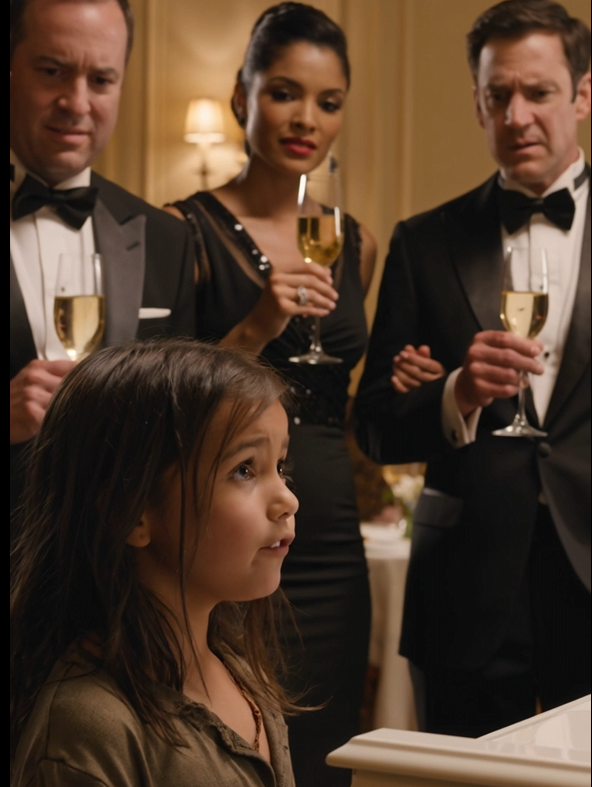
Not thirteen. Not sixteen. Fourteen, exactly, because that was the number that had appeared in a New York Times profile eight years ago — “a fourteen-week wait for a table at Aurel’s is not exclusivity, it is liturgy” — and the number had calcified into fact, into identity, into the kind of detail that wealthy people repeated at other wealthy people’s dinner parties to signal that they understood how things worked.
The restaurant occupied the ground floor of a pre-war building on the Upper East Side, and everything inside it had been chosen to communicate a single feeling: that you had arrived somewhere permanent. The floors were dark walnut. The lighting came from sources you could never quite locate. The tables were spaced far enough apart that conversations stayed private, and the staff moved between them with the particular silence of people who had been trained to be invisible.
In the center of the room, positioned slightly off-axis in the way that things in expensive spaces are always positioned slightly off-axis to suggest they hadn’t been calculated, stood a Steinway Model D concert grand. Ebony. Nine feet long. It was played on Wednesday and Friday evenings by a pianist named Guillaume who wore the same black jacket every night and never acknowledged applause.
Tonight was a Saturday.
The piano was unoccupied.
She appeared from the service corridor.
Nobody saw exactly how. One moment the corridor was empty — a rectangle of warm shadow between the kitchen and the dining room — and the next moment she was standing beside the piano, and several guests had already noticed her before anyone had thought to ask how she’d gotten in.
She was nine years old, possibly. Small for whatever age she was. Her clothes had once been a specific color and were now simply dark — dark with wear, with weather, with the particular grime that accumulates not from a single bad day but from many of them stacked on top of each other. Her face was smudged along one cheekbone, and her hair had been pulled back at some point and had mostly escaped whatever had been holding it. Her shoes did not match.
She stood beside the Steinway the way people stand beside things they have imagined for a long time.
Not touching it. Just beside it.
The nearest guests were a couple in their late fifties — he in a charcoal tuxedo, she in a gown the color of old champagne. They had been mid-sentence when the girl appeared, and they had not resumed their sentence. They were looking at her the way you look at something that doesn’t compute, waiting for the environment to correct itself.
The girl’s eyes moved around the room slowly, without panic. She was taking inventory. She looked at the food on the nearest table — a seared duck breast, a scatter of microgreens, a sauce applied with what appeared to be architectural precision — and then she looked at the people holding their champagne flutes and she looked at the piano and then she looked at the floor for a moment.
Then she raised her eyes and spoke.
“Can I play for food?”
Her voice was soft. Not performatively soft, not the fragile-child softness of someone who has learned that fragility is useful. Just quiet, the way people are quiet when they have been speaking mostly to themselves for a long time and have forgotten to project.
The nearest woman raised an eyebrow. Not unkindly, exactly — more the way you raise an eyebrow at a weather event. A thing happening that has no particular relevance to you.
The man beside her swirled his champagne. His eyes moved from the girl back to his glass, completing a circuit of mild interest.
From the far side of the room, near the service station, the manager — a tall man named Clifford who had managed Aurel’s for six years and who prided himself on the invisibility of his interventions — saw the girl and took one step forward and then stopped. He was calculating. The girl wasn’t causing a scene. She was standing still. The calculus of removal was more complicated than it appeared, because removal would itself become a scene, and a scene was the one thing Aurel’s could not afford.
He waited.
Several guests at nearby tables were now whispering behind their hands.
The girl stood beside the piano and received all of this — the eyebrows, the champagne-swirling, the whispers, the manager’s frozen assessment — and her expression did not change. It was not the blankness of someone suppressing emotion. It was something more specific than that. It was the face of someone who had already accounted for this reaction, had included it in whatever calculation had brought her here, and was simply waiting for it to pass.
She pulled out the piano bench.
It moved with the low wooden complaint that expensive furniture makes when it hasn’t been adjusted in a while. She sat down. The bench was too high for her — she was small and the Steinway was built for adults — and she had to angle herself slightly forward to reach the keys, her feet not quite flat on the floor.
She looked at the keys for a moment.
Her hands were small and dirty. The knuckles slightly rough. The nails cut short and unevenly. She raised them and held them over the keys without touching, hovering there in the warm amber light of the restaurant, and the guests who were watching — and there were more of them watching now, the whispering had spread — saw something in the positioning of her hands that caused a few of them to stop mid-whisper and simply look.
Her hands knew where they were.
The first note landed.
The acoustics of Aurel’s had been engineered by a firm that charged more for acoustic consultation than most restaurants charged for everything else combined. The room was designed to hold sound a certain way — to let a conversation exist at one table without bleeding into the next, to let Guillaume’s Wednesday and Friday performances fill the space without overwhelming it.
The single note the girl played filled the room differently than Guillaume’s notes filled it.
It was pure in a way that seemed almost unreasonable. Clear and sustained, hovering in the air above the tables and the champagne flutes and the architectural sauces, and several guests looked up at the ceiling involuntarily, as if the sound had come from somewhere above them.
Then she continued.
What she played was not a standard piece. Not Chopin, not Satie, not the kind of thing that gets played in restaurants to signal that the restaurant understands culture. It was something else — a melody that moved in a pattern that felt both unfamiliar and immediately recognizable, the way certain melodies feel like they’ve existed longer than their composer, like they were discovered rather than written.
The whispering stopped.
Clifford the manager had both hands at his sides and was no longer calculating anything. He was listening.
The woman who had raised her eyebrow had set her champagne down on the nearest surface without looking for it, her eyes on the girl’s back.
The melody developed. It was not complicated in the way that impressive piano pieces are complicated — it did not accelerate into runs and flourishes designed to signal technical mastery. It was complicated the way water is complicated: simple on the surface, structural underneath. Each phrase led into the next with the logic of something that could not have been otherwise.
In the far corner of the room, at a table set for one, a man named Daniel Carr sat with a glass of Barolo and an untouched entrée and the particular stillness of someone who has grown accustomed to eating alone in public and has made peace with it.
He was sixty-three. He had made his money in the early years of the internet and had spent the subsequent decades giving most of it away in ways that attracted very little attention, which was how he preferred it. He came to Aurel’s on the first Saturday of every month because the routine was a container and containers were useful when other things were not.
He had heard the girl ask to play for food.
He had watched her sit down.
He had been watching her back as she played, the small shoulders slightly hunched forward, the dirty hands moving with a confidence that was not the confidence of performance but of something more private, more internal.
And then the melody reached him.
His hand tightened around the Barolo glass.
Not the grip of stress. The grip of someone grabbing something solid because the ground has shifted.
He knew this melody.
He knew it the way you know the face of someone you loved twenty years ago — not from memory exactly, but from somewhere below memory, from the place where certain things get written in a different ink that doesn’t fade the same way.
He had written it.
He had written it thirty-one years ago, sitting at an upright piano in a apartment in Chicago, in the months after his daughter was born, in the sleepless particular joy of early fatherhood. He had played it for her when she couldn’t sleep. He had never recorded it, never written it down, never played it for anyone else. It existed only in that apartment, in those nights, between him and a infant who was too young to remember.
His daughter had died at two years old.
He had not played the melody since.
He had not thought about it in years, had assumed it was gone, had not known that he had filed it somewhere so deep that the only thing that could retrieve it was hearing it again.
He heard it now.
From the hands of a nine-year-old girl with dirty knuckles and mismatched shoes in a restaurant she had no reason to be in, playing a melody that did not exist outside of his memory.
His voice came out before he’d decided to use it.
“That’s my melody.”
A whisper. Shaken at the edges. The word my doing more work than it could carry.
The guests at the surrounding tables turned to look at him. Then back at the girl. The melody continued, unhurried, moving through its phrases with the patience of something that has waited a long time to be heard again.
Daniel Carr set down his glass. He placed both hands flat on the white tablecloth. He stood up slowly, the way you stand when your legs are not entirely certain they will hold you.
The guests were all turned now. Every table. The champagne forgotten, the food cooling, the fourteen-week reservation and the walnut floors and the carefully engineered acoustics all receding into background, into context, into the frame around the thing that was actually happening.
The girl played.
Her back was to the room. She did not turn. She did not acknowledge the silence that had replaced the whispering, the collective held breath of sixty people in evening wear watching something they could not name.
She just played.
And Daniel Carr stood at his corner table with his hands flat on the cloth and his face doing something that his face had not done in public in thirty years, and the melody his dead daughter had fallen asleep to filled the room that had been designed to hold sound carefully, and it held this sound too, and the sound was enormous.
The camera of the moment — if there had been one, if any of the sixty people present had thought to reach for their phones, which none of them did — would have pushed in slowly from the side, catching the girl’s profile, her chin slightly raised now, her eyes closed, her dirty hands moving across keys that seemed to glow in the amber light.
And then the melody reached its final phrase.
And held the last note.
And the room held it with her.
