A Short Story
The Boy Who Said
“Count With Me”
New York City · Midnight · Sixty-Third Floor
Part One · The Room Above the World
INT. Aureole Rooftop Restaurant — Night
New York never truly goes dark. It dims — pulls its amber glow inward like a breath held too long — and on the sixty-third floor of the Caldwell Tower, where Aureole’s rooftop restaurant floated above everything mortal and ordinary, the city pressed its face against floor-to-ceiling glass and glowed like something divine.
Inside, the world was gold.
Crystal chandeliers threw warm light across marble table-tops veined in white and pale ochre. Women in floor-length gowns laughed softly, their diamonds catching the candlelight and throwing it back in small, private constellations. Men in suits that cost more than most people’s cars leaned toward each other and spoke in the low, satisfied tones of people who had already won.
A piano played in the corner — something nocturnal and French, full of minor sevenths and longing. Nobody was listening. That was the point. The music was wallpaper for the wealthy, a texture of sophistication beneath the more important business of being seen.
At the center table — always the center table — sat Elliot Cross.
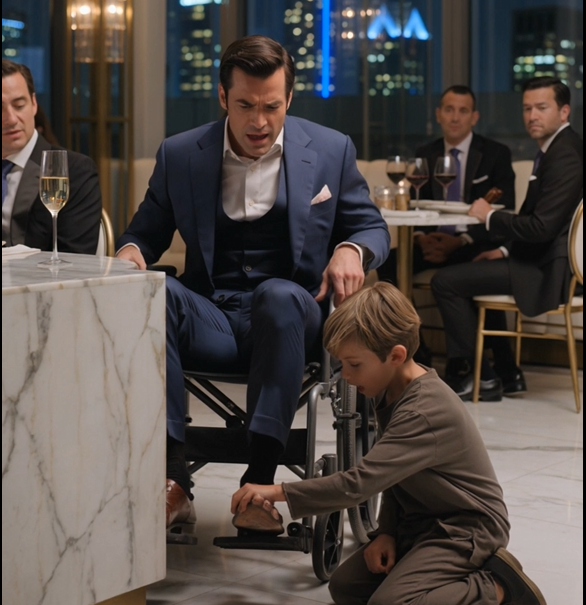
Fifty-four years old. Founder of three companies, two of which had sold for figures that made financial journalists reach for adjectives they kept in reserve. His suit was midnight blue, bespoke, the kind of fabric that didn’t wrinkle even when the man wearing it had been sitting in a wheelchair for eleven years.
The wheelchair was carbon fiber and titanium, worth more than a sports car, and Elliot Cross sat in it the way kings once sat on thrones: as if the chair existed to hold him up, not to hold him back.
In his right hand, a flute of 2008 Krug champagne. He was smiling at something his attorney had said — one of those smiles that never fully reached his eyes, the smile of a man who has learned that most things are amusing when you have enough distance from them.
Nobody at that table spoke about his legs. Nobody anywhere spoke about his legs, not anymore. Not since the accident. Not since the lawsuits. Not since the settlement that ended quietly and was buried under non-disclosures so thick they’d outlast the century.
Elliot Cross could not feel anything below his waist. He had not felt anything there in eleven years. The doctors had been kind about it, in the careful, bureaucratic way that doctors are kind about permanent things.
Irreversible damage to the thoracic spinal cord.
He had bought himself the finest wheelchair in the world and learned to call it freedom.
Part Two · The Interruption
Nobody could explain, afterward, how the boy got past the lobby.
The maître d’ had a theory involving the service elevator and the freight entrance on forty-nine. The head of security had a different theory, one he kept revising. A woman near the bar said she had seen a small shape moving through the coat room, quick and low, like something that had learned to make itself invisible through long practice.
What everyone agreed on was this: one moment the room was complete, sealed against the outside world by glass and money and altitude, and the next moment there was a child standing at the edge of it.
He was small. Perhaps seven years old, perhaps eight — hunger tends to subtract years from a child’s face while adding something else, something older and sadder, to their eyes. His clothes were wrong for every reason: a shirt that had once been white, jeans torn at both knees, sneakers held together at the toe by what appeared to be electrical tape. His hair was dirty blond and needed cutting and his face was — this was the thing that people would keep returning to in their memories of that night — his face was not frightened.
It was calm. Extraordinarily calm. The calm of a child who has already passed through fear and come out the other side into something that looked, from the outside, like courage, but was actually closer to resignation made noble by purpose.
He walked straight. Through the tables, between the startled glances of the beautiful people, toward the center of the room. Toward Elliot Cross.
The piano slowed. Or seemed to. Later, the pianist would say he hadn’t changed a thing — that the music had simply become audible as the room grew quietly attentive, the way a whisper becomes thunderous in a held-breath silence.
The boy stopped in front of the center table.
He looked at Elliot Cross the way very young children sometimes look at things they have decided about completely.
The Boy
“Sir… I can fix your leg.”
The table went still first. Then the adjacent tables. Then, in slow rippling rings outward like something dropped in still water, the rest of the room.
Elliot Cross lowered his champagne glass. Very slowly. The way a man lowers something when he is deciding whether to be amused or offended, and settles on amused because offense would require taking the thing seriously.
He looked at the boy — the dirty clothes, the tape-repaired shoes, the grave small face — and the corner of his mouth pulled upward.
Elliot Cross
“You?”
One word. It contained everything: the vast distance between them, the absurdity of the moment, the comfortable certainty of a man who had heard every pitch from every angle in every room and had never been moved by any of them.
The boy didn’t blink.
The Boy
“Just a few seconds.”
Elliot Cross set the champagne flute down on the marble with a small, deliberate click. He leaned forward slightly, elbows on the table, the way a man leans forward when he has decided to be entertained by something.
His attorney shifted in his chair. His dinner guest — a woman named Diana Holt, partner at a Midtown firm — had gone very still, the way intelligent people go still when they sense a story forming around them that they will want to remember correctly.
The other guests were watching now without pretending not to. Some had put down their forks.
Elliot Cross smiled his most expensive smile.
Elliot Cross
“All right. I’ll give you a million.”
Part Three · The Count
The boy dropped to his knees.
Instantly. Without hesitation. The way a person moves when they have already done a thing a thousand times in their mind and all that’s left is the body catching up.
The room inhaled.
Someone at a far table started to laugh — a reflexive, nervous sound — and then swallowed it, because there was something about the boy’s posture, kneeling beside the titanium wheelchair, that made laughter feel wrong. He was not begging. He was not performing. He was working.
His small hands — dirty, the nails bitten short, the knuckles cracked from cold and outdoor living — hovered over Elliot Cross’s right foot.
The music had stopped. The pianist’s hands rested on the keys but produced no sound. Nobody had told him to stop. He had simply stopped.
The Boy
“Count with me.”
Elliot Cross opened his mouth. Perhaps to say something clever. Perhaps to signal to someone that it was time to have the boy removed, gently, efficiently, in the discreet way that places like this handled the intrusion of the real world.
But the boy’s hand descended.
And Elliot Cross’s entire body seized.
It was not a gentle thing. It was not the polite flinch of a man startled by unexpected contact. His right hand slammed down on the edge of the marble table — a sound like a gunshot, clean and hard — and the champagne flute rocked on its stem and the silverware jumped and Diana Holt pressed back in her chair with her hand at her throat.
The tendons in his neck went rigid. His jaw clenched.
His eyes went wide.
Not with pain. The people near enough to see his face clearly would struggle, later, to describe what they saw in it. Not pain. Something more confusing than pain. Something that didn’t have a clean name for a man who had been told, by multiple neurologists over eleven years, that there was nothing left to feel.”One.”
The boy’s voice was quiet and focused and utterly without drama. He said it the way a child reads aloud in a classroom — clearly, carefully, aware of every syllable.
The amusement had left Elliot Cross’s face completely. It had been replaced by something raw and unguarded that the man hadn’t worn in public in a very long time, perhaps ever. His grip on the table edge tightened until his knuckles whitened. His breath was visible now — short, sharp, chest heaving slightly.
The boy’s other hand joined the first. Both hovering, both pressing, with a precision that suggested knowledge — specific knowledge, deliberate knowledge — of a pressure point that no child this age should possess.”Two.”
A twitch.
It was barely visible. A small, involuntary flex in Elliot Cross’s right foot — the foot inside the Italian leather shoe, the foot that had not received or sent a signal in eleven years. The foot that was, by every medical document in every doctor’s office on three continents, beyond reach.
His attorney saw it. Diana Holt saw it. The sommelier, paused in the middle of the room with a bottle of burgundy, saw it.
Elliot Cross’s body lurched forward — not a controlled movement, not a chosen one, but the kind of movement a body makes when something inside it that has been switched off suddenly, inexplicably, receives current. Both hands were on the armrests now, gripping, as if bracing against something that was coming up through him from below, something seismic and impossible.
His voice, when it came, was barely a sound.
Elliot Cross
“What…?”
The boy looked up.
And this — this was the moment that everyone in that room would carry with them for the rest of their lives, the image that would surface in the middle of ordinary days and refuse to be ordinary: the small dirty face tilted upward, the eyes dark and steady and holding something that was not magic, exactly, but was something adjacent to it — something older, something inherited.
He looked at Elliot Cross the way a person looks at someone they have come a very long way to find.
The Boy
“My mother said… you would move the moment I touched you.”
— Cut —
Epilogue · What the Room Held
Nobody moved for a long moment.
The city glowed blue and amber and white beyond the glass. Manhattan, indifferent to miracles, kept its lights on. Somewhere below, sixty-three floors down, a taxi horn sounded and was swallowed by the night.
Inside, in the room above the world, every beautiful and expensive person held completely still.
Elliot Cross was staring at the boy. His face had shed everything — the smirk, the ease, the practiced performance of a man who had made himself untouchable. What was left was something younger and rougher, the face beneath the face, a man standing at a window he had boarded shut eleven years ago and finding it suddenly, inexplicably, open.
His foot had moved.
He had felt it move.
Not pain. Not the phantom pressure that some spinal patients describe, those ghost-limb sensations that the brain invents in the absence of signal. This was real, tactile, grounded — the specific pressure of two small dirty hands, the carpet beneath the wheel, the distant cold of the glass and the city beyond it.
He opened his mouth. Closed it. He was a man who had built his fortune on words — on the exact right word deployed in the exact right moment — and he had none. Not one.
The boy stayed on his knees. Still kneeling. Still holding. His eyes had not left the man’s face.
The attorney finally moved. He stood, and his chair scraped back, and the sound broke the spell and the room began to breathe again in small, careful increments. Someone whispered to someone else. A glass was set down on a table. The sommelier backed one step toward the wall.
Diana Holt leaned forward.
“Elliot,” she said quietly. Just his name. Just that.
He didn’t look at her. He was still looking at the boy. The boy who had walked in from wherever boys like this come from — the night, the cold, the long unlit geography between the city’s glittering surfaces and its forgotten underside — and had knelt in front of him without fear.
The boy who knew his mother’s words by heart.
“What is your name?” Elliot Cross asked. His voice was very quiet. The voice of a man who has just been reminded that there are questions he has never thought to ask.
The boy looked at him. His expression did not change. That extraordinary calm. That gravity.
And then — slowly, carefully, as if each word had been saved for precisely this moment — he said the name.
And Elliot Cross went white.
The piano remained silent. The city burned on behind the glass. The room above the world held its breath for one more second, and then another, and then the music, as if remembering itself, began again — low and nocturnal and full of minor sevenths — and somewhere in it you could hear, if you were listening for it, the sound of a door opening that had been shut for eleven years.
Some rooms witness things they were not built to hold.
Some children carry messages that cost everything to deliver.
And some silences, once broken, change the shape of everything after them.
End
