he rain had been falling for three hours before it stopped being rain and became something else — a pressure, a weight, a living thing pressing down on the Oklahoma flatlands with the specific fury of a sky that has decided the earth beneath it needs to be reminded of something. The highway was a black mirror. The trucks that passed left wakes like boats. The neon sign above Lucky’s Diner — a red cursive script missing the L in Lucky so that it read ucky’s — flickered in the downpour and threw broken pink light across the flooded parking lot.
Inside, the diner smelled of burnt coffee and cigarettes and the particular human warmth that accumulates in places where people stop to get out of the dark. Black-and-white tile floors, chipped at the grout lines. A long Formica counter with round vinyl stools, most of them occupied. Booths along the window wall where the glass was fogged with condensation, the world outside visible only as smeared neon and the white sweep of passing headlights.
There were eleven people in the diner that night. The waitress — a woman named Darlene, fifty-three years old, twenty-one years at that counter, a woman who had seen every variety of human trouble walk through that door and had developed a professional calm about all of it — moved between tables with a coffee pot and the practiced efficiency of someone who does not waste motion.
And then there were the bikers.
Six of them. Four at the counter, two in the corner booth. They had come in together forty minutes earlier, shaking rain from their leathers, filling the diner with a low, contained energy that the other customers felt without looking up from their plates. They were not the kind of men you made direct eye contact with unless you were prepared for what came after.
The one at the end of the counter was the largest. His name, if anyone had thought to ask, was Grady Cole. Six-foot-three and built like something assembled for a specific purpose. He wore a black leather cut with no patches — which was itself a kind of statement, the way silence is a statement. His forearms on the counter were the size of most men’s thighs. And across the left side of his face, running from cheekbone to jaw in a pale, raised diagonal, was a scar that looked exactly like what it was: the record of a knife, and a decision made in a dark place a long time ago.
He was eating pie. Cherry, from the looks of it. He ate with the focused, unhurried attention of a man whose hunger has a history.
Nobody in that diner was watching him. Everyone in that diner was aware of him. Those are different things.
Darlene was mid-step between table three and table five, coffee pot extended, when she heard it.
Part Two · The Slam
The door did not open. It exploded.
The crash of it — aluminum frame against the doorstop, the bell above it screaming, the sudden cold black wall of rain-smell and October night that came through the gap — hit every person in the diner at exactly the same moment. Darlene’s arm locked. The coffee pot stopped mid-pour. At the counter, four heads turned simultaneously. In the corner booth, a man named Petey put down his phone.
The boy stood in the doorway.
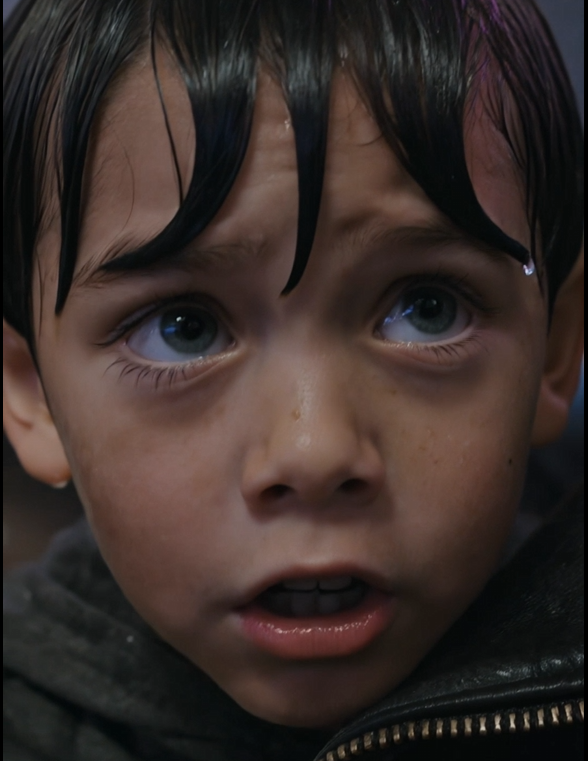
He was perhaps seven years old. Perhaps eight — fear and exhaustion subtract years from a child’s face the same way hunger does, and this child had all three working on him at once. He was soaking wet. His hoodie — grey, too large for him, the drawstring gone — was plastered flat against his chest. His jeans were dark with water from the knees down. His sneakers left smears on the black-and-white tile as he stepped inside.
His hair was light brown and rain-flat and his eyes were blue. Not the polite blue of a summer sky. A sharp, iced blue — the blue of a child who has been through something recent and terrible and is still moving through it on pure animal momentum, the body carrying the self forward because the self doesn’t know what else to do.
He did not look at anyone.
His gaze moved through the diner in one sweeping, rapid arc — the practiced scan of a child who has learned, through specific instruction or specific experience, to find one thing in a room. Not the exit. Not the warmth. Not the waitress with the coffee or the other customers or the safety of numbers and noise.
He was looking for the scar.
The room had gone the particular quiet that rooms go when something happens that nobody has a category for. The coffee pot was still in Darlene’s hand but she had forgotten it. At the counter, four bikers were watching the boy with the still, measuring attention of men who have learned to read situations quickly.
Grady Cole had not turned around yet.
He was the only person in the diner not watching the door. His fork rested against the rim of the pie plate. His eyes were on the counter in front of him, the way a man’s eyes go when he suddenly, without explanation, becomes very still.
The boy found him anyway. The way a compass finds north — not by searching, but by being the kind of instrument built to point at one thing.
He crossed the diner in nine steps. Nobody moved to stop him. Nobody spoke. The rain hammered the windows. Thunder rolled across the flat land outside, slow and enormous, and the neon sign flickered and threw its broken pink light across the tile and the wet sneaker prints the boy left in his wake.
He grabbed Grady Cole’s jacket.
Both hands. Small fists full of black leather. Gripping like something drowning grips the nearest solid thing — not gently, not politely, but with the force of a child who has used up everything else and has arrived at the last option.
Grady Cole turned.
The Boy
“Please… don’t let him take me.”
The words came out in pieces, broken by cold and breathing and the effort of holding himself together long enough to say them. His voice was the voice of a child at the exact edge of the thing that comes after crying — past tears, past sound, in the place where the body simply shakes.
Grady Cole looked at him.
The scar pulled slightly at the corner of his left eye as his expression moved through something — surprise, then assessment, then something harder and older settling in behind the eyes like a tide coming in. He was a man who had learned to read danger the way sailors read weather: fast, from specific signs, with the understanding that being wrong costs you everything.
What he saw was a child. Soaked. Shaking. Holding his jacket with both hands. Blue eyes that had not blinked since they found his face. And behind the terror — underneath it, underneath all of it — something else. Something that looked, in the harsh fluorescent light of ucky’s Diner on a rainy Tuesday in October, like purpose.
Like this child had been going somewhere specific. And had arrived.
Grady Cole set his fork down. Very carefully. The sound it made against the plate was the only sound in the diner for two full seconds.
Grady Cole
“Sit down. Tell me what happened.”
Low. Controlled. The voice of a man who has given orders in rooms much louder and more dangerous than this one, and has learned that volume is not what makes people listen. What makes people listen is certainty. He had it.
The boy shook his head.
His eyes moved to the door. One sharp, sideways look — the look of a rabbit checking the treeline — and then back to Grady’s face. His hands had not loosened on the jacket.
Down the counter, Petey had slid off his stool and moved to the window, slow and casual, the way men in his line of work moved when they were being anything but casual. He looked out into the rain and the pink neon and the parking lot and said nothing. But his posture said something. His posture said: something is out there.
The other bikers had redistributed themselves without apparent coordination — the way a hand closes around something, each finger moving independently but toward the same purpose. The corner booth was now empty. The two men who had been in it were not in it anymore. They were simply elsewhere, in the room, closer to the door than they had been before.
Darlene had put the coffee pot down on the nearest surface and was standing very still behind the counter with her hand near — but not on — the phone.
The boy looked at Grady Cole.
His lips were shaking. He pressed them together. He was trying to hold something in — not tears, not fear exactly, but something more specific, something he had been told to say in the right way to the right person and had been carrying the whole way here through the rain and the dark, and was now preparing to release.
Part Three · The Message
Outside, the rain changed pitch. Higher, faster — the leading edge of a new band moving through, the kind of rain that comes just before something gets worse. A truck passed on the highway, its lights sweeping through the fogged windows, and for one second the diner was full of moving shadows that went as fast as they came.
Petey, at the window, went still.
Not the stillness of a man waiting. The stillness of a man who has seen something.
Grady Cole did not look at him. He was watching the boy. He had been watching the boy since the boy grabbed his jacket, with the full, undivided attention that very few people ever received from him and that no one who had received it had described as comfortable.
“Say it,” he said. Quiet. Just to the boy. Just between them.
The boy’s chin trembled. He pulled in a breath. His blue eyes — steady now, finally, with the steadiness of a person who has rehearsed a thing so many times that the emotion has been worn smooth by repetition, leaving only the words beneath it — fixed on Grady Cole’s face.
On the scar.
The Boy
“He said… if I find the man with the scar… you’ll know what my father died for.”
The diner did not react. Diners cannot react. But the people in it did — in the way that people react when something lands in the air among them that changes the density of it, makes the room feel smaller and lower and more specific than it was a second ago.
Grady Cole stopped.
Not the polite pause of a man processing words. A full, complete, biological arrest — as if the message had hit something central in him, some load-bearing wall, and his entire system had paused to assess the structural damage before deciding whether to continue.
His hand, which had been moving toward the boy’s shoulder in the instinctive gesture of a large man trying to steady a small shaking thing, stopped mid-air. Hung there. Forgot where it was going.
His eyes dropped to the boy’s face with a new kind of attention. Not the assessment of before. Something rawer. Something that had not been on his face — that face with its old scar and its older eyes — in a long time. Something that looked, in the flicker of the neon and the rain and the bad fluorescent light of ucky’s Diner at eleven forty-seven on a Tuesday night, like the moment before a man’s face breaks.
He had known one man who called him that. The man with the scar. He had known exactly one man who used those words, in that order, as if it were a name. As if the scar were the truest thing about him — more true than whatever name his mother had given him, more permanent than any identity he had built or discarded since.
That man had been dead for eight months.
Grady Cole looked at the boy — at his rain-soaked hair, his blue eyes, the jaw that was already, in the soft unfinished way of a child’s face, forming the same line as —
He stopped that thought.
He looked at the boy’s hands, still gripping his jacket.
“What’s your name?” he said. His voice had changed. Still quiet, still controlled, but something in it was doing something that voices do when the person producing them is working very hard to keep them from doing something else entirely.
The boy opened his mouth to answer.
Part Four · The Handle
The sound came from outside. Footsteps — specific footsteps, the sound of a person who is not trying to walk quietly and is not trying to run, which is its own kind of sound, the sound of someone who believes they have already won whatever is about to happen.
Petey turned from the window. His expression was the flat, professional expression of a man delivering information stripped of opinion: “Two of them. Coming across the lot.”
Neither fast nor urgent. He could have been reporting the weather.
The boy’s hands tightened on the jacket. His body went rigid — the specific rigidity of a child who has heard a sound they recognize, a sound their nervous system has already catalogued under a very clear heading. He did not turn to look at the door. He looked at Grady Cole.
Blue eyes. Steady. Terrified in the way that is past terror, past the place where fear makes you run or freeze — in the place on the other side of both, where you have simply decided where to stand.
He had come through a storm and a night and whatever had happened before the storm to reach this specific man. He was not moving.
The bikers had completed their quiet redistribution. The diner had a shape now that it hadn’t had sixty seconds ago — a shape that had to do with exits and angles and the placement of large bodies between small ones and whatever was coming in from the rain.
Darlene, behind the counter, had her hand on the phone. She was a woman who had worked ucky’s Diner for twenty-one years and had never called the police once. She looked at the boy’s face and her thumb moved to the dial.
Grady Cole stood up from the stool.
All of him. The full six-foot-three. The leather cut. The arms. He put himself between the boy and the door with the unhurried deliberateness of a man stepping into a position he has occupied before, in other rooms, on other nights, and has never stepped out of wrong.
He reached back without looking and put one hand — huge, heavy, warm — on the boy’s shoulder. Felt the shaking in him. Felt, beneath the shaking, the stillness that the shaking was covering. The stillness of a child who has delivered what he was sent to deliver and is now, for the first time since it started, waiting to see what happens next.
“Stay behind me,” Grady Cole said.
Quiet. Just that. The whole of it in those three words.
The door handle moved.
… … … drip drip drip …
Slow. Deliberate. The handle turning with the particular confidence of a hand that is not in a hurry, because it has calculated the room on the other side of the door and found it manageable.
Water ran off the door frame and hit the black-and-white tile in a thin, steady stream. The neon outside — pink, broken, missing its first letter — threw light across the fogged glass and the wet parking lot and the two shapes that Petey had seen crossing it and had not looked away from since.
Grady Cole did not reach for anything. His hands were at his sides, open, which in certain circles means more than reaching ever does.
Behind him, the boy held a fistful of his jacket. Not the desperate grip of before. Something different now. Something that felt, to the man in front of him, less like drowning and more like anchoring.
Like the boy was not holding on to him for safety.
Like the boy was holding on to make sure he didn’t go anywhere.
The handle reached its full rotation.
The door began to open.
And Grady Cole stood in the neon-flickered dark of ucky’s Diner, rain against the windows, six brothers behind him, a dead man’s son at his back, and looked at whatever was coming through that door the way a man looks at something when he has already decided he is not moving.
— cut to black —
Some messages travel further than the men who send them.
Some children are born knowing exactly who to find.
And some doors open onto things that were always coming.
End
