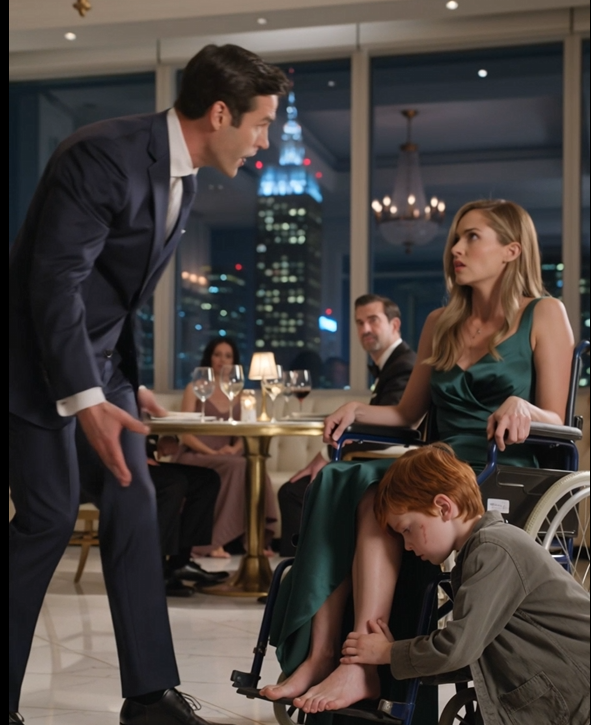
he first thing anyone noticed was the hands.
Not the boy’s face. Not his torn jacket or his matted red hair or the electrical tape wrapped around the toe of his left sneaker. Not the raw cold he carried in with him from the street — the October night of Manhattan that pressed itself against the floor-to-ceiling windows and fogged the glass at the edges where the warmth inside was losing the argument.
Just the hands. Small. Dirty. Already pressed against her ankle before anyone in the room understood what they were seeing.
Her name was Claire Ashworth, and she was twenty-nine years old and had not walked in fourteen months. She sat at table seven in a wheelchair that cost six thousand dollars, wearing an emerald dress that her sister had spent three weeks persuading her to buy, and she was looking down at the boy kneeling in front of her with an expression that could not decide between confusion and something older, something the body remembers before the mind gives it a name.
The chandelier above her threw warm gold light across the marble and the crystal and the white tablecloths. A string quartet played something European and melancholy in the corner. The room smelled of truffle oil and old money and a very good Burgundy that the sommelier had been about to recommend.
None of that mattered now.
The music had not stopped. But it had changed — or the room’s relationship to it had changed — because the sound was still coming from the same four instruments in the same corner and yet something in the air between the notes had thickened, the way air thickens before a storm when the pressure drops and every animal within twenty miles goes still.
Forty people at twelve tables. Not one of them moved.
Part Two · The Intrusion
Nobody could explain how he had gotten in.
Maison Bleue was not a restaurant you walked into off the street. There was a reservation list with a six-week minimum. There was a host stand staffed by a man named Gerald who had worked the door for nineteen years and had turned away a sitting senator on a Tuesday. There were two steps at the entrance — a design choice, the architect had called it — that the restaurant’s accessibility consultant had quietly flagged as a filtering mechanism.
And yet: the boy was here. Kneeling on the imported Italian marble in his torn jeans and his taped-together sneakers, his red hair unwashed and falling into his face, both hands pressed against Claire Ashworth’s ankle with the focused, precise energy of someone performing a task they have been thinking about for a very long time.
His face was perhaps nine years old. His eyes were much older.
The man who moved first was Daniel Ashworth — Claire’s older brother, her guardian by paperwork and by instinct, the one who had sat with her through the surgeries and the physical therapy and the three neurologists and the one alternative medicine practitioner they’d tried in a moment of desperation and never spoken of again. He was in a navy suit he’d had made in London, and he was already on his feet, and his voice when it came was the voice of a man whose fear expresses itself as fury.
Daniel
“What are you doing?! Get away from her — right now.”
He took two steps toward the boy. His hand was extended, reaching for the child’s collar.
The boy did not move. Did not flinch. Did not look up.
His hands remained exactly where they were, pressed against Claire’s ankle — one cupping the heel, one resting along the outer edge of her foot — with a steadiness that was not stubbornness but something beyond stubbornness. Something that didn’t have an ordinary name.
The Boy
“Just wait.”
Two words. Quiet. Completely certain.
Daniel stopped. Not because the words convinced him. Not because he chose to stop. He stopped because something in the boy’s voice bypassed the argument entirely — slipped past the rational and the protective and the furious and landed somewhere older, somewhere below thought, where the body makes its decisions before the mind can override them.
He stood there with his hand in the air, halfway between reaching and retracting, and looked at the boy, and the boy still did not look up.
At the adjacent table, a woman in a red dress put down her fork. At the bar, two men in conversation let their sentences unfinish and trail away. The sommelier stood with the Burgundy still extended and forgot to pour.
The string quartet reached the end of a phrase and, for the first time in the evening, did not begin another one.
The room was silent.
Claire looked down at the boy’s hands. Her expression had moved through confused and arrived somewhere she had no word for. She was gripping the armrests of the wheelchair — hard, the way a person grips something when they are trying to determine if what they are experiencing is real or the very convincing dream that her therapist had warned her not to place too much stock in.
Because something was happening.
Something very quiet and very specific was happening in the part of her body that fourteen months and four surgeries and every doctor she had ever trusted had told her was finished. Was concluded. Was a chapter with a last page and a closed cover.
She opened her mouth. No sound came out.
The boy’s fingers shifted. A slight repositioning. Deliberate. Like a musician finding the right chord.
Part Three · The Count
He pressed down slightly. Just slightly. The pressure of two small thumbs against a specific point above the ankle that no nine-year-old boy from the street should have known existed.
And then he spoke.”One.”
Soft. Focused. The way a child reads a number aloud when they are being very careful to get it right.
Claire’s fingers tightened on the armrests. Her breath came in short. The flicker in her expression deepened into something that wasn’t confusion anymore — it was the face a person makes when they receive news so unexpected that the emotional response hasn’t caught up yet, hasn’t matched itself to a feeling they know how to process.
It was the face of someone being surprised by their own body.
Daniel had not moved. He was watching with his hand still half-raised and his mouth slightly open. The anger had not gone — it was still in him, still pulling — but it was competing now with something he could not name and could not dismiss, because he had spent fourteen months in hospital waiting rooms becoming an expert on the particular stillness of a body that has stopped responding, and what he was watching was not that.
What he was watching was movement.
The boy’s second hand repositioned. One thumb pressed at the base of the ankle. The other hand moved up slightly — three inches, no more — to a point along the lower calf. The same precision. The same knowledge that shouldn’t be there.”Two.”
The tremor was visible.
Not large. Not dramatic. A small, involuntary shudder running through Claire’s right leg — the leg that had scored zero on every motor function test since the accident, the leg that the spinal surgeon had described, gently, carefully, in language designed to be humane, as having sustained damage that was not amenable to recovery.
Her foot moved.
One person at a nearby table made a sound — a sharp intake of breath quickly covered by a hand pressed to the mouth. Daniel took one step back. His face had gone pale in the way that faces go pale when the architecture of what a person believes to be true begins shifting beneath them.
Claire was shaking. Not fear — her face was beyond fear, was somewhere past the ordinary emotions into the country on the other side of them where things happen that language was not built to contain. Her whole body was trembling now, slightly, the way a tuning fork trembles when it finally finds its frequency.
She pressed her lips together. Breathed.
Claire
“…what is happening?”
A whisper. Barely sound. The words of a person who has asked the question not because they expect an answer but because the body needs the mouth to do something while it processes the impossible.
The boy looked up for the first time.
His eyes were green — a very deep, specific green, the color of old glass — and they were wet, and the expression in them was not the calm certainty he had carried through the room and past Daniel’s fury and through the silence of forty witnesses. It was something younger and more fragile. Something that had been waiting behind the certainty like a child waiting behind a door, listening for the right moment to come through.
He looked at her the way you look at someone you have missed for a very long time.
The Boy
“You remember… don’t you?”
Part Four · The Rise
She stared at him.
Something moved across her face — not an emotion she recognized but the shadow of one, the outline of a thing she had no name for. A memory that was not quite memory. An image that came the way images come in dreams: vivid, certain, sourceless. A pair of hands. A voice counting softly. A room — not this room, not any room she could place — where she had been told something she had carried in her body ever since without knowing she was carrying it.
Her breathing had changed. Deeper. Slower. The breathing of someone moving toward something rather than away from it.
Her grip on the armrests shifted. Not releasing. Pressing. The way you press when you are about to use your arms to do something they haven’t had to do in fourteen months because there was no point asking them.
Daniel said her name. Just her name. “Claire.” The voice of a brother who has been standing vigil for over a year and is watching something he was told was impossible and cannot make himself believe it and cannot make himself look away.
The boy remained on his knees. His hands still cupping her foot. His green eyes still on her face. Still wet. Still waiting.
Claire pressed down.
With her foot. Her right foot. The foot that had scored zero. The foot inside the low emerald heel that her sister had also spent three weeks persuading her to wear, because why not, because who says you can’t, because sometimes the argument for beauty is also the argument for hope and you do not know in advance which days are going to matter.
The wheelchair made a sound — a small, mechanical protest, the creak of a frame bearing the redistribution of weight it had never been asked to bear in this direction before.
Her body rose.
An inch. Two. The arms of the chair still in her grip, trembling. Her legs — both legs — finding something beneath her, some forgotten language of muscle and nerve and signal that the surgeons had redacted but not, apparently, erased.
The gasps moved through the room in a wave. The woman in the red dress had her hands over her mouth. Three people at the bar had turned completely. The sommelier had set the Burgundy down on the nearest surface — the wrong table, someone else’s — and was watching with his hands at his sides.
Daniel made a sound that was not a word. That was not quite anything. The sound a person makes when joy and terror arrive at exactly the same moment in exactly the same body and there is no room for both and they come anyway.
Slow motion: Claire rising. The chandelier light catching the emerald of her dress as it fell differently, caught gravity differently, because the body inside it was moving in a direction it had given up on. Her face — eyes wide, jaw set, something ferocious and terrified and luminous all at once crossing her features like weather.
The boy watched her. Tears moving freely down his dirty face now, unchecked, because there was no more certainty to hold them back behind. Just this. Just her. Just the thing he had come here to do, which he had perhaps been sent here to do, by someone or something that this room — with its marble and its chandeliers and its very good Burgundy — was not built to accommodate.
She was almost standing.
Almost.
— Cut to Black —
The music, which had stopped at some point that nobody could pinpoint exactly, came back.
Slowly. The way music comes back when the players have forgotten they stopped — when the hands find the instruments again not by decision but by instinct, because silence of a certain kind demands to be filled by something, and the something available was four strings and a bow and a phrase that had been waiting, unfinished, in the air.
Nobody in the room spoke.
Not for a long moment. Not while the music reassembled itself and the chandelier continued its indifferent gold and the Manhattan skyline pressed its face against the glass and went on being Manhattan — relentless, enormous, indifferent to miracles performed at table seven.
Daniel Ashworth stood where he had stopped with his hand in the air and his face rearranged into something that had no precedent in the forty-one years he had been alive. He was a man who prepared for things. Who researched and planned and kept binders. Who had prepared, fourteen months ago, for the worst, and had been right, and had made his peace with being right — or had told himself he had — and had built a life for his sister around the fixed and permanent truth of what the neurologists had said.
He looked at the boy.
The boy was still on his knees. His hands had lowered to his sides now. The fierce concentrated stillness had left his face and what was left was just a child — exhausted, cold, hungry in the specific way that shows in the bones — with green eyes that were still wet and a torn jacket that was not adequate for October.
Daniel crouched down so they were at eye level.
He was not a man who cried. He had not cried at the hospital. He had not cried during the verdict — no expectation of significant motor recovery — delivered by the third neurologist in the third consulting room with the same careful inhuman kindness. He had gone home and sat in his car in the parking structure for forty minutes and then he had driven to his sister’s apartment and rearranged it for a wheelchair and he had not cried.
He was crying now.
“Who are you?” he asked the boy. “How did you — who sent you here?”
The boy looked at him for a moment. Then he looked past him, at Claire. The way you look at the person you actually came for.
And then he said something. Three words — or four, the witnesses could not agree later, the acoustics of the room conspiring with the resumed music and the general chaos of the moment to make the exact words uncertain.
But Claire heard them.
And her face, which had been fierce and terrified and luminous, went through all of those things again in the space of a second and came out the other side into an expression that Daniel had never seen on her before. Had never seen on anyone before.
She looked at the boy the way you look at someone you lost, a long time ago, in a place you can no longer find your way back to.
As if she recognized him.
As if she had been waiting, without knowing she was waiting, for exactly this child, in exactly this restaurant, on exactly this October night — and the only thing left to understand was how.
Some doors close and stay closed.
And some children come back through them anyway.
End
