Ryan drove four hours to get there.
He hadn’t told anyone he was coming — not his mother, not his aunt Carol who managed these things now, not even his college roommate who would have asked too many questions Ryan didn’t have answers for. He had simply finished his Tuesday shift at the architecture firm in Columbus, changed out of his work clothes in the parking garage, stopped at a bakery on Route 40 that was still open at six-thirty, and driven west into the kind of November dark that makes America feel very large and very quiet.
The bakery woman had asked him what he wanted written on the cake.
He thought about it for a moment. “Nothing,” he said. “Just the strawberries. And seven candles.”
She had looked at him with the particular kindness of strangers who understand without being told.
His grandmother’s name was Eleanor. Everyone had called her Ellie for as long as anyone could remember, except her late husband Gerald, who had called her Ellie-girl until the day he died, which told you everything you needed to know about Gerald and everything you needed to know about what Ellie had lost when he went.
She was eighty-three today.
The memory care facility sat on a flat stretch of land outside of Dayton, a low brick building with carefully maintained flower beds that were brown and empty now in November, waiting for spring the way patience itself waits — without complaint, without certainty. Ryan had been here six times in the past year. Each time the walk from the parking lot to the front door was a little longer than the time before, not in distance but in what it cost him to cover it.
The night nurse, a broad-shouldered woman named Patricia, looked up when he pushed through the door with the cake box.
“She’s having a calm evening,” Patricia said, which was the facility’s careful way of saying she’s here tonight, at least partly. Some evenings Ellie was not calm. Some evenings she was somewhere else entirely, in a year Ryan hadn’t been born yet, speaking to people only she could see.
“Thank you,” Ryan said.
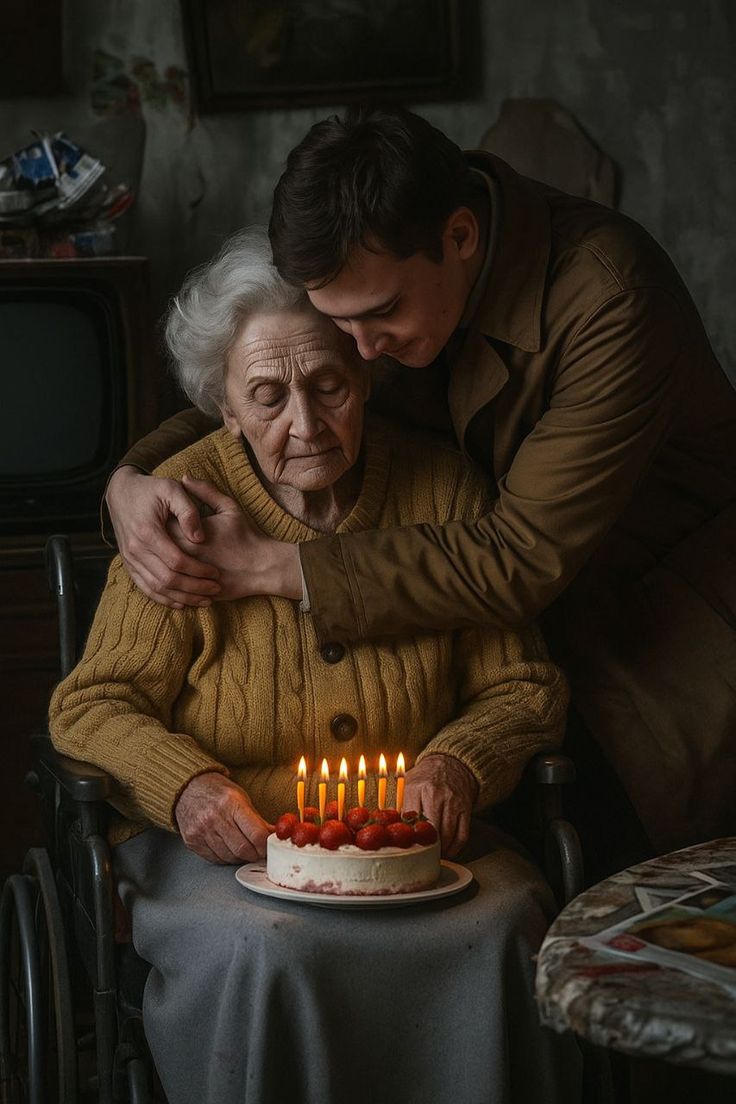
He found her in her room, sitting in the wheelchair by the window, looking out at the parking lot lights with an expression he had spent a year trying to decode. It wasn’t sadness exactly. It wasn’t confusion. It was something closer to the look of a person listening for a sound just below the range of hearing.
He set the cake on the small table beside her and pulled a chair close and sat down. She turned and looked at him. He watched her face — the particular journey of it, the way recognition in her now traveled a longer road than it used to.
Then something arrived in her eyes.
“Ryan,” she said. Quietly. Like a word she had been keeping safe.
“Hey, Grandma Ellie.”
She looked at the cake. At the seven candles, unlit. He had brought a lighter — a small yellow one from the gas station — and now he clicked it and touched the flame to each wick, one by one, until all seven were burning and the small room held more warmth than it had a minute ago.
She watched the candles the way you watch something you want to memorize.
“I don’t remember how old I am,” she said. It was a plain statement, without embarrassment. One of the things Ryan had learned this year was that Ellie, even on her harder days, had never lost her dignity. She reported the facts of her condition the way a good navigator reports weather — clearly, without drama, so that adjustments could be made.
“Eighty-three,” he said.
She considered this. “That’s a good number.”
“I think so too.”
They sat for a moment in the candlelight, and Ryan thought about the Ellie he had grown up with — the one who made biscuits from memory, who drove a Ford pickup until she was seventy-four, who once argued down a car salesman so thoroughly that he had actually applauded at the end. That Ellie was still in here somewhere. He believed that. He had to believe that.
“Gerald loved strawberries,” she said suddenly.
Ryan’s throat tightened. “I know. That’s why I got them.”
She looked at him then — really looked, the full focused look she could still produce sometimes, the one that meant she was entirely present and entirely herself — and she said, “You drove a long way.”
“Not that far.”
“You drove a long way,” she repeated, gently insisting on the truth of it.
“Yeah,” he admitted. “I did.”
She put her hand over his. Her hand was small and mapped with veins and still, somehow, the most familiar hand in the world — the hand that had smoothed his hair when he was sick, that had slipped him extra dollars when his parents weren’t watching, that had held his when Gerald’s casket was lowered into the January ground three years ago and Ryan had not known how to be a man about it and Ellie had held his hand and let him not know.
“Make a wish,” he said.
She looked at the candles for a long moment.
“I already have everything I wished for,” she said.
He didn’t ask her to explain. He just leaned down and pressed his cheek against the top of her silver hair and held on, the candles burning between them, the night outside the window doing what November nights do in Ohio — going very still, very dark, very honest.
After a while she took a small breath and blew.
Six candles went out.
One kept burning.
Ryan leaned over and blew it out himself, and the smoke rose in a single pale ribbon toward the ceiling, and neither of them said anything, because nothing needed to be said.
Outside, the stars were appearing one by one over Dayton.
Inside, the strawberry cake was sweet enough.
