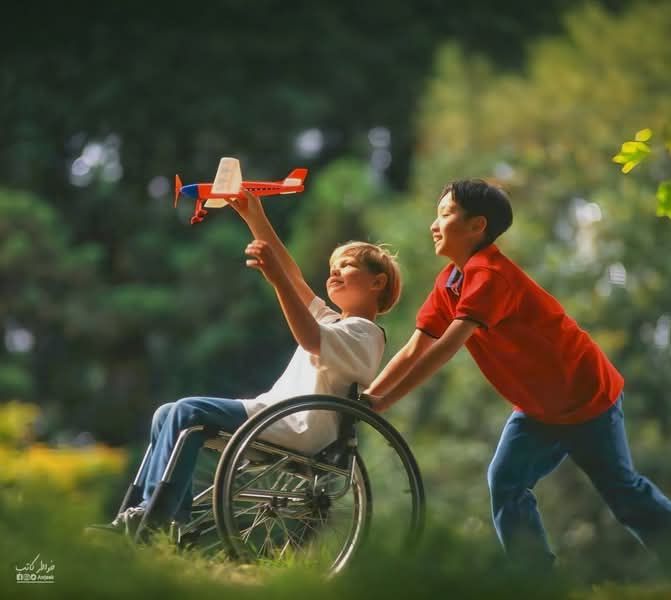
The morning Marcus pushed open the doors of Riverside Park, the air smelled like cut grass and possibility. He gripped the handles of Danny’s wheelchair with both hands, his red shirt already damp with the kind of sweat that comes not from heat but from pure, electric excitement.
“You ready?” Marcus called from behind, his voice cracking the way eleven-year-old voices do when they’re trying to sound braver than they feel.
Danny raised the toy airplane above his head — red body, blue wings, a white stripe running down its belly like a lightning bolt — and grinned so wide his cheeks nearly touched his ears.
“Born ready,” Danny said.
They had found the plane three weeks earlier at a garage sale on Elm Street, two dollars and fifty cents between them, Marcus counting out quarters while Danny negotiated the price down from three dollars by flashing a smile that nobody in the history of the world had ever said no to. They had named the plane Freedom because Danny said every good plane needed a name, and because it was the only word big enough to carry everything they meant.
It was a Saturday in late June, the kind that arrives in small American towns like a gift nobody ordered but everyone desperately needed. School was out. Responsibilities were someone else’s problem. The park stretched before them in every direction — oak trees throwing long shadows, yellow wildflowers pushing up through the grass, a creek somewhere beyond the tree line singing its quiet, endless song.
Marcus had been Danny’s best friend for four years, ever since the second grade when Danny rolled into Mrs. Patterson’s classroom and Marcus had slid a pack of strawberry fruit snacks across the desk without saying a word. Friendship, they both discovered, didn’t need an introduction. It only needed a gesture.
Danny had been in the wheelchair since he was five, the result of an accident that his mother described vaguely as “just one of those things life does.” Danny himself never described it at all. It wasn’t that he was hiding from it. It was that it simply wasn’t the most interesting thing about him. The most interesting thing about Danny was that he believed — without reservation, without doubt, the way children believe in things before the world teaches them not to — that he could fly.
Not literally. He wasn’t delusional. But there was something in him that refused to accept the ground as a permanent address.
“Push faster,” Danny commanded, and Marcus dug his sneakers into the soft grass and ran, the wheelchair wheels humming and spinning, Danny’s arm stretched toward the sky as Freedom caught the breeze. For a moment — maybe three seconds, maybe a whole lifetime compressed into three seconds — the plane seemed to pull ahead on its own, nose tilting upward, wings catching the golden afternoon light like it actually believed in itself.
Danny made engine sounds with his throat. Marcus laughed so hard he nearly tripped.
They crashed into the shade of a great oak tree in a controlled kind of chaos — wheelchair stopping abruptly, Marcus stumbling forward, Freedom tumbling safely into Danny’s lap. Both boys sat there breathing hard, grinning at the sky through the leaves.
“Did you see that?” Danny said.
“I saw it.”
“She almost went,” Danny whispered.
“She almost went,” Marcus agreed.
They stayed under that tree for a long time the way kids do in summer when no one is calling them home yet. They talked about airplanes — real ones, the kind Danny said he was going to pilot someday, the kind that crossed oceans while passengers slept. Marcus said he didn’t think wheelchair users could be pilots. Danny looked at him the way wise people look at small thinking.
“They’re changing the rules,” Danny said. “And if they don’t change fast enough, I’ll change them myself.”
Marcus had no answer for that. He just nodded, because some statements don’t need a response. They just need a witness.
On the walk home — Marcus pushing, Danny steering with occasional barked instructions that Marcus mostly ignored — they passed a little girl sitting on a porch step, maybe six years old, watching them with enormous eyes. She stared at the wheelchair. Children often did. Danny saw her staring.
“Wanna see something cool?” he called.
She nodded slowly.
Danny held Freedom up in the last red light of the setting sun, tipped her nose toward the sky.
“Someday,” he told the little girl, “I’m gonna fly one of these. A real one. Big as this whole street.”
The girl looked at him for a long moment.
“Okay,” she said, as if it were the most reasonable thing she’d ever heard. As if the world worked exactly the way Danny described it.
Marcus thought that might be the best thing anyone had ever said to either of them.
That night, Marcus lay in his bed and stared at the ceiling and thought about what it meant to push someone forward. Not just in a park on a Saturday. But in life. The way friendship worked at its best — not charity, not pity — but two people running together, one with his feet on the ground and one with his hand in the sky, both of them going somewhere neither could reach alone.
Outside his window, the first stars were appearing.
Somewhere across town, he was pretty sure, Danny was looking at the same sky.
Planning.
