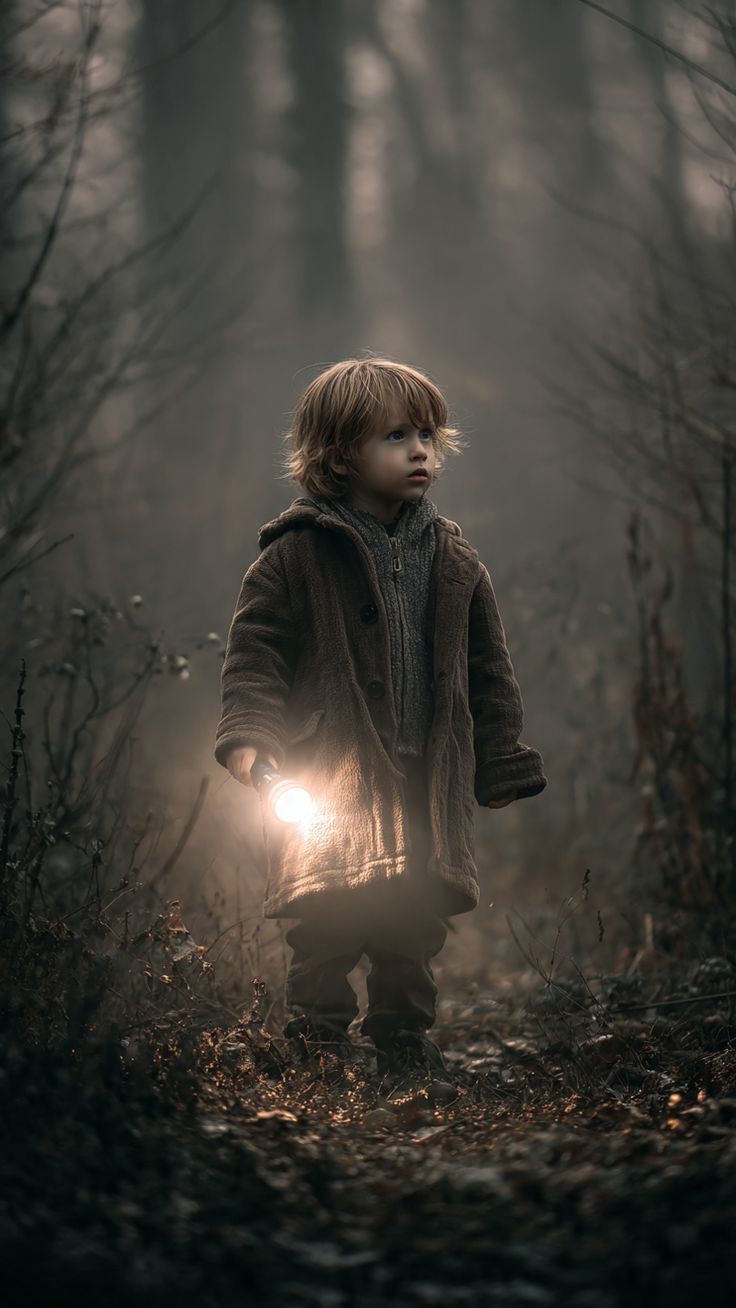
Nobody could explain how he got there.
That was the part that kept Sheriff Dana Collier awake for weeks afterward — not the finding of him, which was miracle enough, but the how of it. The woods behind Millhaven, West Virginia, were not woods a six-year-old wandered into by accident. They were eleven thousand acres of old-growth Appalachian forest, dark even at noon, the kind of place where experienced hunters lost their bearings and hikers with GPS units had to be airlifted out twice in the past decade. The trees grew so dense and so tall that the canopy closed overhead like a cathedral ceiling, and the ground beneath was a tangle of root and creek and decade-old deadfall that could swallow a grown man’s boot whole.
And yet.
There he was.
Standing in the middle of the old logging trail at the forest’s edge, alone, holding a flashlight that did not belong to him, wearing a coat two sizes too big, looking up at the bare November branches with the calm and focused expression of a child who had simply been somewhere and was now coming back.
Deputy Rell Torres found him at five-forty in the morning, sweeping the tree line with his cruiser’s spotlight during the second night of the search. The boy did not run. He did not cry. He turned toward the light with those serious blue eyes and waited, the way children wait when they trust that the person coming toward them means no harm.
His name was Oliver Marsh. Age six. He had been missing for fifty-one hours.
His parents — Tom and Kara Marsh, who ran a hardware store on Millhaven’s Main Street — had not slept. They had walked the search grid alongside volunteers until their feet bled, had answered the same questions from the same officials seventeen times, had held each other in the command tent in the particular way of people who are trying not to think the thought that is right there, right behind every other thought, waiting.
When Dana called Kara’s cell at five forty-seven, she picked up before the first ring finished.
“We have him,” Dana said. “He’s okay.”
The sound Kara made was not a word.
Oliver was examined at Millhaven Regional by Dr. Susan Park, who had been a pediatric ER physician for twenty-two years and had seen enough to be unsurpriseable. She was surprised. Oliver showed no signs of hypothermia, despite two nights in near-freezing temperatures. No cuts on his hands or face from brush. No mud on his boots beyond what you’d expect from a short walk. He was mildly dehydrated and hungry — he ate two packages of crackers and a cup of apple juice with the methodical focus of a small person managing a big appetite — but otherwise, by every medical measure, completely fine.
“Did you eat anything in the woods?” Dr. Park asked him.
“The lady gave me something,” Oliver said.
The room went still.
Dana leaned forward in her chair. “What lady, buddy?”
Oliver considered the question with the seriousness he seemed to bring to everything. “The old lady. She had a house.”
Tom and Kara exchanged a look over Oliver’s head — the wordless, electric look of parents recalibrating everything.
“There are no houses back there,” Tom said, carefully.
“She had one,” Oliver said simply, and reached for another cracker.
He described her without any of the uncertainty you’d expect from a frightened child recounting two nights in the dark. She was tall, he said, with white hair and hands that were rough like his grandpa’s workbench. She had a fire. She had given him something warm to drink that tasted like apples and something else he didn’t have a word for. She had told him stories — he couldn’t remember exactly what they were, only that they were good — and she had let him sleep on a cot near the fire, and in the morning she had walked him to the trail’s edge and pointed toward the lights.
“Did she tell you her name?” Dana asked.
Oliver nodded. “Mae.”
He said it the way you say the name of someone you already knew.
Dana spent the next three weeks doing what good sheriffs do — she pulled old land records, she walked the trail with two deputies and a forestry service map, she cross-referenced the property history of every acre of those eleven thousand going back to 1940. There was no structure. There had never been a permitted structure on that land in recorded history. She found no fire pit, no clearing, no evidence of habitation anywhere along the logging trail or within a mile of where Oliver had been found.
She found one thing.
At a bend in the trail, beneath a shelf of limestone that jutted out like a small roof, half-buried under decades of leaf litter and moss — an old tin cup. Blackened with age. The kind that hadn’t been manufactured since the 1950s.
She brought it to Tom and Kara. They had never seen it. Oliver, when shown a photograph, nodded once.
“That’s hers,” he said, and went back to his drawing.
The drawing was something he had been working on for two days — a careful, deliberate crayon rendering of a woman with white hair standing in front of a small house, smoke rising from the chimney, trees all around. He worked on it with the patience of a child reproducing something from memory, checking details against an image only he could see.
When he finished, he held it up and examined it the way artists do — at arm’s length, head tilted.
Then he handed it to his mother.
“So you can know what she looks like,” he said. “In case she comes back.”
Kara held the drawing for a long time.
Outside the window, the West Virginia hills were grey and still and keeping, as they always had, their own deep counsel.
