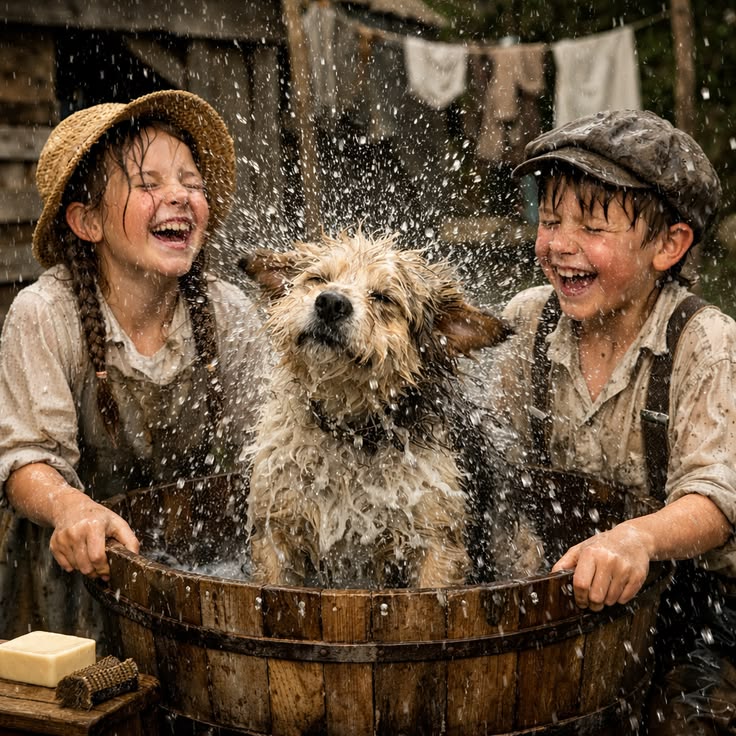
Nobody in Clover Creek, Kentucky, would ever agree on exactly whose fault it was.
Juniper Mae Aldridge, age ten, with her straw hat and her braids and her absolute iron certainty that she was right about nearly everything, would tell you — and did tell you, repeatedly, to anyone who would stand still long enough to listen — that the entire catastrophe began with her brother. Callum, age nine, who wore his newsboy cap tilted at the angle of a person who had already decided he wasn’t guilty of whatever he was about to be accused of, maintained with equal conviction that the fault lay entirely with the dog.
The dog, whose name was Biscuit, had no comment. Biscuit never had comments. Biscuit had actions, which were generally more consequential and considerably harder to clean up than anything either child could produce with words.
It was a Saturday in July, 1934, and the Aldridge farm sat under a sky so blue and so wide it looked like something a child had painted and not quite finished at the edges. The heat had been sitting on Clover Creek for two weeks — the kind of heat that makes chickens stand in the shade with their beaks open and makes grown men speak in shorter sentences than usual. Their mother, Clara, had been up since four-thirty canning tomatoes and was in no mood for anything she could describe as nonsense, a category that, by noon, had expanded to include most of what Juniper and Callum produced on any given day.
“That dog,” Clara said at breakfast, pointing with a wooden spoon at Biscuit, who was pretending to be asleep under the kitchen table, “smells like something died on him and then something else died on top of that. He gets a bath today or he sleeps in the barn.”
Biscuit cracked one eye open. He had an opinion about barns.
The wooden washtub lived beside the well, and it took Juniper and Callum three trips each with the bucket to fill it to a level they judged adequate for one medium-sized dog of considerable reluctance. The soap — a thick yellow bar of lye soap their mother made in the fall — sat on the tub’s rim alongside the scrub brush like tools laid out before a surgery.
The problem was getting Biscuit into the tub.
Biscuit was not a large dog, but he was a committed dog. He went boneless in the particular way of animals who have decided that physics itself is on their side. He sat when they pulled. He lay flat when they lifted. At one point he appeared to actually get heavier, which Callum insisted was impossible and Juniper said was simply a fact she had observed with her own eyes.
“You go around the back,” Juniper said, with the tactical confidence of someone who had never once successfully bathed this dog. “I’ll grab his front.”
“Last time you said that I got bit,” Callum said.
“He didn’t bite you. He tasted you.”
“There’s not much difference from where I was standing.”
What followed was eleven minutes of pure American chaos. Biscuit was briefly in the tub — for perhaps four seconds — during which he produced a full-body shake of such violence and such precision that both children were soaked from hat to boot before he vaulted back over the side and hit the ground running. He ran the full perimeter of the yard. He ran through Clara’s herb garden. He ran under the fence, through the mud puddle that had been sitting beside the pump since Thursday, and then — with what Juniper would later describe as deliberate malice and Callum would describe as pure coincidence — directly through the freshly laundered sheets their mother had hung on the line that morning.
The sheets had been white.
They were not white anymore.
Clara appeared on the back porch. She had the wooden spoon. She did not say anything, which was worse than if she had.
Biscuit sat down in the middle of the yard and looked at everyone.
Juniper and Callum looked at each other. There was a long moment of the kind of childhood silence that happens when two people are calculating identical things simultaneously.
Then Juniper started laughing.
It was not a polite laugh or a careful laugh. It was the full, unguarded laugh of a ten-year-old girl on a hot Kentucky Saturday, the kind that takes over your whole body and makes your hat fall sideways and your braids shake and your eyes water. Callum lasted approximately one and a half more seconds before he broke too — his laugh higher and faster than hers, the laugh of someone who knows they’re in trouble and has decided the trouble is worth it.
Even Biscuit seemed to loosen something. He stood up, trotted back to the tub, and put his front paws on the rim, looking in at the water with the expression of an animal reconsidering his position.
Clara watched all of this from the porch.
The spoon lowered slightly.
The corner of her mouth did something that was not quite a smile but was in the same neighborhood.
“Get him in the tub,” she said. “Then hang new sheets. Then come inside and I will pretend this morning was a dream.”
It took all three of them — Clara included, still holding the spoon, her apron soaked within thirty seconds — to get Biscuit properly bathed. He shook three more times. Juniper’s hat ended up in the yard. Callum’s cap ended up somehow on the dog.
But at the end of it, Biscuit smelled like lye soap and summer, and he stood in the tub with his eyes closed and his ears flattened and a dignity he absolutely had not earned, and the two children on either side of him were laughing so hard the sound of it carried all the way to the Miller farm next door, where old Harold Miller heard it and said to his wife, without looking up from his paper, “Aldridge kids are alive, then.”
His wife said, “Were you worried?”
He said, “A little.”
She said, “Me too.”
And they both went back to what they were doing, satisfied.
