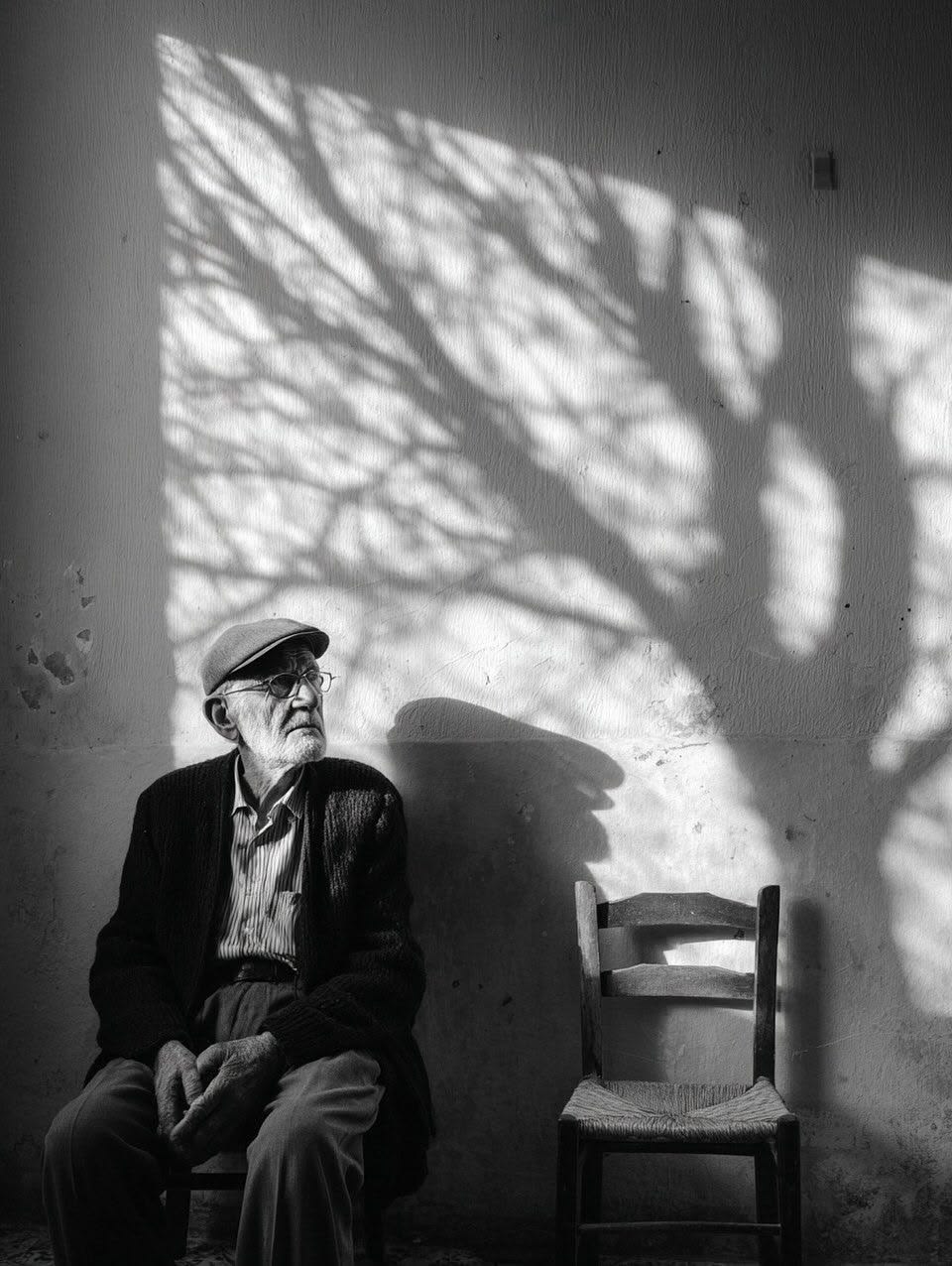
The town of Millhaven, Kentucky had a way of keeping its secrets tucked beneath the surface, like roots beneath frozen ground. Nobody asked too many questions there. Nobody had to. The answers had a way of showing up eventually — in the way a man held his coffee cup at the diner, in the way a woman’s eyes moved toward the church door on Sunday mornings, in the way old Earl Whitmore sat every single afternoon in the same chair, on the same strip of sidewalk outside the hardware store, staring at nothing that anyone else could see.
Earl was eighty-three years old. He wore the same flat cap every day, the gray wool one his late wife Margaret had bought him at the county fair in 1987. He wore his glasses low on his nose, which made him look perpetually skeptical of the world, though the truth was closer to the opposite. Earl believed in things. He believed in the loyalty of dogs, the reliability of rain before a harvest, and the absolute certainty that the people you love never truly leave you — not completely.
The empty chair beside him was not a symbol. It was not metaphor. At least, that was what Earl told Pastor Jim when the younger man once made the mistake of saying something poetic about it.
“It’s just a chair, Jim,” Earl had said flatly. “She liked to sit.”
Margaret had died eleven years ago on a Tuesday in March, when the trees outside their bedroom window were still bare, their branches reaching like dark veins against a pale sky. She had gone quietly, the way she had lived — without drama, without unnecessary noise. She had simply closed her eyes during the late news and did not open them again. Earl had held her hand for six hours before he called anyone. He told the paramedics he hadn’t wanted to disturb her.
After the funeral, after the casseroles stopped coming and the sympathy cards stopped arriving and the well-meaning neighbors stopped dropping by, Earl had carried the spare kitchen chair out to the sidewalk. He set it beside his own and sat down. He had done the same thing every afternoon since, weather permitting.
People in Millhaven had long stopped wondering about it. The tourists sometimes took photographs. A college girl from Louisville had once asked if she could interview him for a podcast about grief. He had told her he wasn’t grieving. She hadn’t known what to do with that.
His grandson Tyler came to visit on the third Saturday of every month. Tyler was twenty-seven now, worked in data analytics in Nashville, wore shoes that Earl privately considered absurd. But he was a good boy. He always brought coffee from the good place two towns over, not the gas station stuff, and he always sat in Margaret’s chair without being asked and without making a fuss about it.
On this particular Saturday in October, Tyler arrived later than usual. The light was already doing what October light does in the late afternoon — turning golden and long, throwing shadows that stretched across the sidewalk like reaching arms. The bare oak tree across the street cast its shadow against the hardware store wall behind Earl, and the shape of it spread wide and branching, like a map of something vast.
Tyler sat down. He handed Earl his coffee. They were quiet for a while, which was their custom.
“You doing okay, Grandpa?”
“Doing fine.”
“You eat today?”
“I had eggs.”
“That’s not what I asked.”
Earl smiled at that. The boy was sharper than people gave him credit for. “I had eggs and toast and half a grapefruit. Your grandmother used to say half a grapefruit was the difference between a man and a civilized man.”
Tyler laughed. It was the right laugh — short, warm, not overdone.
“I’ve been thinking,” Tyler said after a while.
“Dangerous habit.”
“About moving back. Not here, maybe. But closer. Lexington, maybe.”
Earl turned to look at his grandson. It was one of the few times in recent memory that something had genuinely surprised him. He studied the young man’s face — the familiar slope of his nose, which was Margaret’s nose, the way his jaw set when he was being serious.
“What brought this on?”
Tyler shrugged, but it was not a careless shrug. It was the kind of shrug that contains a whole paragraph. “I don’t know. I’ve been sitting in my apartment looking at spreadsheets, and I keep thinking — what is this for? Like, who am I doing this for?”
Earl was quiet for a long time. The shadow of the tree had shifted, moving slightly with the late breeze, the branches ghosting across the wall in slow, silent motion.
“Your grandmother used to say that question is the most important one a person can ask,” Earl said finally. “She also said most people ask it too late.”
“Did you ever ask it?”
“Once. About your age, actually.” He took a sip of his coffee. “I was going to go to Cincinnati. Had a job offer. Good money. I came home to tell her, and she was sitting at the kitchen table cutting coupons, and she looked up at me, and I thought — this. This is what it’s for.”
Tyler was quiet.
“She wasn’t even doing anything special,” Earl said. “Just sitting there with her scissors and her newspaper. But I knew.”
The sun had nearly finished its work on the afternoon. The shadows were long and soft, the tree’s silhouette now covering both chairs, both men, like something sheltering them from above.
“So what do I do?” Tyler asked.
Earl shrugged — his own version, equally full. “Go find the thing that answers the question.”
They sat together as the light faded, two men in two chairs, the ghost of a third presence warm between them, the bare tree on the wall holding its ancient, branching shape against the fading white.
