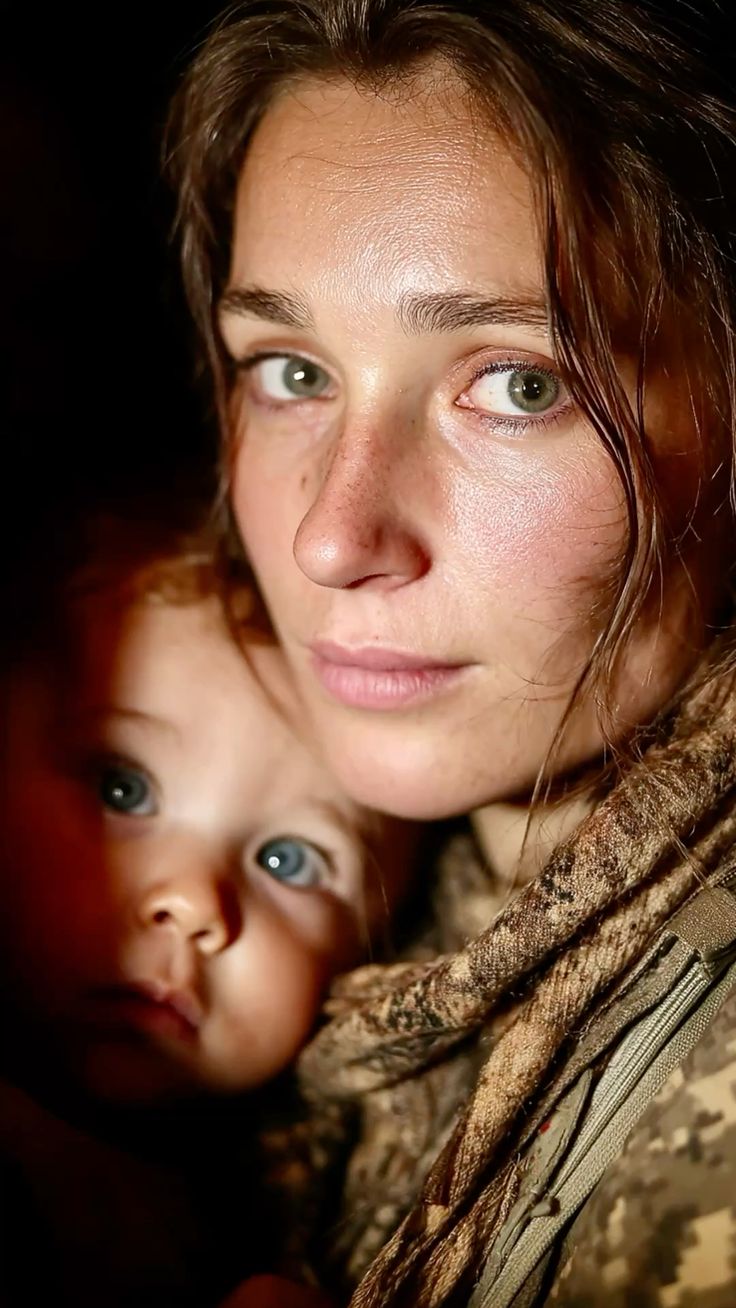
The baby had not cried in four hours, and Sergeant Nora Calloway was beginning to understand that silence in an infant was not always a good sign.
She pressed the child closer against her chest, beneath the open flap of her jacket, sharing body heat the way she had been trained to share resources in the field — with calculation, without sentiment, giving only what was necessary and no more. But the truth was she had stopped being calculated about this particular situation approximately six minutes after she had found the baby, which was roughly the moment the infant had opened its blue eyes and looked directly at her with an expression of complete and devastating trust.
That had been fourteen hours ago.
Nora had been a soldier for eight years. She had done two tours in Afghanistan, one in Iraq, and had spent the last eighteen months attached to a humanitarian liaison unit operating near the eastern corridor, in a region whose name most Americans could not find on a map and whose suffering had not made the evening news in over a year. She was thirty-one years old. She had a mother in Asheville, North Carolina who still set a place for her at Thanksgiving even when she couldn’t come. She had a dog named Patterson who lived with her ex-boyfriend because the deployment had made keeping a dog impossible and the breakup had made everything else impossible for a while after that.
She was not supposed to be here. Not in this building, not in this particular ruined neighborhood on the edge of a city that had been contested and abandoned and contested again so many times that the walls themselves seemed exhausted. She had been separated from her unit during the evacuation of a medical compound two nights ago — a story that involved a vehicle, a bridge, a decision made in four seconds that she was still not certain had been the right one.
She had found shelter in what had once been a pharmacy. Most of the roof was intact. She had water, three protein bars, a first aid kit, her radio — which had stopped transmitting but was still receiving, which meant she could hear but not be heard, which she had decided to treat as useful rather than terrifying — and now she had a baby.
The baby had been in a room at the back of the pharmacy, wrapped in a wool blanket inside a cardboard box, the way someone had placed it there deliberately, carefully, with the specific intention that it be found. There was no note. There was nothing else in the room. Whoever had left the child had made a calculation of their own — that a box in an abandoned building offered better odds than whatever they were walking into.
Nora had stood in that doorway for a long moment. She had thought about protocol. She had thought about her orders, which no longer applied to her current situation. She had thought about the eight years she had spent learning to make clean decisions in dirty circumstances.
Then she had picked up the baby.
The child was a girl — she was fairly certain of this, though the wool blanket made it hard to know for sure. She appeared to be somewhere between four and eight months old, which was as specific as Nora could get without a pediatrician present. She had dark red hair, just a suggestion of it, and those blue eyes that had done the damage on first contact. She was thin. Not dangerously so, not yet, but thin in the way that suggested the person who had been feeding her had been sacrificing to do it.
Nora named her Sparrow. Not permanently — she was clear about that with herself. She just needed something to call her, because calling her “the baby” or “the infant” or “the child” felt like a way of keeping a distance that Nora was no longer capable of maintaining.
Through the day she had kept them both still, conserving warmth, listening to the radio for patterns in the movement outside. Her training was good. Her instincts were better. She had learned long ago that fear is useful if you let it sharpen you rather than freeze you, and she had become very good at that particular trick. But she had never tried to perform it while holding a child against her chest.
Sparrow changed the calculation of everything. Every decision Nora had made alone in the field had been made with one variable: herself. Her survival, her exposure level, her acceptable margin of risk. You could be reckless with yourself if you were willing to own the consequences. You could not be reckless with a four-month-old girl with red hair and blue eyes who had been left in a cardboard box by someone who had loved her enough to let her go.
When the radio crackled at dusk and she heard a frequency she recognized — Sergeant Diaz’s voice, clipped and professional, running a search pattern — Nora felt something loosen in her chest that she hadn’t realized she’d been holding tight since the bridge.
She couldn’t transmit. But she could move.
She looked down at Sparrow, who was awake now, watching her with that expression that Nora had already come to recognize as the child’s default state: alert, serious, present in a way that seemed almost too old for her small face.
“Okay,” Nora said quietly. “Here’s what we’re going to do.”
She had said those words a hundred times in her career, to soldiers, to scared civilians, to herself in the dark. She had always said them with a plan fully formed behind them. This time she said them with half a plan, a lot of hope, and a baby tucked against her collarbone like the most important piece of equipment she had ever carried.
She moved toward the door. Outside, the night was cold and deep and full of sound that required interpretation. She interpreted it. She made her decision.
She stepped out into the dark, and she did not look back.
