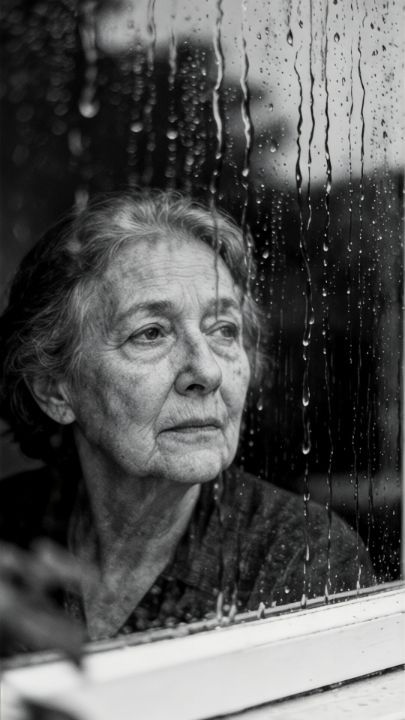
Dorothy Callahan had watched rain fall against that window for sixty-one years, and in all that time, she had never once found it depressing. Rain, she believed, was simply the sky’s way of remembering something. And Dorothy, at seventy-nine years old, understood that need better than most.
The farmhouse outside of Beaumont, Texas had belonged to her husband’s family since 1923. Three generations of Callahans had been born within its walls, had tracked mud across its pine floors, had argued and laughed and wept in its kitchen. Now it was just Dorothy and the rain and the particular silence that settles into a house when everyone who once filled it has moved on — either to other cities or to other places entirely, the kind you don’t come back from.
Her daughter Renee called every Sunday at noon. The calls lasted exactly as long as Renee’s guilt required, which was usually about fourteen minutes. Dorothy never mentioned this. She had raised three children and understood that guilt is a language people speak when love feels too complicated. She accepted the fourteen minutes with grace and asked about the grandchildren by name and laughed at the right moments, and when she hung up, she returned to her window.
It was on a Wednesday in November that the letter arrived.
Dorothy almost never received real mail anymore. Bills came by email now, apparently, though she still paid them by check because she was seventy-nine and had earned the right to do things the way that made sense to her. Catalogs came occasionally. Christmas cards from people who hadn’t yet realized she’d stopped sending her own three years ago when her hands had made the act of writing too painful to justify.
But this letter was different. It had a postmark from Portland, Oregon, and the handwriting on the envelope was so familiar that Dorothy had to sit down on the hallway bench before she could open it.
The handwriting belonged to a woman named Clara Hutchins. Or it had, once. Clara had been Dorothy’s closest friend for thirty-four years — through Dorothy’s miscarriage in 1974, through Clara’s divorce in 1981, through the years when their children grew up alongside each other like the twin oaks in Dorothy’s backyard, their roots tangled together underground. And then, eleven years ago, something had happened. Something that neither woman had managed to climb over, or around, or through.
Dorothy had not heard from Clara since.
She opened the envelope with careful fingers. Inside was a single sheet of cream paper, the kind Clara had always favored. The handwriting was shakier than Dorothy remembered, the letters slightly larger, the way handwriting gets when hands are older or when the writer is working to be legible rather than fast. It was three paragraphs long.
She read it twice. Then she folded it and held it in her lap and looked out at the rain for a long time.
Clara was sick. That was the plain fact beneath the careful language. Not the kind of sick you recover from. The kind of sick that makes a person sort through eleven years of silence and decide that the weight of it is no longer worth carrying.
She had written: I don’t want to go without telling you that I have thought about you nearly every day. I don’t expect anything. I just needed you to know.
Dorothy had not cried in a long time. Not since her husband Robert had passed four years ago, and even then she had cried only at night, privately, the way she had always done everything that mattered most. She was not a woman who performed her emotions for an audience. But sitting there in the hallway with the rain streaking down the window glass and Clara’s letter in her arthritic hands, she allowed herself a few minutes of something she couldn’t quite name — too large for sadness, too quiet for grief, too old for anger.
What had happened between them eleven years ago was not a single event. That was the thing people never understood about the endings of long friendships — they were never really about one thing. They were about accumulation. A hundred small moments of feeling unseen, unheard, set aside. And then one afternoon in Clara’s kitchen, Dorothy had said something honest, and Clara had said something sharp, and both of them had said things they could not take back, and they had each driven home and waited for the other to call.
Neither of them had called.
Eleven years was a long time to wait.
Dorothy stood slowly, using the wall for support — her knees had their own opinions these days — and carried the letter to the kitchen table. She made herself a cup of tea. She watched the rain. She thought about the summer of 1979 when she and Clara had driven to New Orleans together without their husbands, two young women in a brown station wagon with a cooler of bad wine and a road atlas that was already out of date, laughing at everything and nothing for five straight days.
She thought about Clara’s laugh. How it was the kind of laugh that made strangers turn and smile without knowing why.
She set down her tea. She went to the drawer where she kept the stationery she also never used anymore. She found a pen that still worked on the third try.
She wrote: Clara. I’m so glad you wrote. I have something to tell you too.
She paused. The rain shifted against the glass, heavier now, the drops racing each other toward the sill. She thought about all the things she had never said. Eleven years worth of things. A whole second life lived in the silence between two women who had once known each other better than they knew themselves.
She pressed the pen back to the paper and began again.
