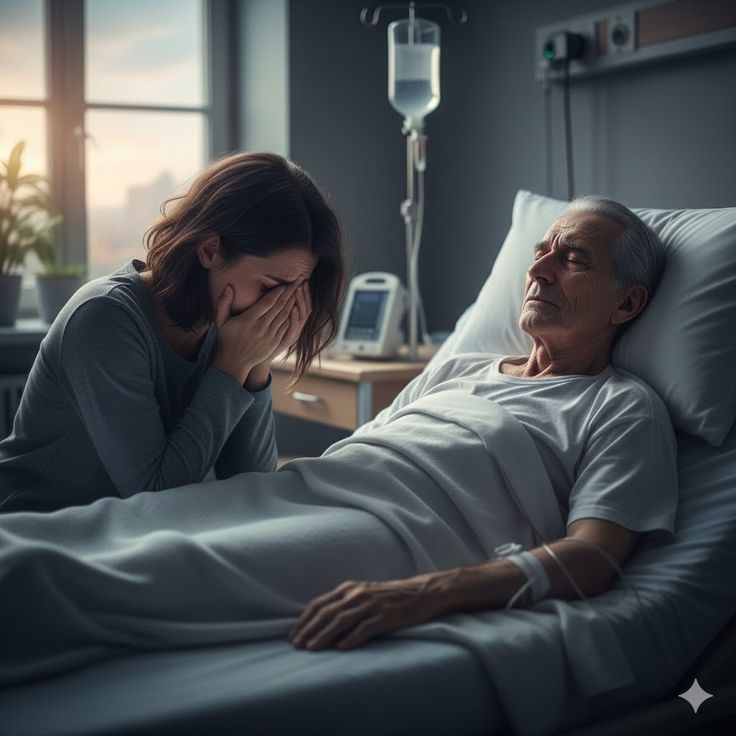
She had promised herself she wouldn’t cry in front of him.
She had made this promise in the elevator on the way up — third floor, oncology, the elevator that smelled like antiseptic and the particular floral artificiality of air freshener applied to a space where air freshener cannot do what it is being asked to do. She had looked at her reflection in the elevator’s steel door, blurred and approximate the way reflections in steel always are, and she had said to that blurred version of herself: not in front of him. You can do the rest of it anywhere. Not in front of him.
She had lasted four minutes.
Not even four. She had come through the door and seen him in the bed — smaller, somehow, though she knew this was the bed doing it, the white sheets and the clinical surroundings making everyone look reduced, making vigorous people look diminished and diminished people look — she had seen him and the promise had simply dissolved, the way promises made in elevators sometimes do when they encounter the actual room, the actual person, the actual undeniable fact of the thing you had been preparing yourself for and discover you were not prepared for at all.
She had put her face in her hands.
She was sitting that way now, bent at the bedside, her shoulders doing the work of crying that was trying to be quiet and not quite managing. Her name was Lauren. She was forty-three years old. She had driven four hours from Columbus without stopping, through Ohio farmland going gray in the November afternoon, with the call still fresh in her ear — not the worst call, not the call she had been dreading for eighteen months, but the one just before it, the one from the night nurse that said he’s asking for you, you should come in the specific tone of night nurses who have learned to say the most important things between the words they are actually saying.
The man in the bed was her father.
His name was Richard Oakes. Sixty-seven years old, which was young and not young, depending on which way you were calculating. He had been a high school history teacher for thirty-four years in Dayton, Ohio — had taught eleven hundred students by his own estimate, had kept a running list, had attended more graduation parties than any teacher in the school’s memory and been fed more graduation cake and had genuinely, specifically, individually loved more teenagers than most people thought possible to love, given the general reputation of teenagers. He had the kind of face that had been handsome in an unremarkable way and had become interesting as it aged — the lines of it mapping the expressions he had made most often, which in his case were attentiveness and amusement and the particular look he wore when a student said something that surprised him, which was the look of a man receiving a gift.
He was not asleep. He had his eyes closed but he was not asleep.
Lauren knew the difference. She had always known the difference with him — could read the quality of his stillness, the subtle tells of a face she had been reading since before she had language for reading. When he was asleep he went fully somewhere else. Right now he was here, behind closed eyes, listening to her cry with his hands folded over the blanket and the monitor beside him keeping its patient, metronomic account of his heart.
After a while he said, without opening his eyes: “You said you weren’t going to do that.”
She made a sound that was partly a laugh. “I said I wouldn’t do it in front of you.”
“I can hear you.”
“You have your eyes closed.”
“Hearing doesn’t require eyes, Lauren. I taught biology for two years before they let me do history.”
She laughed again — more fully this time, the kind that comes out surprised, that arrives before the grief can intercept it. She sat up and wiped her face with the back of her hand and looked at him. He opened his eyes. They were the same eyes — the same dark brown that she had inherited and that she saw in the mirror every morning, the eyes she had always thought of as the family eyes, the Oakes eyes, the thing that ran through them.
“Hi, Dad,” she said.
“Hi, kiddo,” he said.
They sat together in the way of people who have been sitting together their whole lives and have developed, without designing it, a grammar of shared silence — the comfortable kind, the kind that doesn’t require filling. The monitor kept its count. The light through the window was the low, golden, sideways light of late afternoon that came through hospital windows and managed to be beautiful regardless of what was happening beneath it, which Lauren found both consoling and slightly inappropriate.
He was the one who spoke first.
“I’ve been thinking,” he said, “about all the things I meant to tell you.”
She looked at him. “You’ve told me everything, Dad.”
“Nobody tells their children everything.” He said it without self-recrimination, as a fact. The tone of a man who has been doing the honest accounting and arrived at an honest result. “You’re going to find that out eventually. When she gets older.”
She. Her daughter. Twelve-year-old Abby, who had her grandfather’s eyes and her grandfather’s habit of laughing at things that surprised her, who was right now at home in Columbus being looked after by her aunt and who had asked Lauren that morning, with the directness of a twelve-year-old who has not yet learned to go around difficult things: Is Grandpa going to die?
Lauren had said what you say. He’s very sick. The doctors are doing everything. She had not been able to say the true word.
“She asked me this morning,” Lauren said. “She asked me directly.”
He was quiet for a moment. “What did you tell her?”
“I didn’t know how to say it.”
He nodded slowly. Not judging. Just receiving. “There’s no good way,” he said. “There’s only true. True is the best you can do with hard things.”
She looked at her hands.
“I want to tell you some things,” he said. “Will you let me?”
She looked up.
He was watching her with that expression — the one she had seen across the dinner table and in the front row of her school plays and in the doorway of her hospital room when Abby was born, the one that she associated with him more than anything else, more than his voice or his laugh or his Oakes eyes. The attentiveness. The complete and full-on attention of a man who had spent his life deciding that the person in front of him was the most important thing in the room.
“Okay,” she said.
“Don’t write it down,” he said. “Just listen. It goes in better when you just listen.”
This was such a profoundly teacher thing to say that she almost cried again and managed not to.
“I’m listening,” she said.
He took a breath. The monitor kept its count. The afternoon light held steady in the window.
And he began.
