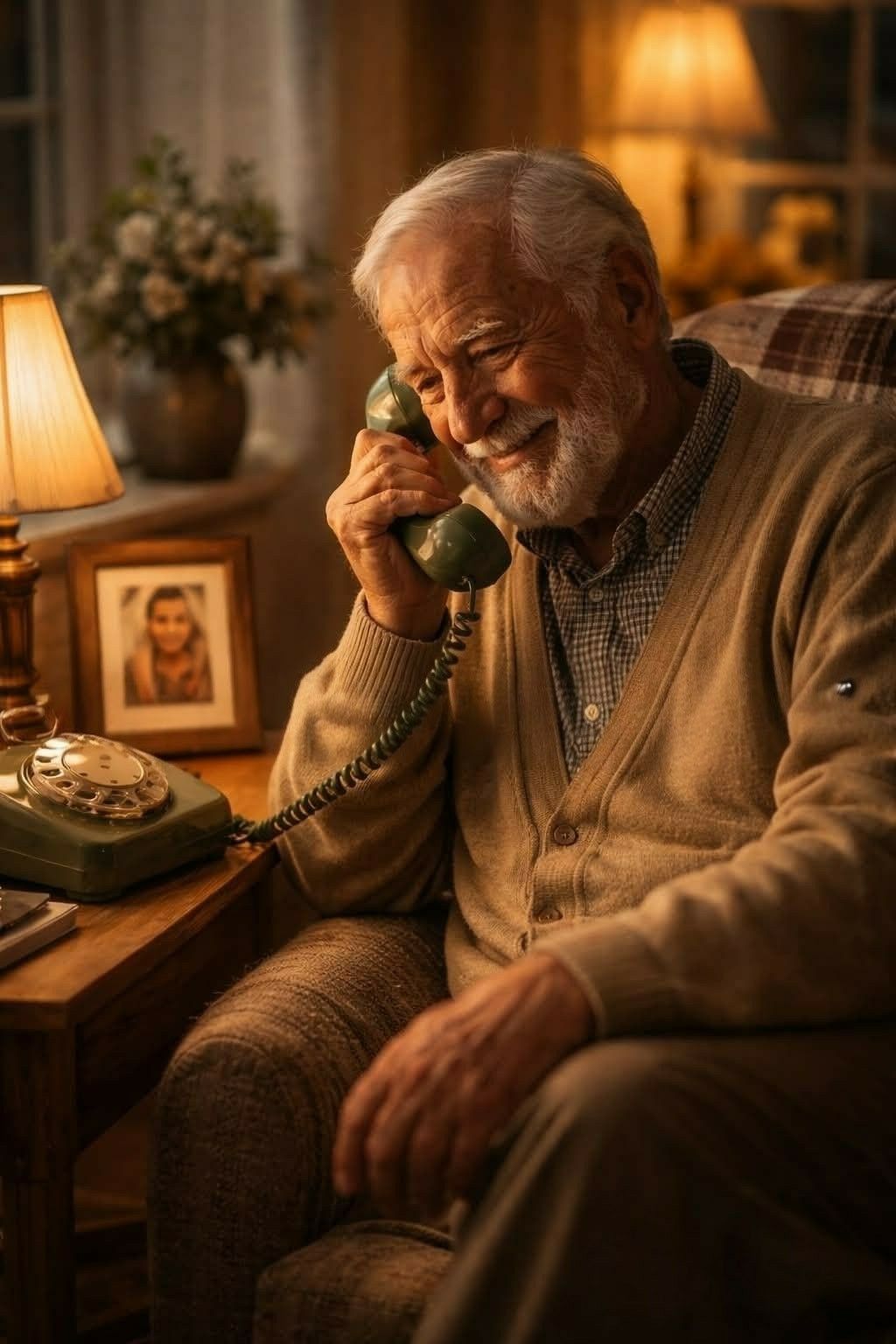
Walter Gaines had not changed the telephone in forty-three years, and he did not intend to start now.
His son Michael had tried. Lord knows the boy had tried — showing up one Christmas with a slim cordless thing that looked like a piece of spacecraft equipment and had more buttons than Walter’s truck dashboard. Walter had accepted it graciously, set it on the kitchen counter still in its box, and left it there for eleven months until Michael visited again and quietly took it back without comment. They were, at their best, a family that understood the value of not pressing a point past its useful life.
The rotary telephone was green. It had been green when Walter and his late wife Eleanor had bought it from the Sears catalog in 1974, and it was green now, sitting on the side table beside his armchair where it had always sat, its cord coiled with the particular permanence of things that have occupied a space long enough to seem inevitable. Eleanor had liked green. She said it was the color of things that were still growing. Walter had not been able to bring himself to replace it when she passed, and after enough years had gone by, the thought of replacing it had stopped occurring to him entirely.
He was eighty years old. He had a bad left knee and a good right one, a garden that produced more tomatoes than he could reasonably eat, and a phone that still worked perfectly well if you had the patience for it. He did not understand why people treated patience as a flaw.
He called his daughter Ruth every Tuesday and Thursday at seven in the evening. He called his son Michael every Sunday after church. He called his friend Harold Birch every other Saturday, which had been their arrangement since Harold’s wife had passed three years ago and Harold had found himself with too much quiet and not enough people to put words into it.
These were the calls that shaped his week the way fence posts shape a field — not decorative but structural, the things everything else ran along.
It was on a Wednesday in October — an unscheduled day, a day with no calls planned — that the phone rang.
Walter was in the kitchen when it rang, standing at the counter eating a piece of toast over the sink the way he had done every morning since Eleanor died, because Eleanor had asked him not to eat over the sink and he had respected that request faithfully for thirty-eight years of marriage and now, in her absence, the small rebellion of it felt like a conversation with her. He heard the ring — that genuine, mechanical ring that digital phones have spent decades failing to convincingly replicate — and he set down his toast and walked to the living room without hurrying. He was eighty years old. Hurrying was a negotiation he conducted only when genuinely necessary.
He picked up the receiver. He settled into his armchair. He said, as he always said: “Gaines residence.”
There was a pause on the other end. Not the automated pause of a robocall — he knew that pause, had learned its texture — but a human pause. The pause of someone gathering.
Then a voice said: “Is this — I’m sorry. I’m looking for a Walter Gaines who lived on Carpenter Street in Morgantown, West Virginia. In the 1960s.”
Walter sat very still.
He had lived on Carpenter Street in Morgantown, West Virginia. From 1962 to 1968, the years he had spent at the university studying agricultural science on the GI Bill, living in a rented room in a green house on Carpenter Street owned by a widow named Mrs. Paulette Marsh who charged fair rent and made exceptional cornbread and asked only that her tenants be quiet after ten and honest always.
“This is Walter Gaines,” he said carefully. “Who is this?”
Another pause. Shorter this time. “My name is Joanna. Joanna Marsh. My grandmother was Paulette Marsh. She passed away last month, and I’m — I’ve been going through her things, and I found something that belongs to you. Or I think it does. I’ve been trying to find you for three weeks.”
Walter looked at the photograph on the side table — Eleanor at twenty-six, laughing at something outside the frame, her dark hair blowing sideways, caught in a moment that had not known it was being preserved. He had looked at this photograph every day for fifty-one years and it had never stopped being specific — not a symbol of the past, but her, exactly her, that afternoon, that laugh.
“Three weeks,” he said. “That’s some looking.”
“You’re not easy to find,” Joanna said. There was something in her voice — warmth, he decided. The specific warmth of a person who has been on a long errand and can finally see the end of it. “Most people your age have email. Or at least a cell number somewhere.”
“I have a telephone,” Walter said. “It works fine.”
She laughed at that. It was a good laugh, unguarded, the kind that arrives before the person has decided whether to let it. “Mrs. Paulette always said the same thing. About the telephone. She had one just like the rotary ones — she kept it until it stopped working and then she just sat it on the shelf because she couldn’t bear to throw it away.”
Walter felt something move in his chest. The particular movement that belongs to moments when the past reaches through and touches the present with a surprisingly warm hand.
“What did you find?” he asked. “In her things.”
The pause this time was different — careful, almost reverent. As if the answer was something she had been holding gently for three weeks, trying not to disturb.
“Letters,” Joanna said. “A whole bundle of them. Tied with kitchen string. They’re addressed to you, Mr. Gaines. All of them. But they were never sent.” She paused once more. “There are forty-seven of them. And the last one — the date on the last one is from just three months ago.”
Walter’s hand tightened on the receiver.
Outside his window, the October garden held its last colors against the coming dark. The lamp beside the telephone threw its warm circle across the side table, across Eleanor’s photograph, across the green rotary phone that had been part of his life longer than most things still living.
He closed his eyes. He breathed.
“Tell me,” he said quietly. “Tell me everything.”
