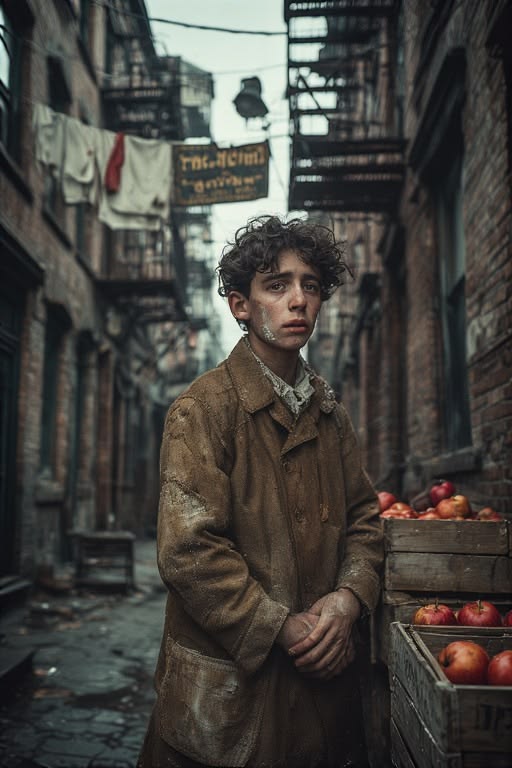
Nobody bought apples at six in the morning on Delancey Street, but Eli Marsh was there anyway.
He had been there every morning for eleven days, standing beside the wooden crate that Mr. Hoznik had let him borrow in exchange for twenty percent of whatever Eli managed to sell, which so far had amounted to very little. The apples were good apples — Eli had selected them himself from the market on Orchard Street, paying for them with the last of the money his mother had given him before she went into the hospital, calculating the margin carefully, the way she had taught him to calculate things. Buy low, sell right, and never confuse what something costs with what it is worth.
He was sixteen years old. He had his mother’s dark curly hair and his father’s eyes, which was a thing people told him as if it were a comfort, though his father had been gone since Eli was four and the eyes in question existed now only in a photograph kept in the tin box under his mother’s bed — a photograph that Eli sometimes took out and looked at, trying to find in the stranger’s face something that corresponded to anything he felt or thought or was.
The Lower East Side of New York City in 1931 was not a place that rewarded sentiment. It was a place that rewarded being awake early and being willing to stand in the cold and being able to look at a situation with the clear eyes that saw what was actually there rather than what you wished was there. Eli had been developing these eyes since the age of twelve, when the world had begun presenting itself to him with an increasing frankness that required a corresponding frankness in return.
His mother’s name was Sarah. She was thirty-eight years old and had worked as a seamstress in the garment district for nineteen years, and the cough that had begun last February as something minor had revealed itself, by September, to be something else entirely. She was at Bellevue now. She had been there for three weeks. She would be there, the doctors said with the careful language of people managing information, for some time more.
The rent was fourteen dollars a month. Eli had seven dollars and forty cents.
He also had forty-three apples, a borrowed crate, a coat that had been his father’s and was therefore two sizes too large and fifteen years out of date, and a mathematical understanding of his situation that was precise enough to be useful and complete enough to be frightening.
He needed a plan. He was working on one.
The alley behind him led to the building where they lived on the fourth floor — he and his mother and, when she had been well, the life she had built around them like a careful structure, the neighbors she knew by name, the Friday evenings with the candles, the particular smell of the apartment that was her smell and therefore the smell of safety. That building was what he was standing here for. Those fourteen dollars, every month, so that when she came home there would be a home to come to.
At half past six a man in a good overcoat came down Delancey at a pace that suggested purpose. Most people in good overcoats did not slow for street vendors, and Eli had learned not to call out to them — it accomplished nothing and cost dignity, which was not an unlimited resource. But this man slowed on his own. He stopped. He looked at the apples with the assessing eye of someone accustomed to looking at things and determining their value quickly.
“How much,” the man said. Not a question, exactly. More of an opening position.
“Three cents each,” Eli said. “Five for twelve cents.”
The man looked at him then — at his face, at the coat that was too big, at the careful posture of a boy trying to present himself as someone conducting legitimate commerce rather than someone standing in an alley in the cold because he had no better option.
“How old are you,” the man said.
“Eighteen,” Eli said.
The man’s expression did not change, which meant he did not believe this and had decided not to press it. “What’s your name.”
“Eli Marsh.”
“These Winesaps?”
“Cortlands. From the market on Orchard. Picked Tuesday. They’re good.”
The man picked one up. He turned it in his gloved hand. He smelled it, which struck Eli as a serious and respectful thing to do — to actually smell a piece of fruit before judging it. He put it back.
“I’ll take ten,” he said.
Eli did the arithmetic instantly. Twenty-four cents, which was better than the five-for-twelve rate, which meant the man either couldn’t do the math or could do it and was choosing not to press his advantage, which were two very different things.
He bagged the apples in the brown paper he’d brought for this purpose, folding the top with the quick, clean fold his mother had shown him.
The man gave him a quarter and a dime. Thirty-five cents. Eleven cents over.
“Keep it,” the man said, already turning.
“I don’t need charity,” Eli said. He said it without heat, without pride — just as information, the way you correct a factual error.
The man stopped. He turned back. He looked at Eli again with the same assessing attention he had given the apples, and this time Eli let him look, because he had nothing to hide and nothing to be ashamed of and he understood, at sixteen, that there is a difference between need and weakness even if the world was not always reliable about recognizing it.
“It’s not charity,” the man said finally. “It’s interest.”
Eli held the extra eleven cents. “Interest on what?”
The man reached into his coat and produced a card. Plain white, black letters, a name and an address on West Thirty-Fourth Street. He set it on top of the apple crate.
“I run a business,” he said. “I need people who can count and aren’t afraid of early mornings. Come by Thursday if you want to hear more.” He picked up his bag of apples. “Don’t come by if you just need a meal. I don’t have time for people who only need a meal.”
He walked away down Delancey without looking back.
Eli picked up the card. He read the name. He read the address. He turned it over — blank on the back. He looked at the eleven cents in his palm and the thirty-three remaining apples in the crate and the seven dollars and forty cents that stood between him and a problem with a fourteen-dollar face.
He put the card in the inside pocket of his father’s coat, against his chest, where he could feel it.
Thursday was two days away. He had apples to sell.
He straightened up, squared himself to the street, and waited for the next person to come down Delancey with enough time to stop.
