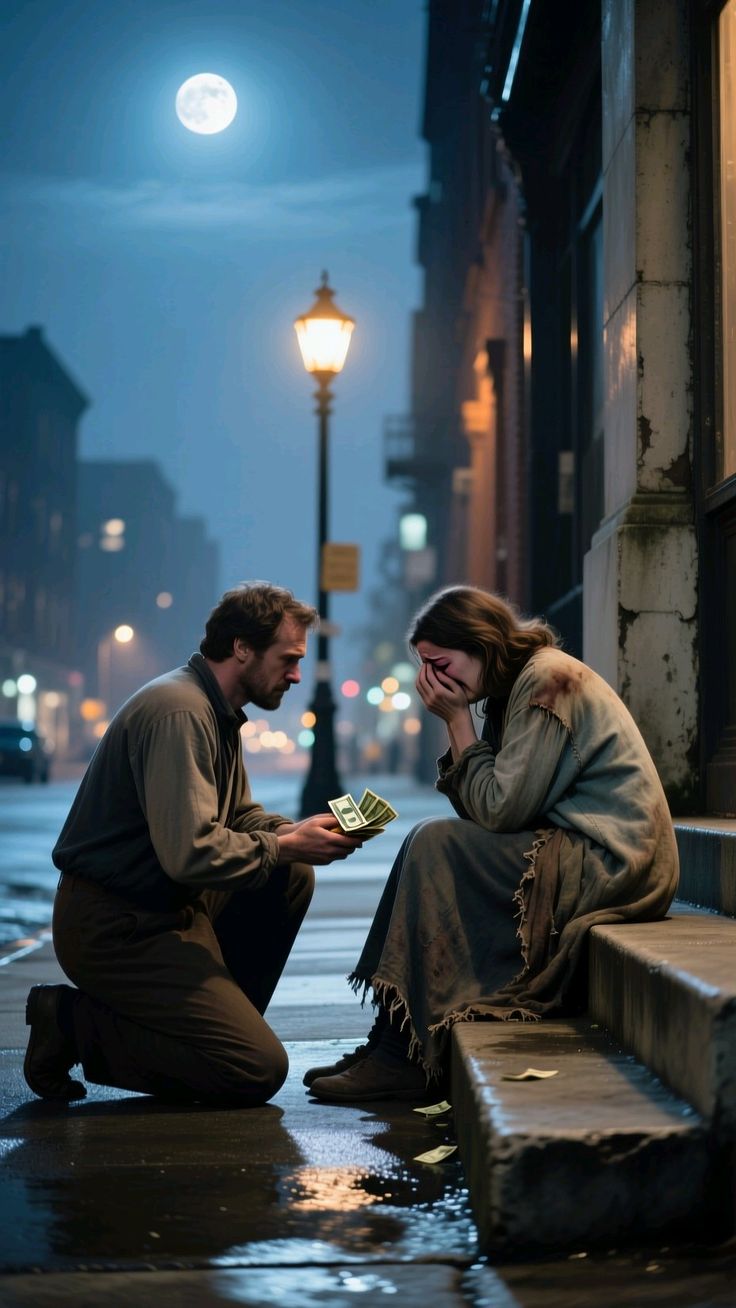
He almost didn’t stop.
That was the truth of it — the uncomfortable, specific truth that Marcus Webb would turn over in his mind for weeks afterward, examining it from different angles the way you examine a stone that has been in your shoe long enough to leave a mark. He had been walking fast, the way he always walked when he was working through something in his head, and the woman on the steps had been in his peripheral vision for exactly the length of time it takes to register a shape and categorize it and keep moving, which is what he had done with a hundred other shapes on a hundred other nights in a city that presents human suffering with the regularity of weather.
But something had made him stop. He could not have named it with precision. It was not heroism — he was clear about that with himself, because he had a habit of being clear with himself about motivations, which was a habit born from years of watching people construct flattering narratives about why they did things. It was something smaller and less noble than heroism. It was closer to the feeling of a loose thread — the sense that something had snagged, that walking away would leave something incomplete in a way that would require accounting for later.
So he stopped. He turned back. He looked at her properly for the first time.
She was young — that was his first real impression. Young in a way the darkness had initially concealed, young in a way that reorganized the scene entirely, because there is a particular wrongness to a young person alone on wet steps at midnight under a full moon that is different in kind from the wrongness of older suffering, more urgent, more demanding of response. She had brown hair that was damp from the mist and her face was buried in both hands and she was crying in the manner of someone who had been crying long enough that it had moved past the acute stage into something steadier and more exhausting, the kind of crying that is less about the release of feeling and more about the simple inability to stop.
She had not heard him approach. He crouched down so that he was below her eye level — a thing he had learned, somewhere in his life, was the right geometry for approaching someone who might startle or fear.
“Hey,” he said. Not loud. Not soft. Level.
She looked up. Her eyes, in the lamplight and the moon, were the reddened eyes of extended grief, and they held in them the specific wariness of someone who has learned that strangers approaching at midnight are not typically a source of good news.
“I’m not — ” he started, and then stopped, because whatever he had been about to say was going to be inadequate to whatever this was. He tried again. “Are you okay?”
The question landed between them with the clumsy weight of questions that already know their answer. She looked at him for a moment and then looked at the street, at the wet pavement reflecting the lamplight in long orange ribbons, and said nothing.
Marcus Webb was thirty-four years old. He was a former Army medic who now worked as a contractors’ safety inspector in a job that paid adequately and required him to be in downtown Pittsburgh on Wednesday evenings for a standing meeting that had ended two hours ago. He was not, by any conventional measure, the protagonist of anyone’s story tonight. He had his own things — his own weight, his own loose threads, the particular inventory of problems that a thirty-four-year-old man accumulates without entirely meaning to. He had been walking through them when he had almost not stopped.
He had stopped.
He looked at what he had in his hands — he had been holding his wallet when he turned back, some instinct having produced it from his jacket pocket without his full conscious participation. He opened it. He had, in cash, a forty and two twenties, which was eighty dollars, which was what he had taken from the ATM before the meeting because the meeting sometimes ended with drinks and he was old-fashioned about buying rounds in cash.
He held the money out toward her. Not dropped in her lap, not placed on the step beside her — held out, at her level, in the manner of something offered rather than dispensed.
She looked at the money. Then at him. The wariness was still there, but behind it something else was making its calculations.
“I don’t want your money,” she said. Her voice was steadier than he had expected. Educated, he thought — not as a judgment but as an observation, the voice of someone who had grown up reading things and been in places that required articulation.
“Okay,” he said. He did not move the money and he did not put it away. He left it in the space between them as a statement of availability rather than an insistence.
“I’m not homeless,” she said. The clarity of it suggested she had needed to say it — that this was a distinction that mattered to her specifically, tonight, for reasons connected to whatever had put her on these steps.
“I didn’t think you were,” Marcus said. “I thought you were sitting on some steps at midnight crying, and I thought that seemed like a hard place to be.”
She looked at him again. The wariness shifted. Not disappeared — she was too smart for that, and he respected the intelligence of it — but shifted into something more like reassessment.
“My car got towed,” she said at last. “My wallet was in it. My phone died an hour ago. I have a room at the Marriott on Liberty and I can’t get into it because my ID was in my wallet and I can’t call anyone because my phone is dead and I’ve been sitting here for—” she paused, and something in the pause contained an entirety that she reduced to: “A while.”
Marcus absorbed this. It was, logistically, a solvable problem. He was good at solvable problems. He had spent six years in the Army learning to identify which problems were solvable and how quickly, and this one had several solutions, none of which required heroism, only the willingness to be useful to a person who needed usefulness rather than sympathy.
“My phone works,” he said. “And I know where the tow lot is. And I can walk you to the Marriott and explain your situation to the desk, because I have ID and I’m reasonably trustworthy looking, or at least I’ve been told that.” He paused. “Or you can tell me to leave and I’ll leave and no part of tonight changes for me except that it’ll be one of those things I think about sometimes.”
She looked at him for a long time. In the moonlight and the lamplight, in the wet Pittsburgh night, with her red eyes and her damp hair and her specific intelligence conducting its specific calculation.
“Why would you do any of that,” she said. “For a stranger.”
Marcus thought about this with the seriousness it deserved. He thought about the loose thread and the peripheral vision and the almost of almost not stopping. He thought about the eighty dollars still in his outstretched hand and the medic training that had given him a permanent, low-level alertness to people in trouble and the specific texture of a Wednesday night that had not asked to become anything other than what it had been.
“Because you’re sitting on a step at midnight,” he said, “and the moon’s been full all night and nobody else stopped.”
She looked at the moon. He followed her gaze upward — full and bright above the mist, indifferent and magnificent, the kind of moon that makes the ordinary world look briefly like something that was arranged with intention.
She stood up. She was taller than he’d thought. She straightened herself with a dignity that had been there the whole time, underneath the crying, waiting.
“My name is Claire,” she said.
“Marcus,” he said.
She looked at the money still in his hand. “I don’t need it,” she said. “But thank you for holding it out like that. Like it was a real offer.”
“It was a real offer,” he said.
“I know,” she said. “That’s why I said thank you.”
He put the money back in his wallet. He took out his phone. He pulled up the number for the Pittsburgh tow authority, because he actually did know it — a fact that he attributed to the particular profile of a man who reads municipal service numbers the way other people read sports statistics, which was either a flaw or a feature depending on how you looked at it.
“Okay,” he said. “Let’s start with the car.”
They stood together on the wet sidewalk, under the full moon, in the lamplight, two people who had been strangers four minutes ago moving with the tentative coordination of people learning each other’s pace. Above them the moon held its position, as it had held it all night, witnessing everything and saying nothing, the way the best witnesses do.
