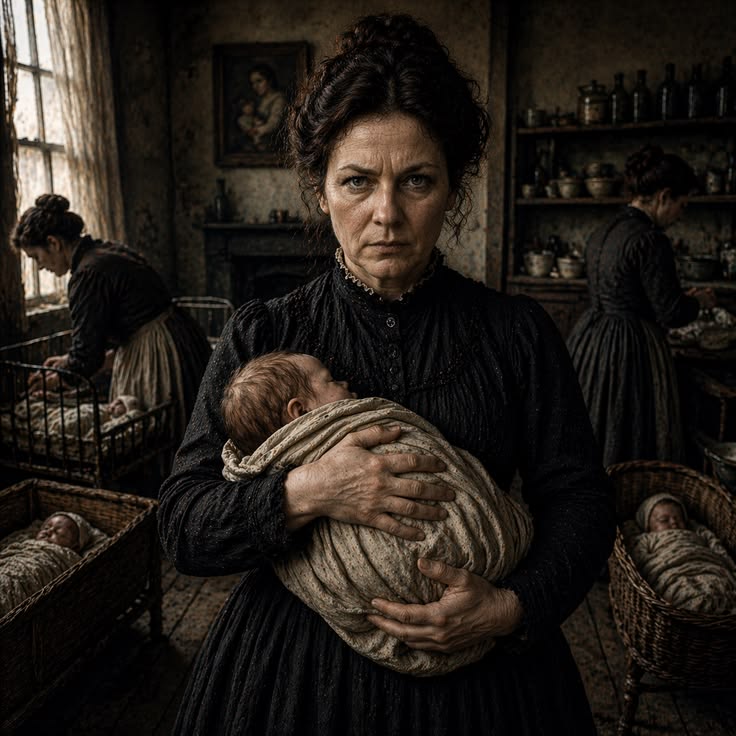
There were eleven infants in the room, and Nora Flanagan knew every breath of every one of them.
This was not sentiment. Sentiment was a luxury that the Whitmore Foundling House of Philadelphia could not afford in the year 1887, and Nora had understood this from her first day as its matron, fourteen years ago, when she had walked through the front door at the age of thirty-one with a carpet bag, a letter of appointment, and the kind of practical intelligence that recognized immediately that love and efficiency were not opposites — that in a house full of abandoned infants, love expressed as efficiency was the highest form of both.
She knew their breathing the way a sailor knows weather — not by consulting instruments but by listening with a part of herself that never fully slept. She could tell from across the room when the Hannigan boy’s chest was tightening toward croup. She could hear the difference between the hunger cry of the infant they had taken in last Tuesday — a girl, left on the steps in a flour sack with nothing but a sprig of dried lavender tucked inside, which Nora had interpreted as an act of desperate tenderness and had kept — and the pain cry that meant something required immediate attention.
She had saved forty-three lives in fourteen years. She had also lost nine, and she carried each of those nine with her in a way she did not discuss with anyone, that she marked each year on a date she kept to herself, in a small leather book that she locked in her desk and never showed.
The infant in her arms now was the one they had received this morning. A boy, approximately three weeks old, in better health than most of the foundlings that came through the Whitmore’s door — which meant someone had been feeding him well until very recently, which meant something had changed very recently, which meant there was a story attached to this child that she did not yet know but intended to find out.
Nora did not look at the man from the city registry who was standing behind her waiting for her to complete the intake form. She looked at the child. She had learned long ago that the information you needed was always in the child — in the state of its clothing, the condition of its skin, the quality of its wrapping, the small signs that told you whether it had come from poverty or from something else entirely.
This child’s wrapping was linen. Not wool, not cotton — linen, and fine linen at that, the kind that was expensive enough in 1887 that most of the families who passed through the Whitmore’s radius could not have afforded it for their own backs, let alone for swaddling. The stitching at the edge was precise. Done by someone who knew what they were doing, or done by someone with access to someone who knew what they were doing, which amounted to the same thing in terms of what it told her about origins.
There was something else. Pinned to the inside of the linen, with a small brass pin of the kind used for fine dressmaking rather than the crude steel pins of ordinary households, was a piece of paper folded to the size of a calling card. Nora had found it during her examination and had not unfolded it yet. She had a sense, developed over fourteen years of this particular work, about the right moment to open things. The right moment was not while the city registry man was standing behind her exhaling impatiently and scratching his pen across his forms.
She completed the intake. She handed the registry man his copy. She waited until she heard the door close behind him and his footsteps descend the front stairs. Then she carried the boy to the chair by the window — the good chair, the one that caught the morning light properly — and she sat down and unfolded the paper.
The handwriting was a woman’s. Educated — she could tell by the formation of the letters, the consistency of pressure, the absence of the labored quality that came with hands unused to holding a pen regularly. The note was brief. Eight sentences. Nora read them once, then read them again, then sat for a long moment looking out the window at the gray Philadelphia morning, at the street below where a cart horse stood in the November drizzle with the patient resignation of animals that have accepted their circumstances completely.
Then she looked down at the boy in her arms.
He was awake. This surprised her — most infants of this age slept the larger portion of their hours, exhausted by the enormous work of existing. But this one was awake, and he was looking at her with the unfocused but intent expression of a very new person encountering the world with more curiosity than fear.
“Well,” Nora said quietly. She had never been a woman who spoke to infants the way some of her staff did — the high sing-song voices, the nonsense syllables. She spoke to them the way she spoke to everyone: directly, as if they were capable of understanding and simply hadn’t gotten around to it yet. “You’ve arrived in an interesting set of circumstances.”
The boy moved his mouth. Not crying. Something else. Something that looked, in the merciful winter light, almost like response.
Nora looked at the note again. At the eighth sentence specifically, the one she was still turning over in her mind, the one that changed the weight of everything that preceded it.
She folded the note carefully. She placed it in the pocket of her dress, against her side, where she could feel it with every breath.
She looked at the eleven other infants in the room — their bassinets arranged with the precise spacing she required, their blankets checked at six and ten and two, their lives suspended temporarily in her care like boats in a harbor, waiting for the tide that would carry each of them somewhere.
And then she looked back at the boy in her arms — this particular boy, in his fine linen wrapping with his brass pin and his eight-sentence note — and she made a decision that she knew, even as she made it, would alter the remainder of her life.
She stood up. She walked to her office. She sat at her desk and opened the intake ledger and looked at the line she had just entered.
Then she dipped her pen and changed one word.
Just one word. But in the careful architecture of official records, one word was everything.
