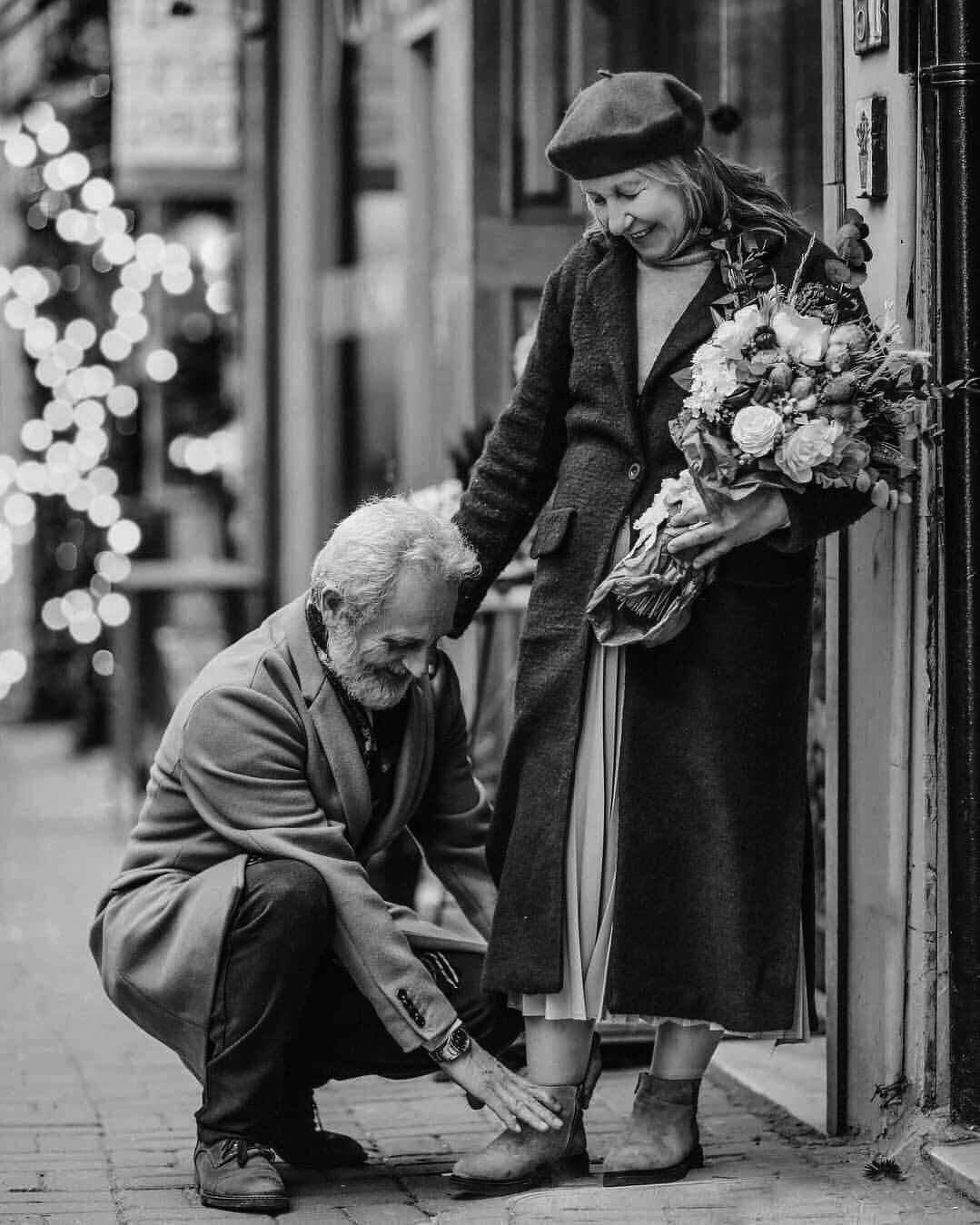
It was the smallest thing.
That was what Margaret Ellison kept coming back to, in the days and weeks that followed, when she tried to explain it to her sister on the phone, to her friend Carolyn over coffee, to herself in the quiet of her apartment at night when the city had gone soft outside her window and she sat with a glass of wine and turned the whole impossible thing over in her hands like a snow globe she couldn’t stop shaking. It was the smallest thing. A shoelace. Coming undone on the corner of Birch and Fifth, in front of the little flower shop with the lights in the window, on a Tuesday afternoon in December when the whole street was gilded with Christmas and cold and she had a bouquet of white roses in her arms because she had bought them for herself, which was something she had only recently learned to do.
She was sixty-three years old. She was wearing her good wool coat and her beret and the ankle boots she loved and the shoelace of the left one had come undone and she had noticed it with the particular mild frustration of someone whose arms are completely full and has no graceful way to solve the problem.
She had stopped on the sidewalk and was considering her options when the man crouched down.
She didn’t ask him to. He simply appeared in her peripheral vision, already lowering himself to one knee on the cold pavement in his good gray coat, already reaching for the lace with the matter-of-fact ease of someone doing an obvious thing that needed doing. He was perhaps sixty-five, silver-haired, with a white beard trimmed close and the kind of face that had been lived in well — the lines deep but arranged pleasantly, a face that had smiled a great deal and meant it. He wore a watch on his left wrist. She noticed the watch the way you notice specific details when something unexpected is happening and your mind is trying to take inventory.
“May I?” he said. Looking up at her, already having begun.
She laughed. The surprise of it — the sheer courtly unexpectedness, a stranger on a Tuesday kneeling on the sidewalk to tie her shoe without being asked — came out as a laugh, which she was slightly embarrassed about and then decided not to be.
“You already are,” she said.
He tied the bow with two practiced loops, the kind of knot that stays, and then he looked up at her again with a smile that reached all the way to its edges, the real kind, and something in Margaret’s chest did a thing it had not done in a long time. It didn’t announce itself. It was subtle. Like a door, somewhere deep in a house, opening a inch.
He stood. He was tall.
“There,” he said. “The city is a dangerous place with an undone shoelace.”
“Terribly dangerous,” she agreed. “Thank you.”
“My pleasure entirely.”
They stood for a moment on the corner of Birch and Fifth with the Christmas lights soft and blurred in the background and the cold sitting on everything and the flowers between them smelling of something that belonged to a warmer season. The moment had the quality of a held breath. Margaret was sixty-three years old and she had been on her own for seven years, since the divorce that had been the right decision and still the hardest thing she had ever done, and she had built a life in those seven years that was genuinely good, that she was genuinely proud of, that fit her in the way a life fits you when you have stopped trying to make yourself fit the life. She was not looking. She had stopped looking a long time ago, not bitterly, not in defeat, but with the clean acceptance of someone who has made peace with a particular landscape.
And yet.
“I’m Martin,” he said.
“Margaret,” she said.
He looked at the flowers. “For someone special?”
She held his gaze. “For me,” she said simply.
Something shifted in his expression — a small recalibration, a recognition. He nodded once, the way you nod when someone says something that reveals, in passing, something true about who they are.
“Best kind,” he said.
She expected that to be the end of it. She was already calculating the slight pivot, the polite farewell, the walk to the subway that would close the parentheses on this small charming Tuesday moment and file it away as exactly what it was — a kindness from a stranger, a story to tell Carolyn over coffee, proof that there were still gentlemen in the world and December was not without its small graces.
“Would you like to get warm somewhere?” he said. “There’s a place around the corner that does an extraordinary hot chocolate, and I was going there anyway, and I find I’m very tired of going places alone.”
Margaret looked at him.
She was sixty-three years old. She had bought herself flowers. She had a good life and a good coat and a shoelace that was now properly tied and absolutely no reason to say yes to a stranger outside a flower shop on a Tuesday.
“I have nowhere to be,” she said.
Which was true. And was also, in its way, the bravest thing she had said in years.
They walked around the corner together, Martin and Margaret, in their good coats, with the roses between them, two people who had each, separately, built a life from the wreckage of a different one and arrived, without planning it, at the same corner at the same moment with the same lace coming undone, which is perhaps the least romantic way to begin something and also, somehow, exactly right.
The hot chocolate was extraordinary, as promised.
They talked for three hours. She missed the subway twice without noticing. He told her about the architecture firm he’d retired from the previous spring, about his daughter in Portland, about the way retirement had felt at first like a room with no furniture and how he was slowly, piece by piece, filling it. She told him about the bookshop she had opened at fifty-eight, the thing everyone had said was impractical and that had turned out to be the most practical thing she’d ever done, because it was the first thing built entirely on what she loved.
He listened the way very few people listen — not waiting for his turn, but actually present, actually receiving what she was saying, turning it over the way you turn over something you want to understand fully before you respond.
When the café began stacking chairs around them, they looked up, surprised.
Outside on the pavement they stood in the familiar configuration of a moment that has reached its edge. The cold had deepened. The Christmas lights were still doing what Christmas lights do. Margaret shifted the flowers to her other arm.
“Thank you,” she said. “For the shoe. And the hot chocolate.”
“Thank you for the company,” he said. And then, without flourish, without strategy: “I would very much like to see you again.”
She looked at him standing there in his good gray coat in the December dark, this man who had kneeled on a cold sidewalk for a stranger without being asked, who had listened for three hours as though what she said mattered, who was tired of going places alone and had said so without shame, which she found, she was discovering, to be the most attractive quality in a human being.
“All right,” she said.
She gave him her number. She walked to the subway with her flowers. She did not look back, because she did not need to. She knew, the way you know certain things before you can prove them, that he was still standing there a moment, watching her go, smiling the smile that reached all the way to its edges.
She was right.
The door in the deep part of her house swung open another inch.
She let it.
