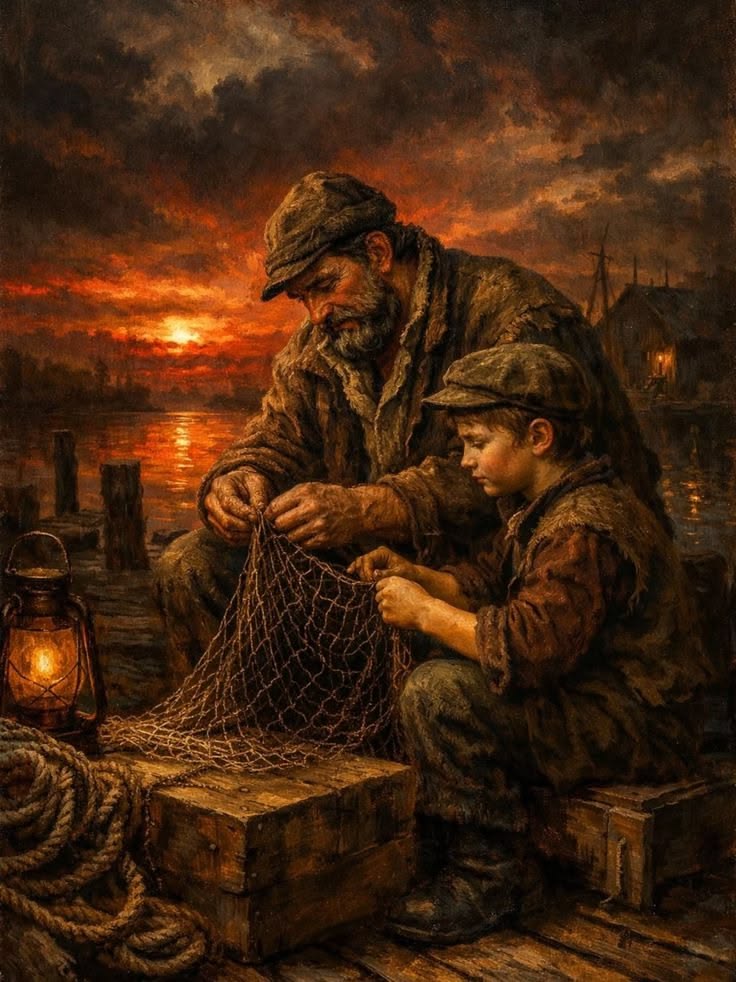
The sun was going down in fire over Gloucester Harbor and Thomas Ardell was teaching his grandson how to mend a net.
This was not, on the surface, a remarkable thing. Men had been mending nets on this dock for two hundred years — the Ardells among them, generation upon generation, their hands learning the same knots their fathers’ hands had learned, the work passing downward through time like a river that knows only one direction. The dock had changed. The boats had changed. The harbor had filled and emptied and filled again with different faces, different flags, different fortunes. But the net was the net and the knot was the knot and here were two more Ardells in the dying October light, an old man and a boy, doing what Ardells had always done.
The boy’s name was Samuel. He was nine years old and he had his grandfather’s hands — broad across the palm, the fingers slightly squared at the tips, built for grip and precision both. He did not know he had his grandfather’s hands. Children don’t see those things yet. Thomas saw it every time he looked at the boy and felt the complicated tenderness of a man watching himself continue in someone who does not yet know they are a continuation.
“You’re pulling too hard,” Thomas said. Not unkindly. Observation, not criticism. “The net doesn’t need force. It needs patience.”
Samuel looked at the mesh in his hands and tried again. The lantern beside them threw its amber circle against the dusk, the old kind of light, the kind that makes everything it touches look like something worth remembering.
“Grandpa,” Samuel said, working the cord.
“Mm.”
“Why do we fix them by hand? Wouldn’t a machine be faster?”
Thomas considered this the way he considered most things Samuel asked him — seriously, as though the question deserved an honest answer rather than a convenient one.
“Faster,” he said. “Yes. But a machine doesn’t know where the net has been. Your hands do, if you pay attention. You can feel where it gave way. You can feel what the water did to it, what the weight did to it. When you mend it by hand you’re learning its history. You’re making it stronger in the places it already proved it was weak.”
Samuel was quiet for a moment, working the cord. The harbor moved in the last light — dark water, copper sky, the distant shapes of the other boats coming in like slow thoughts arriving home.
“Is that why you always do it yourself?” he said. “Even when your hands hurt?”
Thomas looked at his hands. They did hurt, most days now. The cold especially, which in Gloucester came early and stayed long, got into the joints by October and didn’t leave until May. He had been mending nets on this dock for sixty years, since his own grandfather had sat beside him in this same fading light and taught him the same knots, and the hands that had done that work showed it honestly, every year written in them somewhere.
“That’s part of it,” Thomas said.
He did not say the rest of it, which was this: that the net mending was the thing that had survived. He had lost his wife, Eleanor, twelve years ago, and something in him had gone quiet that had not come back. He had lost the Ardell Rose, his father’s boat and then his own, to a storm in 1987 that he did not like to talk about and which Samuel’s mother, when she was a girl, had understood without being told was a subject that required a wide berth. He had lost, gradually and then all at once, the fishing life that had been the structure of his days, the rhythm that told him who he was and where he stood in the order of things, replaced by the smaller life of a retired man in a harbor town who was no longer of the harbor in any working sense. He had lost things the way old men lose them — steadily, without drama, each one a rearrangement of what remained.
But every evening he came to the dock with whatever net needed work and he sat in the lantern light and he mended what was broken, and in that specific act — the hands moving through the familiar motions, the knots forming the way they always formed, the feel of the cord and the mesh and the history encoded in every weakened strand — he found the thing that had no better name than continuity. The sense that something was being maintained. That the breaking and the mending were both parts of the same long story, and that his hands in this net on this dock were connected, through an unbroken chain of lantern-lit evenings, all the way back to the beginning of the Ardells on this harbor, and all the way forward to Samuel beside him, learning the knot, learning the patience, learning without knowing he was learning that the things worth keeping require the kind of attention that machines cannot provide.
“Here,” Thomas said, guiding Samuel’s fingers to the join that needed reinforcing. “Feel how it loosened here? Something put a lot of pressure on this spot. Maybe a catch, maybe the current. Doesn’t matter what. What matters is we find it and we fix it before it goes out again.”
Samuel’s fingers moved under his grandfather’s — young hands, old hands, both working the same mesh in the same lamplight.
“What if we miss a spot?” Samuel asked.
“Then it tears in the water,” Thomas said. “And we mend it again when it comes home.” He looked at the boy. “Things tear, Samuel. That’s not failure. Tearing is just what nets do in the sea. The failure would be not bringing them home to fix them.”
Samuel worked the cord. The knot formed, tighter this time, the real kind that holds.
“Good,” Thomas said. Quiet and certain. The only praise that mattered.
The sun finished its work and dropped below the harbor line and the sky went from fire to deep red to the first faint appearance of stars, and the lantern did what lanterns do — it held its ground against the dark, amber and steady and sufficient for the work at hand. Thomas and Samuel sat on the dock in that small circle of light with the net between them and the whole dark harbor breathing around them, and the old man taught the boy what his grandfather had taught him, on this same dock, in this same light, because the net needed mending and the hands were there and some things survive not because they are protected but because they are practiced, passed forward through the patient act of doing them again.
Thomas’s hands ached. He did not stop.
Samuel watched everything. He did not know yet what he was receiving. He would know later, much later, on a dock of his own, in a lantern light of his own, with hands that by then would look like his grandfather’s, teaching someone young and unaware of what they were inheriting.
That was how it worked. That was how it had always worked.
The net would need mending again. It always did.
They would mend it.
They always had.
