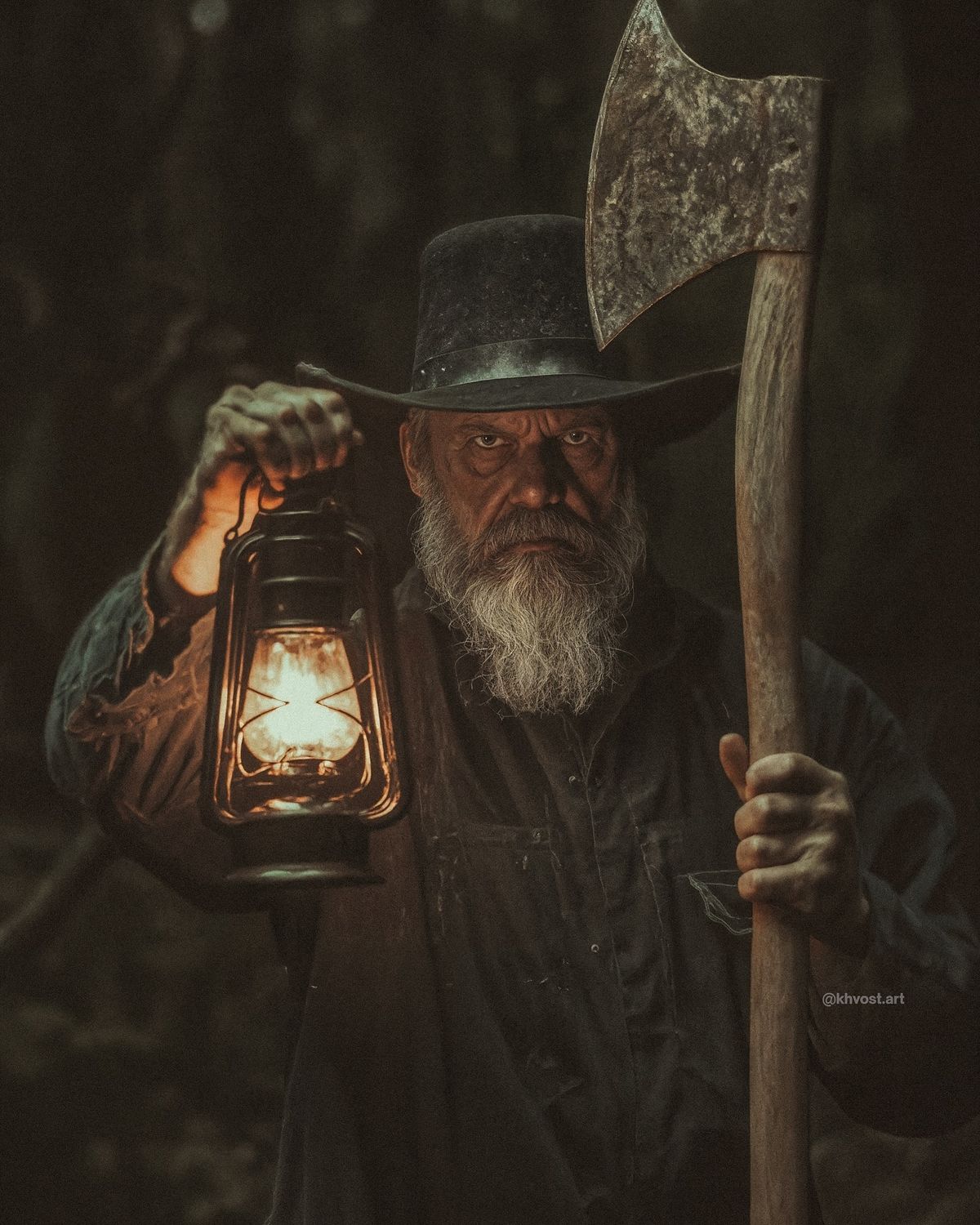
Everyone in Calder’s Creek knew two things about Silas Horne.
The first was that he had lived on the edge of Harrow Wood for longer than anyone could reliably remember — longer than the oldest residents, longer than the town’s written records, which went back to 1887 and mentioned him already as if he were a permanent feature of the landscape, like the ridge or the river, something that had simply always been there. The second was that you did not go into Harrow Wood after dark. Not because of anything Silas had done, exactly. Because of everything he prevented. There was a distinction, and the town understood it in the way that small towns understood things that their inhabitants never quite put into direct language — in the collective, inherited knowledge of people who had learned certain lessons through generations of proximity to something they could not fully explain and had decided not to try.
He came into town twice a month for supplies.
Those mornings had their own quiet ritual. The hardware store owner, Dale Pruitt, would have Silas’s order ready before he arrived — same things, mostly, month after month, with occasional additions that Dale had learned not to ask about. The woman at the feed store, Mrs. Yamamoto, would nod when he came through the door and pull his bag from beneath the counter without conversation, which was the arrangement they had arrived at over years of mutual understanding. Children were steered indoors by parents who did it casually, without drama, the way you steered children away from the edge of a roof — not because you expected the worst, but because proximity to certain things required a caution that didn’t need explaining.
Silas accepted this arrangement with the equanimity of a man who had long since stopped requiring the world to be comfortable with him.
He was not, by appearance, a man you would choose to meet at the edge of a dark wood. He was aware of this. The hat, the axe, the lantern he carried even in daylight — these were functional items, not affectations, but he understood that function and appearance were not always the same conversation, and that the face he’d been given by seventy-odd years of hard living in harder country was not a face that invited casual acquaintance. His eyes, which were the pale grey of winter ice, had an unsettling directness that people interpreted as hostility and which was actually something closer to the opposite — the complete, unfiltered attention of a man who had learned that seeing things clearly was the first and most essential task of staying alive.
He saw things very clearly.
That was, in the final accounting, the whole of what he was and what he did.
The night that changed the town’s understanding of Silas Horne began ordinarily enough — or as ordinarily as things began in Calder’s Creek, which was a town where ordinary had its own particular texture, a little rougher at the edges than most. It was a Friday in October, which was the month when Harrow Wood became most active, in the way that Silas thought of as active and had no better word for. The light went bad in October. Not dark — bad. There was a difference that most people had no occasion to learn and which Silas had spent decades trying to articulate to himself with only partial success.
The three teenagers had gone in at nine-fifteen.
He knew because he watched them from the tree line — two boys and a girl, sixteen or seventeen, the universal confidence of young people who have not yet encountered the specific thing that will permanently correct their understanding of what the world will and will not do. They had the gear that teenagers brought into woods they shouldn’t enter: flashlights, a phone camera, the bravado of a dare that had probably started as a joke and accumulated social momentum until backing out cost more than going in.
He knew that momentum. He had seen it before.
He let them get fifty yards in before he followed.
Not because he doubted what was in the wood — he never doubted that, had not doubted it in forty years of keeping this boundary — but because there was a calculation he made each time, a reading of the wood’s current disposition, the way you read weather or water before deciding on your approach. October nights were variable. Some were merely cold and dark and the teenagers would come out frightened and intact and telling stories they’d embellish for years. Others were something more, something that required him to be closer, faster, more directly between what lived in the deep of Harrow Wood and the foolish luminous things that wandered into its attention.
Tonight felt like the second kind.
The lantern he carried was not for his benefit — he knew these paths in total darkness, had walked them so many thousands of times that his feet knew them the way his hands knew his own axe handle. The lantern was for theirs. So that when they saw him coming toward them through the trees — and they would see him, because he would make sure they saw him, because the alternative was worse — they would see something human. Something to run toward rather than away from, which was the critical distinction, the difference between a bad night and an ending.
He moved through the wood quietly for a man his size.
Ahead, he could hear them — the flashlight beams swinging, the whispered argument that had replaced the bravado, the particular quality of silence that falls over young people when they have gone far enough in a direction to feel the full weight of the distance back. He recognized that silence. It was the moment confidence became doubt and doubt became the first clean edge of genuine fear.
He picked up his pace.
The lantern threw his shadow long and ragged through the trees, and somewhere deeper in the wood, in the darkness where his light didn’t reach, something that had been still became aware of the light and of him and — this was the part that forty years had not made routine — turned its attention toward the boundary he represented.
He raised the axe.
He walked forward.
He did what he had always done.
