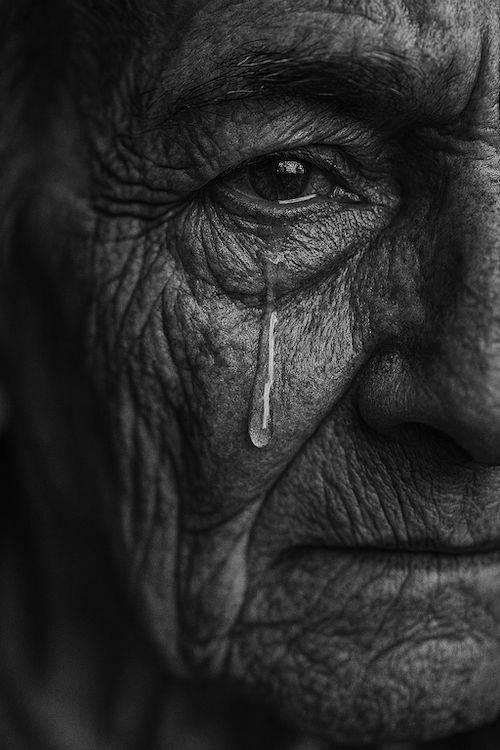
He had not cried in fifty-three years.
Not at his wife’s funeral. Not when his son stopped calling. Not through the wars he had witnessed, the losses he had absorbed, the long accumulated weight of a life that had asked more of him than most lives ask and had received, in return, the particular hardness that forms in a person when they decide — consciously or not, early enough that the decision becomes character — that feeling things fully is a luxury they cannot afford.
His name was Joseph Elias Mercer. He was eighty-four years old. He was sitting in a chair by the window of a room in a care facility in rural Tennessee, and he was crying for the first time since 1972, and he didn’t entirely know why, except that the afternoon light through the window was doing something specific to the dust in the air, turning it gold, the way light had done in a kitchen he had not thought about in decades, in a house that no longer stood, on a morning that had been the last ordinary morning of his life before everything changed.
The tear moved down his face slowly, finding its path through the topography of eighty-four years — the deep lines, the weathered skin, the map of every hard winter and harder decision — and it felt, to Joseph, like something being released that had been waiting a very long time for permission.
He had grown up in Alabama, the third of six children in a family that measured love in actions rather than words, in the food that appeared on the table and the roof that stayed on the house and the father who worked two jobs without complaint for thirty years. They were not a crying family. They were not an expressing family. They were an enduring family, which was its own form of love and its own form of damage, and Joseph had carried both forward into his adult life with the faithfulness of someone who has never been offered an alternative model.
He had been a soldier. Korea, then a desk in Germany, then twenty years of the Army’s particular education in suppressing everything that made you human in service of everything that kept you and the men beside you alive. He had learned to read a battlefield and not feel it until later, and then to not feel it at all, or at least to locate the feeling somewhere so deep and so habitual that it ceased to present itself as feeling and became instead simply the texture of who he was.
He had been a husband. Margaret had known what she was getting when she married him — or had known enough, the way you knew enough at twenty-four, before the full dimensions of a person revealed themselves through decades of proximity. She had not been a complaining woman. She had built a life inside the life he offered and had made it warm and full with the creativity of someone working in a constrained space, and he had loved her in the way he loved everything — practically, demonstrably, through the things he did rather than the things he said.
He had never once told her that watching her sleep sometimes filled him with something so large and so without name that it pressed against the inside of his chest like a tide.
She had died in the winter of 2019. He had sat beside her bed and held her hand and been present in every way that presence could be managed, and when it was over he had stood up and thanked the nurses with the formal courtesy he applied to everything and had driven himself home and made dinner for one for the first time in fifty-seven years and had not cried.
He thought he was fine.
He had always thought he was fine.
The young woman who came on Tuesday afternoons — her name was Deja, she was twenty-six, she had the unhurried quality of someone who had learned that old people moved at their own pace and that this was not a problem to be solved — had asked him last week if he wanted to talk about Margaret. He had said no in the way he said no to most offers of the interior kind — politely but finally, the door closed and latched.
She had not pushed. But she had left a photograph on his side table — not intrusively, just set it down while she was tidying, as if it had simply ended up there by accident. It was a photograph she’d found in his things while helping him organize, the kind of help he’d reluctantly accepted when his hands started having opinions about fine motor tasks.
The photograph was from 1968. Margaret at the beach, laughing at something off-camera, her hair moving in the wind, her face entirely unguarded in the way that faces were when they didn’t know they were being watched.
He had not looked at it when she placed it there.
He had looked at it at three in the morning.
He had looked at it again in the afternoon light, just now, and the light through the window had hit it in a particular way and he had thought: she is gone and I never told her about the tide, I never found the words for the tide, I let fifty-seven years pass with that unsaid and now the person who needed to hear it is somewhere I cannot reach and I am eighty-four years old in a chair by a window and I have run out of time to say the things I should have said.
That was when the tear came.
One tear. Moving slow. Down the long topography of his face.
He did not wipe it away.
He let it go where it went, because it had earned its path, because fifty-three years of held things had earned this one slow passage down his face in the gold afternoon light.
Deja came in at four o’clock with his medication and stopped in the doorway and looked at him for a moment — not with alarm, not with the clinical assessment of a caregiver checking on a patient, but with something quieter and more honest. She set the medication on the table and sat down in the chair across from him without asking if she could.
“Sir,” she said, after a long moment, “do you want to tell me about her?”
Joseph Mercer looked at the photograph of his wife in 1968, laughing at something he had said — he remembered now, he had made a joke, a rare thing, and she had laughed with her whole face, the way she did, the way he had never stopped being grateful for.
“I don’t know how to start,” he said. His voice was rough from disuse and something older than disuse.
“Start anywhere,” Deja said. “I have time.”
He looked at her. At this twenty-six-year-old woman who had placed a photograph like a key in a lock and then waited, without knowing she was waiting, for the door to open.
“Her name was Margaret,” he said.
And he began.
