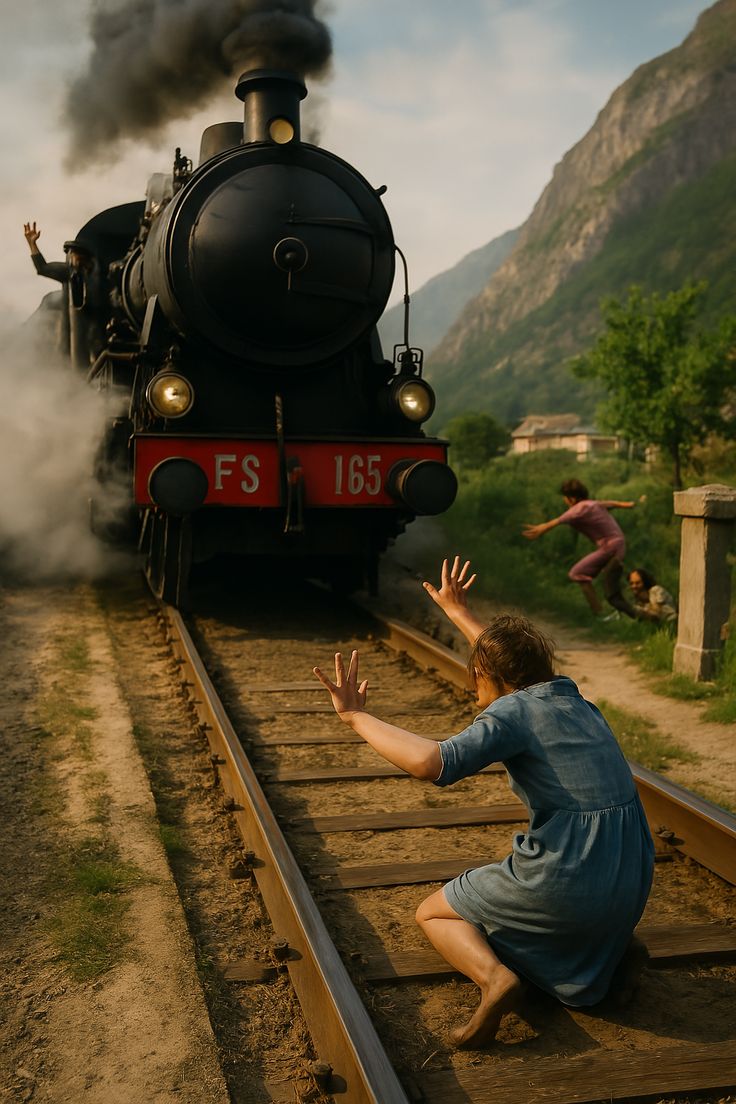
The engineer saw her when there were seven seconds left.
He knew the number precisely because he had replayed those seven seconds in his mind every day for the thirty-one years since, turning them over with the obsessive fidelity of a man trying to locate the moment where a different choice was possible, the frame where the outcome could have been redirected by some action he had or hadn’t taken. Seven seconds from the moment her blue dress appeared on the track ahead to the moment the train reached the place where she had been. He had done the mathematics so many times they lived in him like a second heartbeat. Seven seconds at that speed, on that grade, with that load behind him. He had hit the brake at second one. It had not mattered.
Her name was Anna Russo. She was nine years old. She had tripped on the rail while crossing the track on a summer afternoon in a mountain valley in northern Italy, and her ankle had caught between the tie and the rail with the particular cruelty of chance that doesn’t concern itself with fairness or proportion or the age of the people it affects.
She had looked up at the train coming and raised her hands.
Not to shield herself — the gesture was wrong for that, palms forward, fingers spread, arms extended at the full reach of a nine-year-old girl’s arms. It was, the engineer would later tell his wife, the gesture of a child trying to stop something too large to be stopped by a child. The gesture of someone who had not yet been taught that some things couldn’t be pushed back.
He had closed his eyes at second five.
When he opened them, the track behind the train was empty.
He brought the locomotive to a stop half a mile down the valley, his hands shaking on the controls with a tremor that would not fully leave him for the rest of his working life, and he climbed down from the cab and walked back up the track expecting to find what he expected to find.
He found a girl sitting in the grass at the edge of the track.
She was holding her ankle. She was crying — not the silent crying of shock but the full-throated crying of a child in pain, which was the most beautiful sound he had ever heard in his life, because a child in pain was a child alive, and he had spent the longest half-mile of his career certain that alive was no longer an option.
The woman in the pink dress — her older sister, as it turned out, seventeen and frantic — had pulled Anna clear at the last possible second, had grabbed her by the shoulders and hauled her off the track with the blind, adrenaline-powered strength of someone for whom the alternative was unthinkable. She had not gotten fully clear herself. The slipstream of the passing locomotive had spun her sideways into the grass and she was sitting ten feet away with her hands in the dirt and an expression on her face that the engineer recognized because he was wearing the same one.
The expression of a person who has just stood at the absolute edge of something and come back.
His name was Giorgio Ferretti. He was fifty-two years old, twenty-six years on the line, a man who had driven this route through every season and every weather and had never once had a morning like this one. He crouched down beside the older sister — whose name, she told him in a voice that was mostly breath, was Sofia — and they looked at each other across the specific shared knowledge of what had almost happened, and neither of them said anything for a long moment because there were no words in any language that were the right size for those seven seconds.
“She’s alright,” Sofia finally said. It came out like a question.
“She’s alright,” Giorgio confirmed. It came out like a prayer.
Anna, for her part, had stopped crying and was examining her ankle with the clinical interest of a child who has processed the immediate terror and moved on to the concrete. It was swollen. It hurt. It was, the doctor in the village confirmed two hours later, badly sprained but not broken, which was a sentence that Giorgio received with the disproportionate gratitude of a man for whom not broken had a meaning far beyond the medical.
He visited the Russo family that evening. He brought wine he couldn’t afford and sat at their kitchen table and shook their father’s hand for a long time without speaking, in the way that men of his generation communicated things that were too large for words. Anna sat across from him and studied him with the direct, uncomplicated gaze of a child who had already filed the afternoon’s events under that was very bad but I am fine now and moved on.
“You tried to stop,” she said.
“I did,” he said.
“It wasn’t fast enough.”
“No.”
She considered this with the serious attention she appeared to give everything. “But Sofia was fast enough.”
“Yes,” Giorgio said. “Your sister was fast enough.”
Anna nodded, satisfied, in the way of someone who has located the correct lesson in an experience and filed it properly. Then she ate her dinner and asked to be excused and went to bed, and Giorgio sat at the table with her parents and Sofia and the wine and the knowledge that he would carry this afternoon for the rest of his life — not as a wound, exactly, but as a permanent alteration of his understanding of what seven seconds contained.
He drove the route for twenty more years.
Every time the train entered that valley, approaching that crossing, he reduced his speed before regulations required it, by a margin that his supervisors occasionally noted and never formally objected to, because railroads in small Italian valleys understood certain things that didn’t appear in operating manuals.
He never saw Anna Russo again.
He thought about her every single time.
