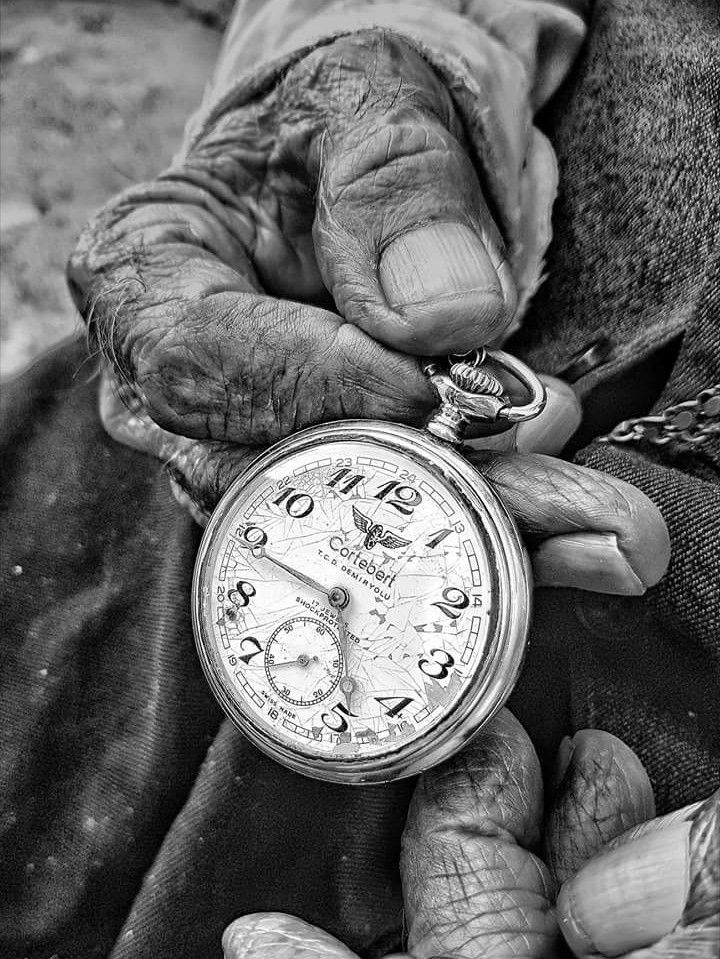
Elias Turner had fixed watches for fifty-three years before his hands began to fail him.
The tiny gears that once obeyed his touch now slipped between trembling fingers. Customers stopped bringing him their broken pocket watches and heirloom clocks, not because they didn’t trust him, but because time itself had moved on. People wore smartwatches now. Phones told them when to wake up, when to eat, when to sleep, when to hurry. Nobody listened to ticking anymore.
But Elias still did.
Every morning, before sunrise touched the hills of Ashgrove, Kentucky, he opened the dusty little repair shop his father had built in 1948. The sign outside hung crooked, the gold lettering faded by decades of rain and heat:
TURNER WATCH & CLOCK REPAIR
Inside, the smell of machine oil and old wood lingered like memory itself. Shelves overflowed with silent clocks waiting for second chances. Some had been abandoned years ago. Others belonged to people who had died before returning to collect them.
Elias repaired them anyway.
“Everything deserves another chance to tick,” he used to tell his grandson Noah.
But Noah hadn’t visited in nearly seven years.
That was the part that hurt most.
Not the arthritis.
Not the unpaid bills.
Not even the loneliness.
It was the silence between family members who once loved each other deeply.
Noah had left Ashgrove at eighteen after a bitter argument with his father, Daniel. The fight had started over money but ended with words too sharp to take back. Noah packed his truck and drove to Chicago that same night. Since then, birthdays passed without calls. Christmas cards stopped coming. Daniel pretended not to care.
But Elias knew better.
Every evening, his son sat on the porch staring down the empty road as though regret might someday drive back home.
One cold October afternoon, Elias discovered an old silver pocket watch buried inside a drawer beneath stacks of faded receipts. He didn’t remember seeing it before.
The watch was beautiful despite its cracked glass. Delicate engravings curled around the edges, and on the back were three initials:
M.T.W.
Elias opened the cover carefully.
The watch wasn’t ticking.
But inside the lid was a tiny handwritten message:
FOR THE MAN WHO NEEDS MORE TIME.
Elias frowned.
He had repaired thousands of watches in his life, but something about this one felt strange. Heavy. Important.
He placed it beneath the magnifying lamp and began working.
Hours passed unnoticed.
Outside, rain tapped against the windows while darkness swallowed the town. Elias cleaned the gears, adjusted the spring, replaced a fractured jewel bearing with one salvaged from another broken watch.
Finally, near midnight, he wound it gently.
Tick.
The sound echoed unnaturally loud.
Tick.
Tick.
Then everything in the room changed.
The air grew warmer.
The lights flickered.
And suddenly Elias heard laughter.
Not outside.
Inside the shop.
He froze.
At first he thought memory was playing tricks on him. But then he saw movement reflected in the glass cabinet near the wall.
A boy ran through the room.
Young Noah.
Eight years old, barefoot, laughing while holding a jelly donut in both hands.
Elias nearly dropped the watch.
Behind the boy came Daniel, younger by decades, pretending to chase him with exaggerated stomps.
“You get powdered sugar on my clocks and your grandma’s gonna blame me!” Daniel shouted, laughing.
The scene lasted only seconds before fading like smoke.
Silence returned.
Elias stared at the watch in disbelief.
His chest tightened painfully.
The watch had shown him the past.
For the next week, Elias experimented carefully.
Every time he wound the pocket watch, moments from the past appeared around him. Not random moments — meaningful ones. Lost pieces of life.
He saw his late wife Clara dancing in the kitchen while snow fell outside.
He saw Noah fishing beside the river, proudly holding his first trout.
He saw Daniel crying alone the night Noah left town.
That memory shattered Elias the most.
Because his son had whispered something into the darkness no father thought anyone heard.
“I should’ve told him I was proud of him.”
Elias realized then that regret ages people faster than time ever could.
The watch became an obsession.
But the more he used it, the weaker he grew.
Dark circles formed beneath his eyes. His hands shook harder. Sometimes he forgot what day it was.
Still, he kept winding the watch.
One evening, while replaying memories of Noah as a child, Elias noticed something strange.
The memories were changing.
In one vision, Noah suddenly looked directly at him.
Not through him.
At him.
“Grandpa?” the boy whispered.
Elias stepped back in terror.
The image dissolved instantly.
That night he barely slept.
The next morning, there was a knock at the shop door.
A woman stood outside wearing a gray coat soaked by rain. She looked to be in her forties, with tired eyes and nervous hands.
“You’re Elias Turner?” she asked.
“Yes.”
She hesitated before pulling out an old photograph.
Elias recognized the man instantly.
Michael Theodore Warren.
M.T.W.
The initials on the watch.
“He was my father,” she said quietly. “Before he died, he told me to find you.”
Elias felt cold all over.
“He said you would eventually repair the watch,” she continued. “And when you did, you’d need to hear the truth.”
She stepped inside and closed the door.
“My father didn’t make that watch,” she whispered.
“He found it.”
The rain outside intensified.
Elias listened carefully as she explained.
In 1961, Michael Warren had worked as a railroad engineer in Pennsylvania. One winter night, after a derailment near an abandoned mining town, he discovered the pocket watch inside the coat pocket of a dead man.
There was no identification.
No missing persons report.
No record of the man existing at all.
But Michael soon realized the watch could show moments from the past.
At first he used it to relive happy memories.
Then he became addicted.
He stopped sleeping. Stopped eating. He lost his family, his sanity, nearly his life.
“Before he died,” the woman said, voice trembling, “he warned me about one thing.”
Elias swallowed hard.
“What thing?”
She looked directly into his eyes.
“The watch never shows memories by accident.”
A silence fell between them.
Then she said the words that made Elias’s blood run cold.
“It shows the moment you most need to change before it’s too late.”
That night Elias sat alone in the shop staring at the pocket watch resting on the table.
Tick.
Tick.
Tick.
For the first time, he was afraid to wind it.
But eventually, with trembling fingers, he turned the crown once more.
The shop disappeared.
And suddenly Elias stood beside a hospital bed.
Machines beeped softly in the darkness.
An older Daniel sat in a chair, exhausted and gray-haired.
Beside him stood Noah.
Older now.
Broken.
Crying.
Elias looked toward the bed.
And saw himself lying there motionless.
Noah gripped his grandfather’s hand tightly.
“I came too late,” he whispered through tears.
Then Daniel placed a shaking hand on his son’s shoulder.
And after years of silence, the father finally spoke the words both of them had waited nearly a decade to hear.
“Come home.”
The vision ended instantly.
Elias gasped for breath.
The pocket watch stopped ticking.
And for the first time in years, Elias understood something terrifying:
Time doesn’t heal families.
People do.
The next morning, before dawn broke over Ashgrove, Elias picked up the phone and dialed the one number he had never stopped memorizing.
Chicago answered on the fourth ring.
“Hello?”
Elias closed his eyes.
“Noah,” he whispered, voice cracking. “It’s Grandpa.”
And on the other end of the line, silence turned into breathing.
Then breathing turned into tears.
The old watch rested quietly on the counter beside him.
As though its work had only just begun.
The rain hadn’t stopped in Ashgrove for three straight days when Noah finally crossed the state line back into Kentucky. He told himself he came because of the phone call. Because his grandfather sounded weak. Because guilt had become too heavy to carry anymore.
But deep down, Noah knew something else had pulled him home.
Something unfinished.
Something waiting.
And when he stepped inside Turner Watch & Clock Repair for the first time in seven years, he noticed the strange silver pocket watch immediately. It sat motionless on the counter beneath the dim lamp, cracked glass gleaming softly in the shadows. Elias covered it with his hand almost protectively.
Then Noah saw the fear in his grandfather’s eyes.
Not fear of dying.
Fear of what the watch might show next.
