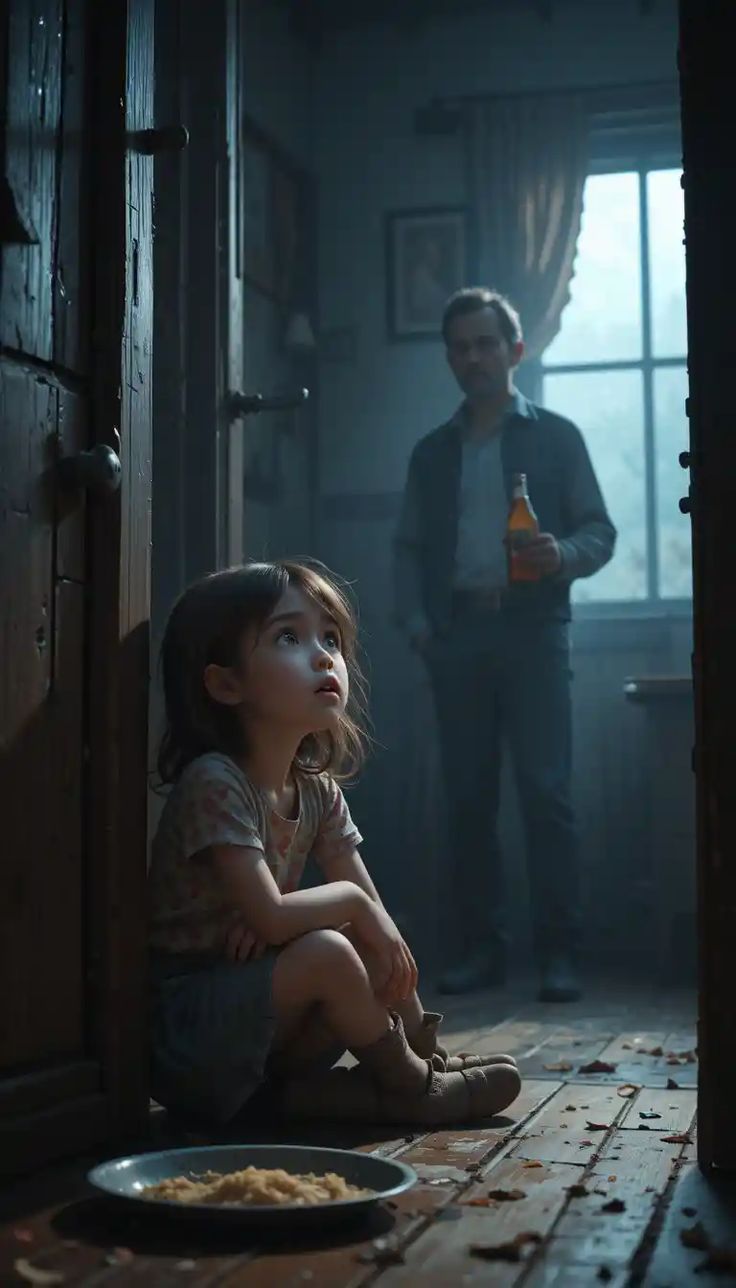
She had names for all the water stains on the ceiling.
The large one above the door was Gerald. Gerald was shaped like a sleeping bear and had been there since before Gracie could remember, which meant he had been there since always, which meant he was as permanent as anything in her life got. The smaller one near the window was Margaret — rounder, softer at the edges, the kind of shape that looked like it was trying to become something more specific and hadn’t quite decided yet.
Gracie was seven years old and she had learned, with the quiet ingenuity of children who grow up in unpredictable houses, to make the ceiling interesting. This was a skill. She understood it as such, the same way she understood her other skills — the ability to read the sound of footsteps and know from their weight and rhythm whether to stay where she was or find a smaller space; the ability to fall asleep with noise happening and wake up in true silence; the ability to be very, very still.
She was being very still now.
Her father stood in the doorway behind her. She could feel him the way you feel weather — not by looking directly at it but by the change in the air around you, the shift in pressure that tells your skin something has changed before your eyes confirm it. He had the bottle. She could tell without turning around. The bottle changed his silhouette in a way she had memorized, the way it altered the angle of his arm, the particular looseness it put in his shoulder.
She looked up at Gerald the sleeping bear and breathed slowly and waited for the moment to decide what kind of moment it was going to be.
The plate of rice on the floor in front of her had been there for an hour.
She had put it there herself, gotten it from the pot on the stove, served herself with the careful precision of a child who has learned that taking care of herself is not a failure of anyone else’s duty but simply a practical matter, the way learning to tie your shoes is a practical matter. She was good at the stove. She was careful with the burner. Her teacher, Mrs. Patterson, had once said that Gracie was extraordinarily self-sufficient for her age, and Gracie had not known whether to be proud or sad and had settled on both simultaneously, which she was also good at.
The rice had gone cold. She didn’t mind cold rice. You ate what was there and you were glad it was there and you didn’t spend energy on the distance between what was there and what you wished was there, because that distance was not closeable tonight and energy was finite.
Her father’s name was Paul. He was thirty-four, which Gracie knew because she had done the math from his birthday, which was in March. He had brown hair that needed cutting and eyes that were the same color as hers, which was the thing about him she thought about most when she was trying to remember who he was before the bottle changed him each evening into someone adjacent to her father but not quite him.
There was a him that existed between nine in the morning and approximately four in the afternoon. That him made pancakes on Saturdays and knew all the words to songs from the seventies and had once spent an entire Sunday afternoon teaching Gracie how to identify three constellations from the backyard. That him called her Gracie-bird and laughed at things she said and sat with her sometimes in a silence that was warm rather than watchful.
She loved that him without reservation.
The other him required a different set of skills.
“Hey,” her father said. His voice had the soft, unfocused quality it got, the way a photograph goes blurry when the camera moves at the wrong moment.
“Hey, Daddy,” she said. She kept her eyes on Gerald.
“You eat?”
“Yeah.”
He made a sound that was not quite a word. She heard him shift his weight, the particular sound of his shoes on the broken tile she had been asking him to fix for two months. He moved to the window and stood there, and she could tell from the quality of his stillness that tonight was not a loud night. There were loud nights and quiet nights and the quiet nights were better though not in the way that quiet usually meant better, because this quiet had a weight to it, a density, the quiet of someone standing at the bottom of something deep.
She picked up her rice. Ate it slowly. Kept her breathing even.
After a while she said, without turning around: “Daddy. What’s Orion?”
A pause. She felt him come back slightly, the way he sometimes did when she said something that reached the him underneath the other him.
“Hunter,” he said. “He’s a hunter. Three stars in a row, that’s his belt.”
“We saw him. From the backyard.”
“Yeah.” Another pause. “Yeah, we did.”
She put her plate down. She looked up at Gerald and Margaret and the seven other stains she had named and she thought about the backyard and the three stars in a row and the him that knew their names.
“Can we look again sometime?” she said. “At the stars.”
The silence lasted long enough that she began to build a roof over her hope, the way she always did, the protective architecture of a child who has learned not to leave hope exposed to weather.
Then her father said, quietly, in a voice closer to the morning voice: “Yeah. We can do that.”
She didn’t turn around. She didn’t want to see which version of his face had said it. She wanted to keep it as just a voice, the right voice, promising something small and astronomical and possible.
She looked up at Gerald. Gerald looked like a sleeping bear. Everything, for this moment, was exactly what it was, and she was still here inside it, and the stars were outside, and she knew their names.
