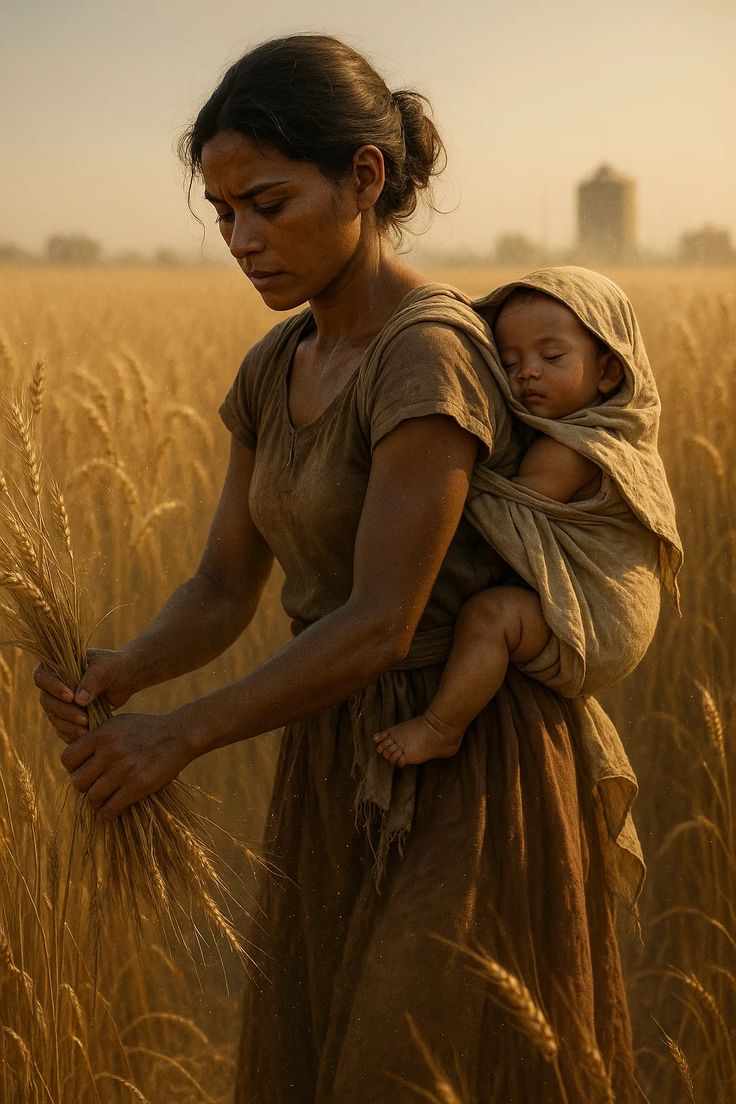
She counted the rows the way other women counted other things.
Prayers. Pills. Days since the last phone call that didn’t end in a dial tone. Rosa counted rows because rows were concrete, rows were progress, rows were something that moved you measurably from one end of the day to the other, and on a morning like this — the air already thick at six a.m., the Kansas sky the color of old brass, the baby sleeping against her back with the absolute trust of someone who has not yet learned that trust requires evidence — measurable progress was the only kind she could afford to believe in.
She was twenty-nine years old and she had been working this field since she was seventeen. Not this field exactly. Fields like it. The particular grammar of wheat — the way it moved in wind like a conversation between things that had no voices, the way it smelled at harvest, the way it cut your hands if you weren’t careful and sometimes even when you were — this grammar was the first language her body had learned, before English was fully comfortable, before she understood the difference between a work visa and a promise.
The baby’s name was Lucia. She was four months old and she slept the way babies sleep when they are carried — deeply, completely, surrendered to the motion of her mother’s body the way sailors surrender to the motion of a ship, trusting the vessel entirely.
Rosa had not slept more than three hours in four months.
She kept moving through the wheat.
The farm belonged to a man named Gerald Hatch, who was seventy-one and had inherited it from his father and had spent fifty years being simultaneously proud of it and exhausted by it, which was a relationship that Rosa recognized and respected. Gerald was not a cruel man. He was not particularly a kind man either. He was a practical man, which in Rosa’s experience was sometimes better than kind and sometimes considerably worse, depending entirely on what the practical calculus of a given moment required.
He had hired Rosa six years ago through a labor contractor whose name Rosa had since forgotten, because that was how these things worked — there was always a name in the middle that dissolved over time, leaving only the arrangement itself, the field and the worker and the space between them where the wage lived.
When Lucia was born, Gerald had said Rosa could bring her to the field if she kept working at the same pace. He had said this as if it were generosity, and Rosa had accepted it as such because the other option was not working, and not working was not an option, and the space between those two facts was where her entire life currently resided.
She kept working at the same pace.
What Rosa thought about while she worked was not what people assumed women in fields thought about.
She had been asked, twice, by journalists with cameras and the particular bright concern of people who have recently discovered a problem — what do you think about out there? The implication was suffering. The implication was that the field was a site of pure endurance, a theater of hardship that she was simply waiting to escape.
She thought about Lucia’s hands. The specific architecture of them, the way the fingers curled in sleep, the impossible miniature of her fingernails, which Rosa trimmed every Sunday with a pair of scissors she kept cleaner than anything else she owned.
She thought about the wheat. About the fact that wheat has been growing in this part of Kansas for a hundred and fifty years, that the ground under her feet had been turned by hands before hers and would be turned by hands after hers, and that there was something in this continuity that was not comforting exactly but was real in a way that comforted her anyway. She was part of a long line of people who had put their hands into this soil and made something from it. That was not nothing.
She thought about her mother, in Oaxaca, who had worked fields too and who had told Rosa before she left, standing at a bus station at four in the morning: the work is the same everywhere. The ground doesn’t know what country it’s in. Your hands won’t either, after a while. Learn to love what you can reach.
Rosa had spent twelve years learning what that meant.
By midmorning the heat had settled fully and Lucia was awake, making the small observational sounds of a baby cataloguing the world — the gold of the wheat, the blue pressing through the brass of the sky, her mother’s voice talking her through the rows the way Rosa had been talked through everything that mattered.
“This is wheat,” Rosa said, in the Spanish she was saving Lucia like a gift. “This is what we grow. This is what the bread is made from. When you eat bread, you will know where it began.”
Lucia grabbed a stalk with both hands, the way she grabbed everything — completely, without reservation, with the total commitment of someone who has not yet learned that some things are worth holding more carefully than others.
Rosa let her hold it.
She looked up at the water tower on the horizon, the one that marked the edge of the Hatch property, the one she used to gauge how far she’d come and how far remained. It was the fixed point of her days. She had looked at it ten thousand times. She knew exactly how long it took to walk from where she stood to where it stood, and she had done the math, in the way that people who are saving money do the math, the kind of math that is really a kind of prayer — how much, how long, how many more seasons before the number she needed became the number she had.
Three more harvests. Maybe two, if the yield was good and Gerald paid what he had promised rather than what he remembered promising.
She adjusted Lucia on her back, felt the small warm weight settle, and moved to the next row.
The wheat closed behind her like a door, golden and indifferent and full of everything she was working toward.
