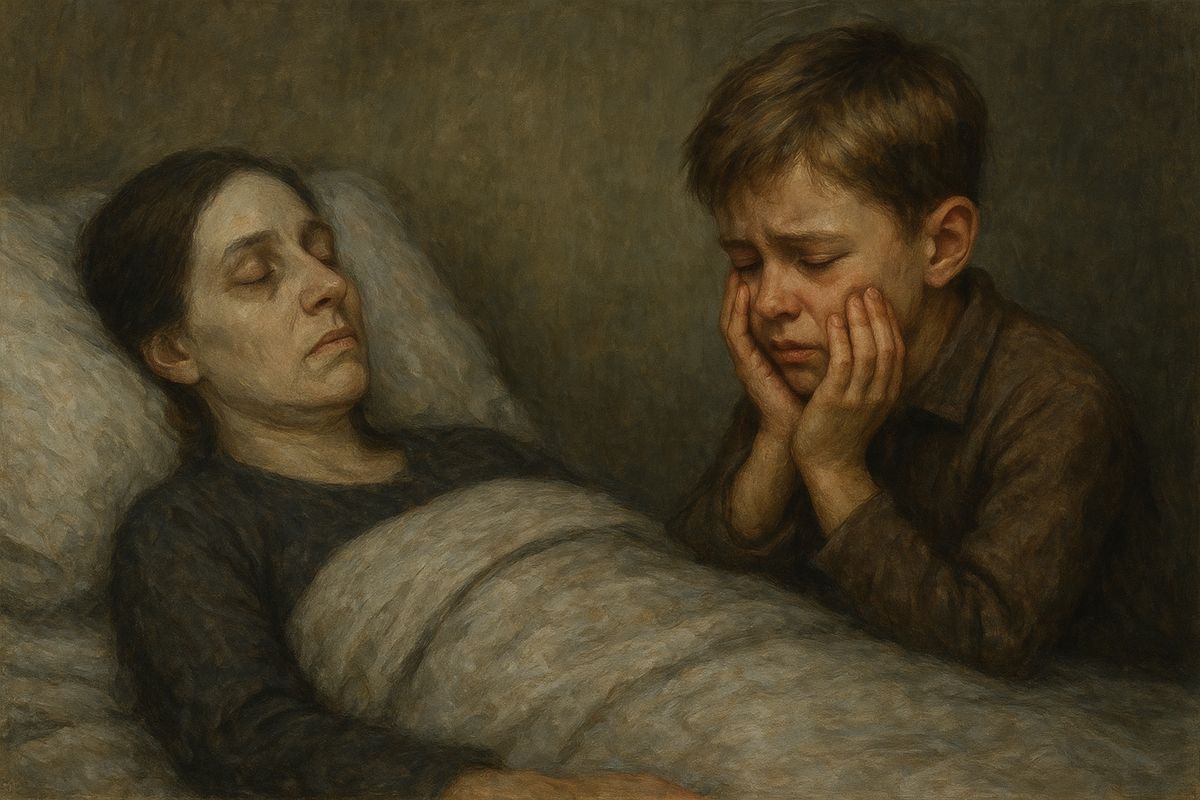
He had been watching her breathe for three hours.
Not because anyone told him to. Not because there was anything he could do about the breathing or the not-breathing or any of the territory that existed between those two things. But because he was ten years old and his name was Owen and watching his mother breathe was the only job available to him in a world that had suddenly reorganized itself entirely around a thing he did not fully understand and could not fix and could not leave alone.
He had his face in his hands. He had put it there the way people put their faces in their hands when they are trying to hold something in, and also hold something out, simultaneously, which is an impossible task but one the body attempts anyway because the body is optimistic in ways the mind has already abandoned.
His mother’s name was Claire. She was thirty-eight. She had dark hair that was spread against the pillow in a way that made her look, Owen thought, like she was simply sleeping, like this was an ordinary Tuesday night and she had simply gone to bed early and he had come in to say goodnight and found her already under and had stopped at the bedside the way you stop when someone you love is sleeping because the sleeping of people you love has a quality to it that makes you want to stand near it without disturbing it.
But it was not an ordinary Tuesday night.
The illness had a name that Owen could pronounce but not fully comprehend, the way you can say a word in a foreign language correctly without knowing what it means. Encephalitis. The doctors had explained it three times in three different ways and each time Owen had nodded and understood the individual words and lost the meaning somewhere between hearing it and holding it.
What he understood was this: his mother’s brain was inflamed. The inflammation was causing her to sleep more than she was awake. The doctors were treating it and were cautiously optimistic and were monitoring her closely, which were phrases Owen had also memorized without fully metabolizing.
What he understood in his body, which was a different kind of understanding, was that his mother had been the fixed point of his entire world and the fixed point was now horizontal and very still and the world was therefore spinning in a way it had not previously spun.
His father, Greg, was in the hallway making phone calls. Owen could hear the low register of his voice through the door — the specific tone of a man delivering information he is still getting used to himself, the voice people use when they are being strong for someone on the other end of a call while standing in a hospital hallway being not strong at all.
His father was handling things. This was what his father did. Owen understood that handling things was a form of love, that the phone calls and the conversations with doctors and the insurance paperwork that his father had already started were all expressions of care made practical. He understood this intellectually.
But handling things required being in the hallway, and Owen was in here, and the distance between the hallway and in here was twelve feet and felt considerably larger.
His mother had been sick before. Small sick — the colds and the flus and the one time she had broken her wrist falling on ice in the driveway and had made jokes in the emergency room that made Owen laugh despite everything, because she was the kind of person who made jokes in emergency rooms, who brought her full self to inconvenient situations and refused to let the inconvenience be the main character.
She was the kind of person who remembered which lunch he preferred on Mondays versus Thursdays. Who had read every book in his school’s reading list before he got to them so they could talk about them. Who drove forty minutes each way to his chess club every Wednesday without complaint, who sat in the parking lot reading while he played and never made him feel the weight of the forty minutes.
She was the kind of person who knew when he was sad before he knew it himself, who would simply appear beside him with the particular radar of mothers who have tuned themselves to their children’s frequencies so precisely that the child’s internal weather becomes legible to them in advance.
She was the kind of person who, when she was well, filled every room she entered with a quality of attention that made the people inside it feel fully seen.
She was very still now and the room was very quiet and Owen had his face in his hands and was watching her breathe.
He reached out and put his hand over hers.
Not to wake her. Not to ask anything of her. Simply to complete a circuit, to restore a connection that the illness had interrupted in one direction but not, he believed, in both. His mother was somewhere inside the sleeping, he was certain of this — somewhere inside the inflammation and the medication and the deep unreachable quiet of it, she was still his mother, still tuned to his frequency, still receiving.
“I did my homework,” he said. Quietly, to the room. “Math and English. I did them in the waiting room.”
He told her this because it was the kind of thing she would want to know, and because telling her the ordinary things felt like a way of insisting that the ordinary still existed, that there was a world outside this room that was still running on its regular schedule, that he was still in it, that he was managing.
He was managing. He was ten and he was managing in the way that children manage the unmanageable, which is imperfectly and completely and with everything they have.
“Dad’s in the hallway,” he said. “He’s calling Aunt Ruth.”
The breathing continued. Even. Steady. The most important sound in the world, reduced to its simplest form.
Owen kept his hand over his mother’s hand and talked to her about the ordinary things and outside the window the evening happened without them, the city maintaining its enormous indifferent hum, and inside the room a boy held his mother’s hand in the particular silence that exists between what we are afraid of and what we refuse to accept, which is sometimes the bravest place a human being can occupy.
