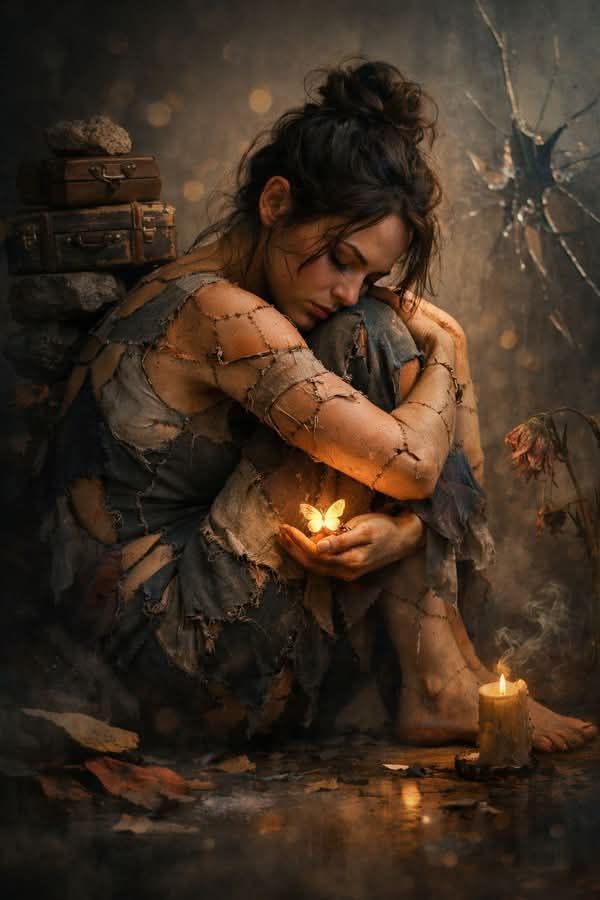
She had been sitting in the ruins of herself for so long that she had started to mistake them for a home.
This was the most dangerous part. Not the breaking — the breaking had happened all at once, the way serious breaks do, sudden and total and unmistakable. You knew when you were breaking. The dangerous part was after, when the rubble became familiar, when you learned the shape of every jagged edge and stopped cutting yourself on them because you had memorized where they were, when the darkness stopped being absence of light and started being simply the atmosphere of your life, when you arranged the broken pieces into something resembling furniture and called it surviving and told yourself that surviving was enough because you had forgotten — genuinely, completely forgotten — what enough actually felt like from the inside.
Her name was Vera. She was thirty-four. The suitcases stacked behind her contained everything she had carried out of the life she had lived before the breaking, which was less than you would think and heavier than it looked, because the weight of suitcases is never really about what’s inside them.
She had been sitting here — in this particular configuration of darkness and cold stone and guttered candles — for what felt like a very long time. Months, in the real world. In the interior world, where the clocks ran differently, it felt geological. It felt like something that had always been true about her, something she had been working toward her entire life without knowing it, the way rivers work toward the sea.
She was holding a butterfly.
Not a real one. She understood this. She was not so far gone that she had lost the line between real and not real — she had lost other lines, many other lines, but not that one. The butterfly in her hands was the last small light she had managed to keep, the thing she had cupped between her palms when everything else went out, the belief — irrational, stubborn, present despite all available evidence — that something living was still possible.
She had read once that the Japanese mend broken pottery with gold, that they fill the cracks with precious metal rather than hiding them, that the philosophy behind this practice holds that the history of something breaking is part of what makes it beautiful. She had read this at a different time in her life and filed it under interesting. Now she sat in the dark and thought about it differently, thought about what it would mean to be the pottery rather than the person holding it, to be the thing that had been broken and was waiting for someone to decide whether the cracks were worth the gold.
She was not sure anyone was coming with gold.
She was not sure she was worth the gold.
This was the thought she had been living inside. This was the temperature of the air in the ruins she had furnished with her broken pieces and called surviving.
The candle near her feet had nearly burned down. She watched it with the detached attention she had developed for small things, having found that small things were the only scale she could currently manage. The large scale — her life, her future, the question of what came next and whether next was even a concept that applied to her — the large scale was a country she did not have the passport to enter. But the candle she could watch. The way the flame bent in drafts she couldn’t feel. The way the wax ran and pooled and hardened into new shapes at the base, which was its own small argument about transformation that she noticed without yet being able to use.
Before the breaking she had been someone who operated entirely at the large scale. She had been a landscape architect in Portland, Oregon — the kind of work that required you to see a vacant lot and hold in your mind simultaneously what it was and what it could become, to plant things whose full beauty was a decade away and trust that the decade would arrive. She had been good at this. She had been professionally optimistic in the most literal sense, paid to believe in futures she would not personally see completed.
She had not been good at applying this professionally to herself. She had given all her forward vision to other people’s spaces and arrived at thirty-four with a beautiful portfolio and a life that had not been tended with the same care.
The relationship that broke her was not dramatic. This was the thing she couldn’t adequately explain to the people who asked — there was no villain, no single catastrophic event. It was four years of gradual diminishment, so incremental that she had not identified it as diminishment while it was happening, had called it compromise, had called it adaptation, had called it what you do when you love someone, until the morning she woke up and tried to locate herself and found so little remaining that the shock of it was retroactive — the grief not of something newly lost but of something long gone that she was only now discovering the absence of.
She had sat down in this darkness and she had not yet found a reason to stand.
The butterfly pulsed in her hands.
She looked at it — this small impossible light she had kept — and thought about the potter’s gold, and thought about the candle’s wax finding new shapes at the base, and thought about the lots she had planted with things whose beauty was a decade out, and thought about the decade arriving, reliably, in every case, regardless of whether she had been there to see it.
The decade always arrived.
She looked at the butterfly and she thought: I used to know how to see what something could become. I did it every day. I was paid for it. I was good at it.
She had just never turned it toward herself.
The candle guttered. The butterfly held its light. Vera sat in the ruins she had mistaken for a home and felt, for the first time in months, the specific sensation of something shifting — not healing, not yet, not even close to yet, but the precondition of healing, the moment when the stone under you stops feeling permanent and starts feeling like a place you are resting before you rise.
It was small. It was the smallest possible version of hope. She held it the way she was holding the butterfly — carefully, with both hands, without squeezing.
She did not let it go.
