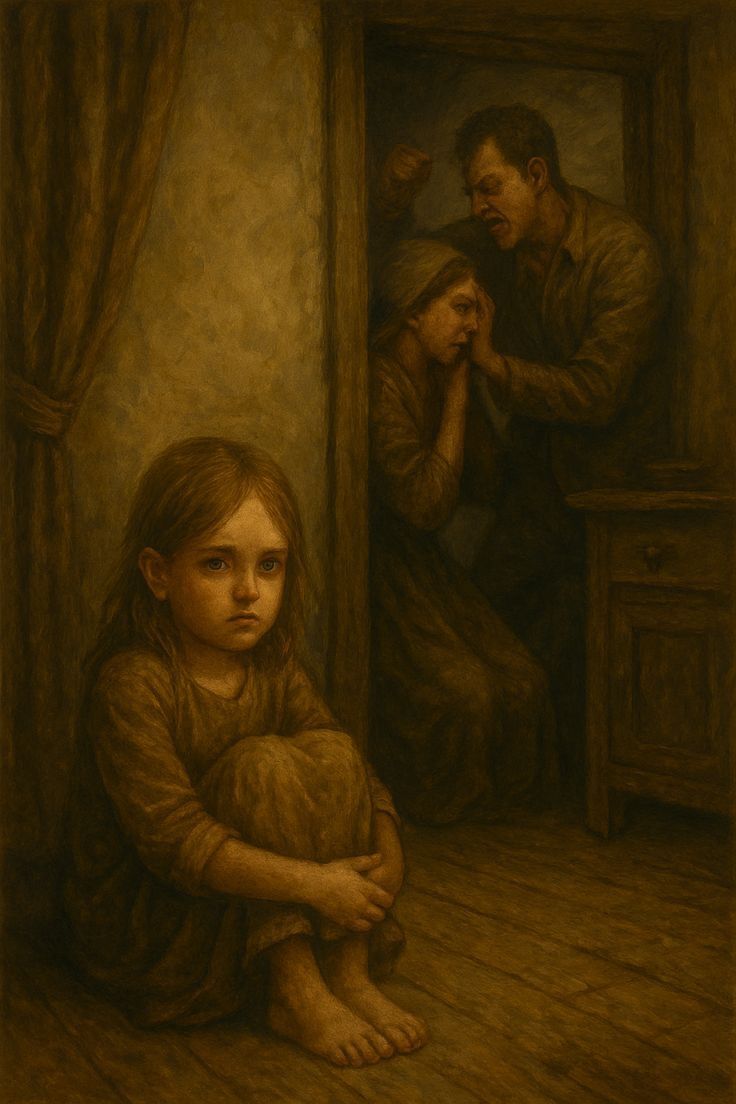
She had learned to make herself small in the specific way that children learn things — not through instruction but through repetition, through the body memorizing what the mind was still too young to name.
Small meant knees to chest. Small meant back against the wall where two surfaces met and made a corner, because corners were the only geometry in a house like this that reliably held. Small meant eyes open and forward because closing them didn’t make the sounds stop, it only made you unable to track where the sounds were moving, and tracking where the sounds were moving was information, and information was the only currency available to an eight-year-old girl in a house where the adults had stopped managing what they brought inside.
Her name was Alice. She had hair the color of autumn and eyes that had developed, young, the particular quality that eyes develop in children who have learned to watch carefully — a steadiness, an attention, an ability to read a room from across it that adults sometimes mistook for maturity and that was not maturity at all but simply the adaptation of a child who needed to know things in advance.
Behind her, through the doorway, her parents were doing what they did. This was how she had categorized it at some point — not fighting, because fighting implied an equality of combatants, a match between opponents who had chosen their positions. What her parents did was more like weather. You didn’t fight weather. You tracked it, you prepared for it, you found shelter and you waited for it to pass and you assessed the damage after.
She was in the shelter. She was waiting.
Her father’s name was Ray. He was thirty-six and had once, before the years that had accumulated into the man who stood in that doorway, been someone her mother had chosen and her mother did not choose carelessly. Alice knew this from photographs and from the stories her Aunt Bev told, always in the past tense, always with the specific quality of someone describing a country they had loved that no longer existed in its original form.
He had been funny, apparently. He had been the kind of man who fixed neighbors’ cars on Saturdays and remembered everyone’s birthdays and made her mother laugh from across a room with a single look. Alice tried, sometimes, to find this man in the one currently standing in the doorway, and occasionally she caught glimpses — early mornings before the day’s arithmetic began, or sometimes on Sundays when things were quiet and he would sit beside her on the porch and they would watch the street together and he would be close enough to the man in the photographs that she could almost reach him.
The job had ended. The job had ended and other things had filled the space the job left, and Alice understood in the way children understand things they cannot yet fully articulate that the man in the doorway and the man in the photographs were both real and that the distance between them was a wound, not a character, and that wounds could sometimes be treated but only if the person carrying them acknowledged they were there.
Her father had not yet acknowledged this.
Her mother, Ellen, was thirty-four. She was in the doorway too, bent toward herself in the posture that Alice recognized as the posture of endurance — not defeat, not yet, because Ellen was not a person who arrived at defeat easily, but the posture of someone expending enormous energy in the maintenance of a position that a reasonable person would have surrendered months ago.
Ellen stayed because of Alice. Alice understood this too. It was the kind of understanding that felt like a weight rather than a comfort, the knowledge that your existence is the load-bearing wall of someone else’s endurance, which is both precious and terrible when you are eight and have no way to set it down.
Alice had a teacher named Mrs. Fontaine who had noticed her in September.
Not with alarm — or not only with alarm. With the specific attention of someone who has learned to see past the surface presentations of children to what the presentations are covering. Mrs. Fontaine was sixty-one and had been teaching second grade in Cincinnati for thirty-three years and had developed, across those thirty-three years, what she called in her own private language her weather eye — the ability to look at a child and know when the child was carrying something that did not belong to a child.
Alice carried it with extraordinary composure. This was the thing that Mrs. Fontaine noted first — not distress, not the behavioral signals that the training described, but composure. A too-still quality. An alertness that belonged to a much older person. The ability to move through a school day without leaving a mark on it, to be present without requiring anything, to have learned so completely the lesson of making yourself small that she had applied it even in spaces where it was not necessary.
Mrs. Fontaine began leaving books on Alice’s desk. Not assigned. Not discussed. Simply left — novels and stories about children who had navigated difficult terrain and found the other side, left with the specificity of someone who had read them recently and thought about who else might need them.
Alice read every one. She never mentioned them.
But Mrs. Fontaine noticed, in the way she noticed things, that Alice began to sit slightly differently at her desk. Not dramatically. Not in any way that would register to someone who hadn’t been watching. But fractionally upright. Fractionally more present. Fractionally less like someone waiting for the next piece of weather.
It was small. It was the size of a book left on a desk without explanation. But Mrs. Fontaine had been teaching for thirty-three years and she understood that the size of the intervention never predicted the size of the result, that the right small thing at the right moment in a child’s life could reroute a trajectory in ways that played out across decades, invisibly, in the lives that child would eventually build.
She left another book on Monday. And another the following week.
She was patient. She had time. Alice, she had decided, was worth every bit of both.
