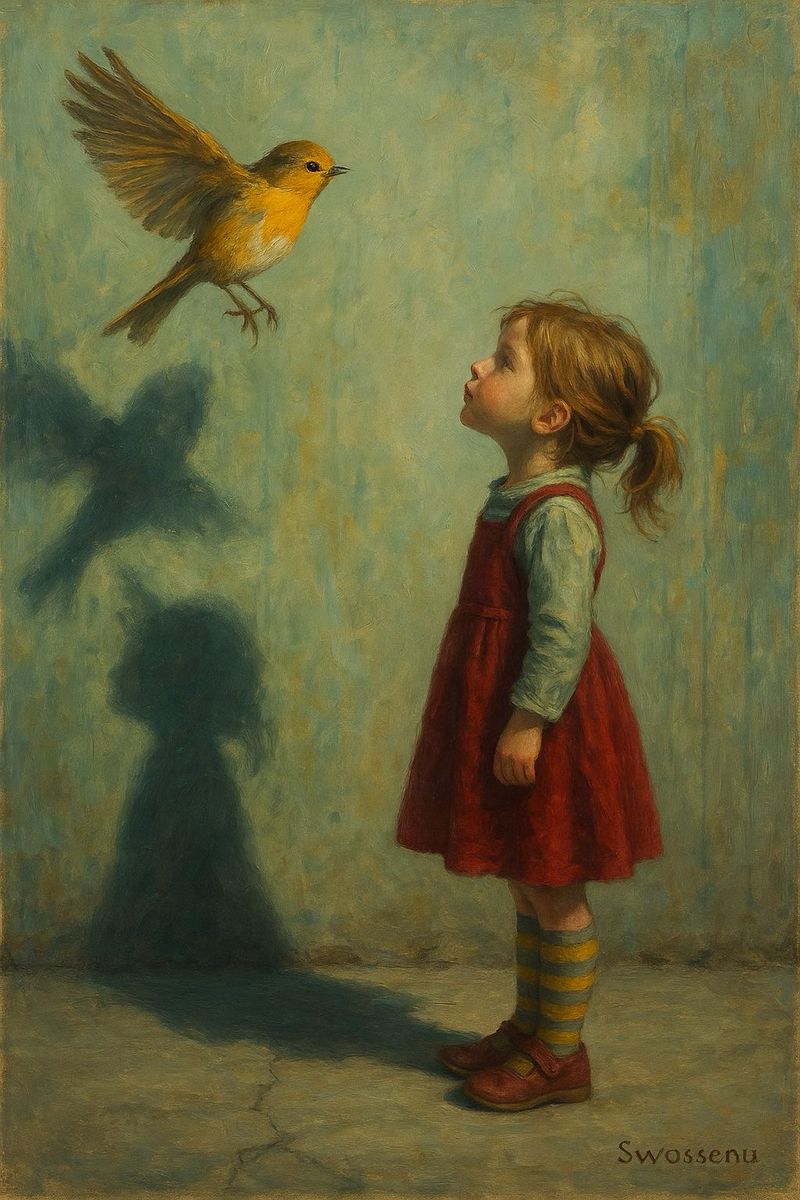
Nobody else could see it.
This was the first thing Lily understood about the bird, on the morning it appeared in the backyard of their house in Asheville, North Carolina, hovering at eye level in a way that birds of its size did not hover, looking at her with the specific attentiveness of something that had come a long distance with a purpose. It was golden and rust-colored, the size of a large sparrow, and it had arrived on the Tuesday morning three weeks after Lily’s grandmother died, and Lily was four years old and certain in the complete and undefended way that four-year-olds are certain about things they have not yet been taught to doubt.
Her mother was inside. Her father was at work. The yard was cool and the light was the particular early light that made everything slightly more itself than usual, and the bird was there, and Lily looked at it, and the bird looked at Lily, and neither of them moved for what felt like a very long time.
“Nana,” Lily said.
Not as a question.
Her grandmother’s name had been Rose. She had been sixty-seven and had lived twelve minutes away and had been the fixed point of Lily’s universe in the way that certain people become the fixed points of small children’s universes — not through grand gestures but through consistent, specific presence. Rose had been the person who taught Lily the names of birds from a laminated card they kept on the kitchen windowsill. She had been the person who made the particular scrambled eggs, the only scrambled eggs Lily would eat, done in a way that nobody else had successfully replicated. She had been the person who called every morning at eight and said Lily’s name in a voice that made the name feel like it had been chosen specifically and carefully for exactly her.
Three weeks ago the calls had stopped. The house twelve minutes away had become a house that Lily was not taken to anymore, at least not yet, because the adults around her were navigating their own geography of loss and could not simultaneously navigate hers and theirs.
Lily had been told, carefully and kindly and with the specific vocabulary recommended by the pediatrician who had been consulted, that Nana had died. That dying meant gone. That gone meant not coming back.
Lily had listened to all of this and then had gone to the backyard and sat in the grass and looked at the sky and said, to no one specifically: but what if something comes back anyway.
The bird had come back anyway.
It came every morning for the following week. Always in the backyard, always at approximately eight o’clock, which was the time the phone used to ring. Always at exactly Lily’s eye level, which required a kind of hovering that her father, who was an engineer and noticed things like this, would have found difficult to explain, had he ever seen it, which he did not, because the bird was never there when anyone else was looking.
Lily did not find this suspicious. She found it entirely appropriate. Some things, she understood with the clean logic of four years old, were for specific people.
She began talking to it. Not asking it questions, because she understood that whatever the bird was, it was not a telephone, that communication in this direction did not work the way communication used to work. She talked to it the way she had talked to Nana — reporting, updating, narrating the details of her days that she had previously saved for the eight o’clock call. The eggs her mother had made that were not the same. The book she had read three times because it was about a dog and Nana had read it to her once in a specific voice and reading it herself meant she could almost hear that voice if she read it slowly enough. The striped socks she was wearing because Nana had given her striped socks and wearing them felt like wearing something that still knew Nana’s hands.
The bird listened with its whole body, the way certain creatures listen — completely still except for the slight movement of its head, tracking her, present.
Her mother, June, discovered the ritual on the fifth morning.
She had come to the back door to call Lily for breakfast and had stopped in the doorway when she saw her daughter standing in the yard, head tilted back, addressing the empty air with the complete seriousness of someone in an important conversation. June stood very still and listened, and what she heard dismantled her in the quiet way that grief sometimes dismantles people — not suddenly but by removing, one by one, the supports that have been holding the structure upright.
She heard Lily tell the empty air about the scrambled eggs. She heard Lily describe the striped socks in the careful detail of someone making sure the listener had the full picture. She heard Lily say, at the end: I looked for you in the robin book but you are not a robin. You are more orange. Nana, what kind of bird are you?
June had her hand over her mouth. She was a scientist — she taught biology at the community college, she understood ornithology at a level that precluded most of what her daughter was apparently experiencing. She stood in the doorway of her own house and listened to her four-year-old daughter’s one-sided conversation with a grief too large for a small body to hold alone and felt, with the precision of someone trained to observe, that something was happening in her backyard that mattered more than explanation.
She did not call Lily in for breakfast.
She went quietly back to the kitchen and took out the laminated bird card from the windowsill — the one Rose had left at their house, the twin of the one on Rose’s own windowsill twelve minutes away — and she waited until Lily came inside, pink-cheeked and somehow lighter than she had been in three weeks, and she put the card on the table between them.
“Tell me what it looks like,” June said. “We’ll find it together.”
Lily looked at the card. She looked at her mother. Something passed between them that neither of them could name but both of them felt — the particular current of two people deciding, together, to take something seriously that they might separately have let go.
“It’s very orange,” Lily said. “And it looks at me like it already knows my name.”
