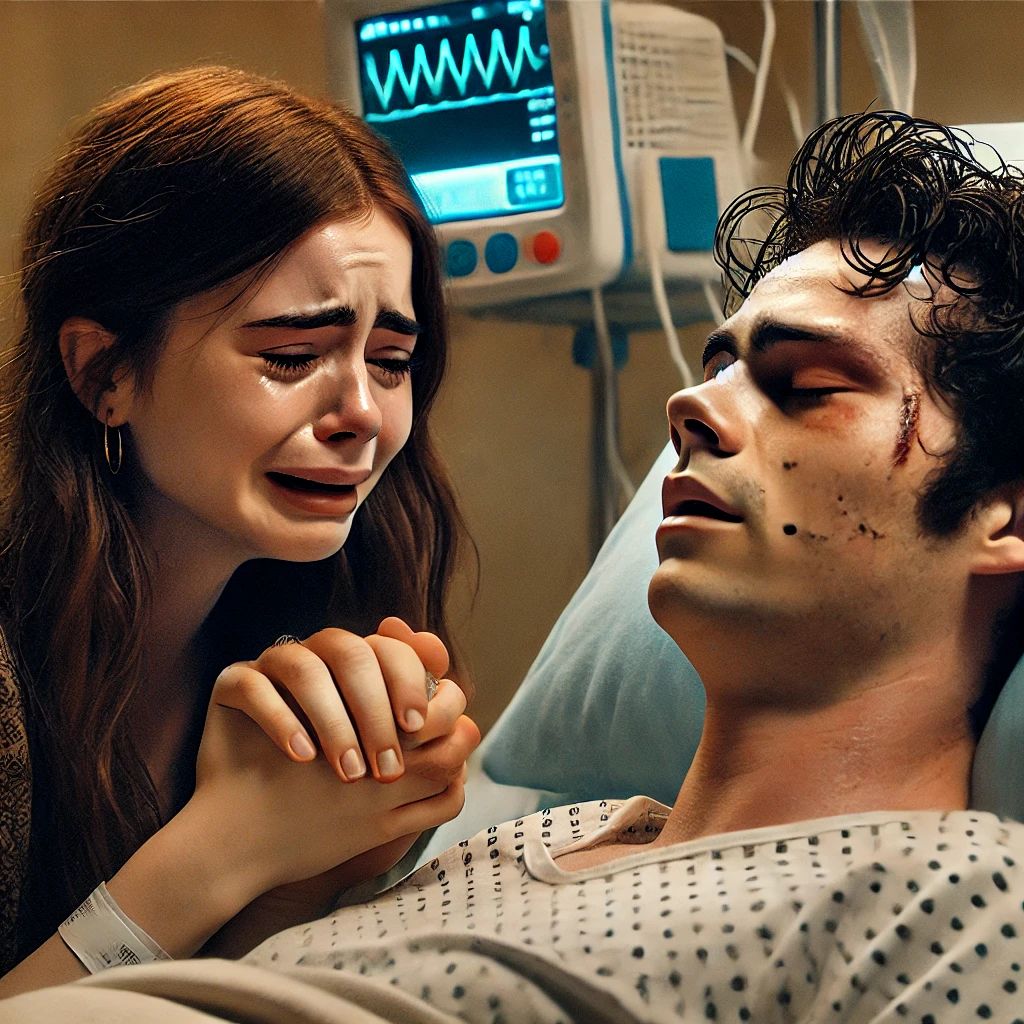
The monitor above his bed told her he was alive in the only language it knew.
Peaks and valleys. Green light on a dark screen. The rhythm of a heart that had, against considerable odds and the initial assessment of two paramedics who had exchanged a look over his body that she had seen and would never forget, decided to keep going. She had been watching that monitor for six hours and she knew now the precise shape of each peak, the exact interval between them, the way the line moved with the specific personality of this particular heart — the heart she had fallen asleep listening to approximately three hundred times in the past two years, pressed against his chest in the dark of his apartment on Maple Street, convinced in the way you are convinced of things when you are twenty-three and in love for the first time with the right person that she knew every language this person’s body spoke.
She had not known it spoke this one.
His name was Marco. He was twenty-five. His face was a geography of damage — the road rash across his cheekbone, the cut above his brow that the ER team had closed with eight stitches while she sat in a plastic chair in a hallway and held herself together by cataloguing everything she could see from where she was sitting, which was a method she had developed in childhood for surviving overwhelming moments and which had served her reliably until tonight, when the things she could see from where she was sitting were not helping.
She held his hand in both of hers. She pressed her knuckles against her mouth. The monitor made its steady indifferent sound.
The accident had happened at 7:43 PM on a Wednesday.
She knew this because the detective — young, tired, carrying the particular exhaustion of someone who delivers this kind of news professionally and has not yet found a way to make it not cost him something — had told her when he came to the waiting room. 7:43 PM. Marco had been on his motorcycle on Route 9, heading west, when a car had run the light at the intersection of Route 9 and County Road 4 and struck him at a speed that the detective described with the careful precision of someone who understood that the family members of victims need specific information to make the experience real enough to process.
The car had not stopped.
This was the fact that Sarah returned to, between the peaks on the monitor, like a tongue finding a sore tooth. The car had not stopped. Someone had done this and driven away, and Marco was in this bed with his face like this and his chart full of words she had been googling on her phone and wishing she hadn’t, and somewhere in the ordinary Wednesday evening of this New Jersey city a person was doing whatever people do after they have broken something this important and decided not to be accountable for it.
She was twenty-three and she had not previously understood the full weight of the word accountable. She was understanding it now.
They had met at a coffee shop. This was not a remarkable origin story — they had met at a coffee shop the way people meet in coffee shops, through the accumulation of small repeated observations that eventually cross the threshold from noticing to needing-to-speak. He had been there every Tuesday and Thursday morning, always the same corner table, always a book, always the same order that she had memorized before she knew his name. She had been working the counter. He had left tips that were extravagant for a graduate student and she had told him once that he didn’t have to do that and he had said he wanted to and that had been the beginning of understanding that Marco was a person who did what he wanted to do rather than what was expected, not out of selfishness but out of an unusual honesty about what he actually valued.
What he valued, she had come to understand across two years, was specific and consistent: his work — he was studying environmental engineering, studying it with the focused love of someone who had known since childhood what they were supposed to do with their life; his family, his mother and two sisters in Trenton who he drove to see every Sunday; the motorcycle, which Sarah had never liked and had said so, with the exact frequency that a person says things about the choices of someone they love — enough to register her position, not so much as to make it a condition.
She wished now she had said it more. She wished now she had said it every day. She understood this was not rational.
At two in the morning the doctor came in and spoke to her in the careful calibrated language of someone delivering a prognosis that was neither the worst case nor the best case but the actual case, which was always messier than either extreme and required more from the people receiving it. There was swelling. There was monitoring. There were the next twenty-four hours, which were the hours that mattered most and about which the most honest thing the doctor could say was that they would know more when they were through them.
She thanked the doctor. She turned back to Marco.
She leaned close to him, the way she had seen people in movies lean close to unconscious people and had always found slightly theatrical, and now understood was simply the body’s insistence on closing the distance when distance is intolerable.
“I need you to listen to me,” she said, quietly, to his face and the damage on it and the heart that was still making its peaks on the green screen. “I know you probably can’t hear me. I’m going to say it anyway because I have been not saying things my entire life and I am done with that.” She pressed her forehead briefly against his hand. “The coffee shop is still open and your corner table is still there and I need you to come back and sit in it and I need you to do it soon because I have things to tell you and I am significantly better at telling them to you than I am at telling them to a monitor.”
The peaks continued. Even. Steady. Possibly listening.
She settled into the chair and held his hand and prepared to wait for as long as the waiting required.
