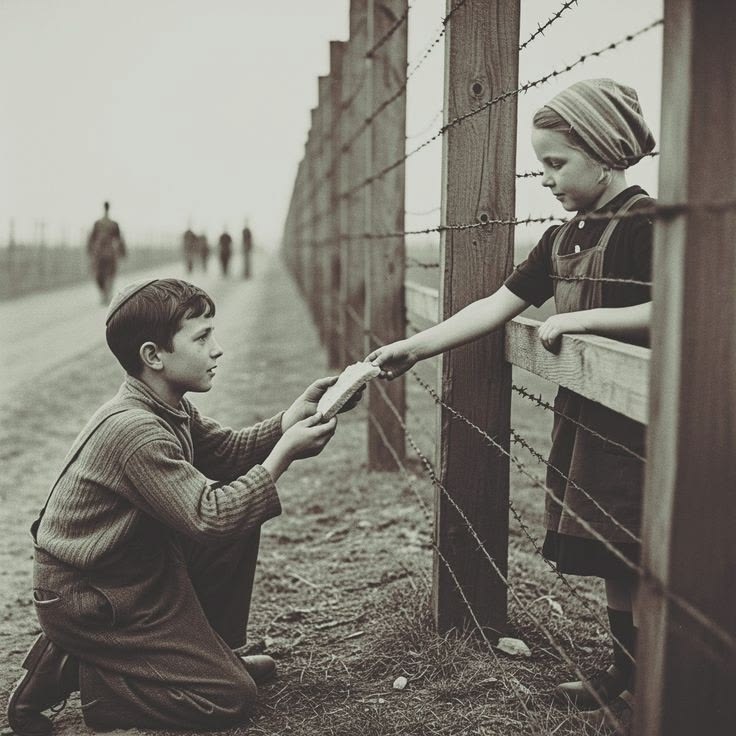
The fence was not supposed to have anything on the other side of it worth looking at.
That was the design of it — the deliberate, engineered dehumanization of it, the way it reduced everything beyond its wire to category rather than person, to problem rather than face. The barbed wire ran in three parallel lines along the top, and the posts were sunk deep in the Polish mud, and the whole apparatus communicated in the clear and universal language of absolute prohibition: nothing passes here. Nothing connects here. The people on one side of this wire are not the concern of the people on the other side, and anyone who forgets this will be reminded in terms that leave no room for ambiguity.
Jakob Weiss was eleven years old and had been inside the fence for four months and had learned many things in those four months that eleven-year-olds are not supposed to learn.
He had learned that hunger is not one thing but many — that it changes over days and weeks from an acute, specific pain into something ambient, a constant low-frequency signal that the body eventually stops processing as emergency and begins accepting as weather. He had learned that cold is similar. He had learned that the men who walked the perimeter with their rifles were easier to be around when they were bored, and more dangerous when they were not. He had learned to become very small in the presence of authority — to compress himself, his eyes, his posture, his entire volume of presence — in the way that children in dangerous places learn to make themselves harder to notice.
He had learned that his father was gone and that his mother’s eyes had changed in a way he did not have words for and that his sister Miriam, who was eight and had before all of this believed with complete confidence that the world was essentially good, had gone very quiet in a way that frightened him more than anything the guards did.
What he had not learned — what four months of wire and cold and systematic degradation had not yet taught him — was that kindness was not possible here.
He was about to be reminded of this in the way that changes a person permanently.
Her name was Anna Breckenridge and she was ten years old and she lived on a farm two kilometers from the camp with her father, who grew potatoes and tried not to know things, and her mother, who knew everything and kept it inside her like a stone.
Anna had seen the camp from a distance. Everyone in the district had seen it from a distance — the gray block shapes of it, the smoke that rose from it at certain hours, the sounds that came from it on still days when the wind ran the wrong direction. The adults in her life had developed an elaborate architecture of not-seeing, the way adults construct, out of fear or complicity or the simple human need to continue functioning, a wall between themselves and the knowledge that would require them to act.
Anna had not yet built this wall. She was ten. The wall takes years of practice.
She had begun coming to the fence three weeks ago. Not with any plan. She had been walking the field road that ran along the perimeter — a route she had taken since childhood, before the camp existed, when the field beyond the wire had been someone’s farmland — and she had seen a boy on the other side. Just standing. Looking at nothing. Wearing a face that she did not have words for at ten years old but that she would spend the rest of her life knowing she had seen.
She had come back the next day with bread.
It had become a thing of extreme precision and terror.
She came in the early afternoon, when the guard rotation created a gap — she had mapped this over three weeks with the observational accuracy of a child who understands, at a cellular level, that the stakes are absolute. She came through the field, not the road. She wore the dark coat. She moved along the fence line casually, the way you move when moving casually is the most important performance of your life.
Jakob was always there.
She did not know how he knew. He was simply always at that section of fence, crouching in the mud, when she arrived. As if he had been waiting. As if waiting had become one of the few activities available to him.
They did not speak the same language. This turned out not to matter very much.
She pushed the bread through the lowest wire — flat pieces, folded small, that her mother baked and did not ask Anna about and that Anna’s father did not see because he had perfected not-seeing to a degree his daughter had not and could not achieve. Jakob received it with both hands, with a care that the bread itself did not require but that the act of giving it did — the recognition, in the gesture, that this was not simply food but something else, something that the wire was designed to prevent and that was passing through it anyway.
Sometimes he looked at her. Really looked — not the compressed, invisible look he used for the guards, but the full open look of someone emerging briefly from a very long submersion.
She looked back. Also fully.
This was the thing the fence was designed to prevent. Not bread. The looking. The recognition of personhood across the wire — the insistence, conducted in silence and in terror and in complete defiance of every apparatus of ideology and power arrayed against it, that the person on the other side was a person.
She was ten. He was eleven. They conducted this insistence with the matter-of-fact courage of children who have not yet learned that certain kinds of courage are supposed to be extraordinary.
The day it almost ended was a Thursday in November.
Anna had come through the field in the dark coat, bread flat against her ribs, watching the guard in his tower with the peripheral attention of someone who has learned to see without appearing to look. She reached the section of fence. Jakob was there.
She knelt. She reached through.
He reached back.
Their hands met around the bread in the space between the wires — her fingers, cold from the November air, against his, which were colder — and for a moment neither of them moved. Not a long moment. A necessary one. The length of time it takes for two human beings to communicate, across every apparatus erected to prevent exactly this communication, the simple and radical message: I see you. You are real. You matter to me.
A sound from the guard tower. A movement.
Anna withdrew her hand. She was already moving, casually, the dark coat, the field, the practiced innocence of a child who is not doing anything worth noticing.
She did not look back. Looking back was the mistake. She had learned this.
Behind the wire, Jakob held the bread against his chest and became very still and very small and watched the guard and breathed.
He ate the bread slowly that night in the dark, the way you eat things that are more than they appear to be — carefully, with full attention, making it last. He gave half to Miriam. He did not tell her where it came from. Some things you keep, not from selfishness but because the keeping is a kind of protection.
He lay in the dark and thought about the cold fingers and the bread passing through the wire and the face of a girl he did not know and would probably never speak to and who had, for reasons he could not explain and didn’t need to, decided that he was worth the risk.
He fell asleep holding this.
In the morning, the hunger was the same. The wire was the same. The cold was the same.
But something was different in the specific geography of his chest, in the place where four months of systematic dehumanization had been doing its slow and deliberate work.
Something that the fence had not accounted for.
Something that bread, passed through wire by a ten-year-old girl in a dark coat, had quietly, stubbornly, impossibly kept alive.
