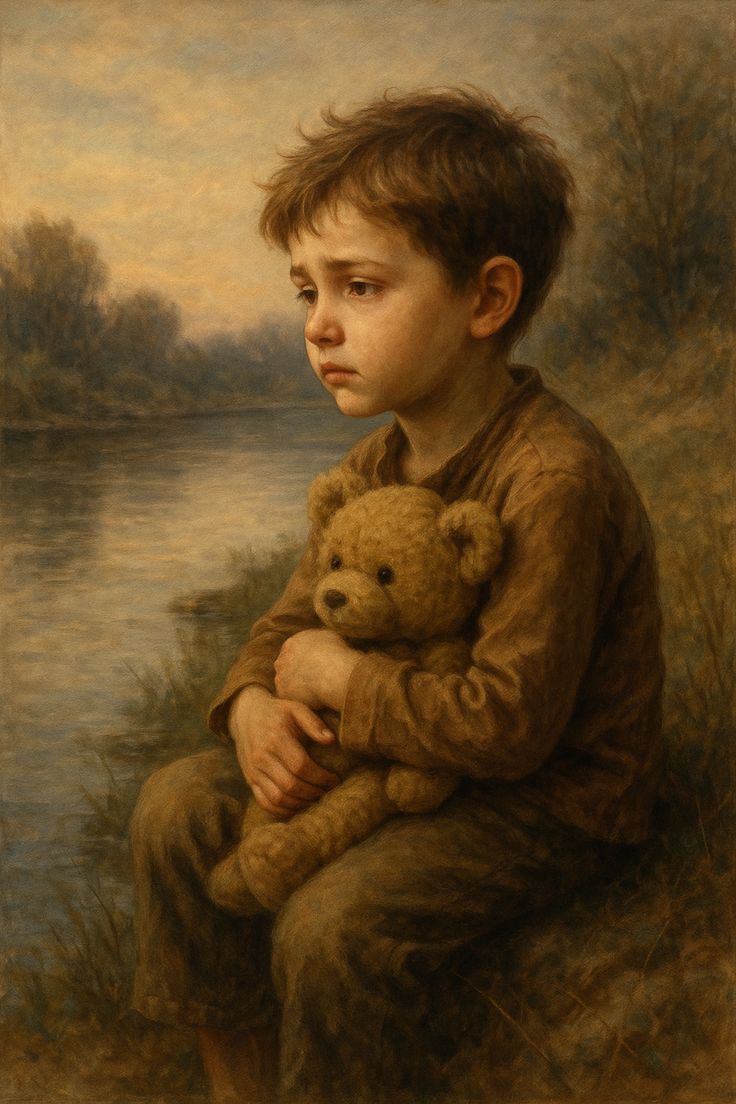
His name was Samuel, and he was six years old, and he had been sitting by the river for a long time.
Not lost. He knew exactly where he was — the bend in the Millhaven River behind the old Carver property, three-quarters of a mile from the house, where the bank flattened out and the grass grew tall enough to make a kind of room if you sat down in it, a private room with a river view and no roof and no one in it but you. He had been coming here since he was four, when his legs were shorter and the walk took longer and his mother had not yet stopped noticing when he left.
He was not lost. He was hiding, which is a different thing entirely — hiding requires knowing exactly where you are while making yourself difficult for the world to locate.
Samuel was very good at hiding. He had been practicing for two years.
The teddy bear’s name was George. George was four years old, which made him ancient in the accounting of beloved things — his fur worn smooth in the places that hands go most often, his left ear slightly flattened from being held against faces in the dark, his button eyes patient and reliable in the way that objects that have been loved thoroughly become reliable. Samuel held George against his chest with both arms in the particular grip of a child who has learned that some things can be taken without warning and so must be held with appropriate attention.
He was looking at the river.
The river did not look back, which was one of the things he liked about it.
The house had been loud again last night.
Samuel organized his understanding of the world around this variable — the loudness of the house — the way other children organized theirs around weather or school schedules. There were loud nights and quiet nights, and the loud nights had a particular texture that he had learned to read in advance the way animals read approaching storms: a shift in atmospheric pressure, a change in the quality of the silence before it broke.
He could tell by the way his father’s keys sounded in the door. There was a Tuesday-evening key sound and a different key sound, and Samuel could distinguish between them from his bedroom with the door closed and the television going and George held firmly against his chest.
Last night had been the different key sound.
He didn’t have words for what happened in the house on those nights. He had sounds — the particular sounds that adults make when the parts of them that are supposed to stay inside come outside, the sounds of things breaking that were not always the sounds of objects. He had feelings — the specific topography of a child’s fear, which is different from adult fear because it contains no agency, no capacity for intervention, no exit that does not require passing through the source of the danger.
What he did was what he had always done: he held George, and he made himself as small and as still as possible, and he waited for the loud to become quiet again.
But something had happened this time that had not happened before.
Something that Samuel was sitting by the river trying to understand.
He had come outside into the morning after — the particular morning-after quiet that settled over the house like sediment after a storm — and he had found, on the kitchen table, a suitcase.
Not a travel suitcase. His father’s duffel bag, the big green one that had always lived on the shelf in the closet, now sitting on the kitchen table already zipped, already finished, already decided.
His mother had been at the counter with her back to him, and she had not heard him come in, and for a moment he had stood in the doorway of the kitchen observing the two things — the bag on the table, his mother at the counter, her shoulders doing the thing they did when she was very still on the outside and very not-still on the inside — and he had understood something that he did not have the language for and that his body had processed before his mind did, a cold and settling understanding that rearranged something in his chest.
Then she had heard him and turned and her face had done the thing faces do when adults are trying to become something other than what they are for the sake of the child watching them.
She had smiled. It was the kind of smile that costs something.
“Morning, baby,” she had said.
Samuel had looked at the bag. He had looked at her. He had said nothing because he was six and there was nothing in his six years of vocabulary adequate to the questions he was carrying.
He had taken George from his room and walked out the back door and come to the river.
He had been here for two hours now.
The river moved the way it always moved — with the comfortable, unhurried certainty of something that has been doing this for a very long time and has no doubt about the direction. Samuel watched it. He found, as he always found, that watching something move continuously and purposefully was a kind of answer to something, even when he couldn’t have said what the question was.
A dragonfly appeared above the water. Hovered. Disappeared.
He held George tighter.
Here was what he knew, organized as well as a six-year-old can organize the things that are too large for him: his father was loud sometimes and quiet sometimes and the loud was getting louder and last night had been the loudest and this morning there was a bag on the table.
Here was what he didn’t know: everything else.
Here was what he was afraid of, in the specific wordless way of a child whose fear is larger than his language: that loud and quiet were the only two settings available, and that the removal of the loud might also, somehow, remove something he needed, some structural element of the architecture of his days that he would not know he depended on until it was gone.
He did not know if this made sense.
He was six. He did not yet know which of his feelings made sense and which did not. He felt them all with equal, undiscriminating intensity.
He pressed his face into George’s worn head.
The river kept moving.
The woman who found him was not his mother.
She was a neighbor — Eleanor Marsh, sixty-eight, a retired schoolteacher who walked the river path every morning for her knees and had been doing so for eleven years and knew this bend in the Millhaven intimately, knew its moods and its light and its birds, and knew that there was not usually a small boy sitting in the grass by the water with a teddy bear held against his chest and the particular expression on his face that Eleanor, who had spent thirty years with children, recognized immediately and precisely.
She had stopped on the path. She had looked at him. She had made the decision that experienced people make in the presence of a child who is not lost but is very much in need — not to make it big, not to approach with the alarming energy of an adult in rescue mode, but to simply and quietly reduce the distance.
She sat down on the bank. Not next to him — a respectful distance, where her presence was available without being imposed.
She said nothing for a while.
Samuel looked at her sideways with the wariness of a child who has learned that adults sometimes make things louder.
She was looking at the river.
“It’s a good river,” she said finally. Not to him specifically. Just to the air.
Samuel considered this. “It goes all the way to Clarksburg,” he said, because this was a fact he knew and facts were solid when other things were not.
“It does,” Eleanor agreed. “And further than that, eventually.”
They sat with this information.
“Everything goes further than you can see from where you’re sitting,” she said, after a while. Still to the air. Still to the river. “That’s the thing about rivers.”
Samuel held George and thought about this with the serious, total attention of a child processing something that he suspects is meant for him.
