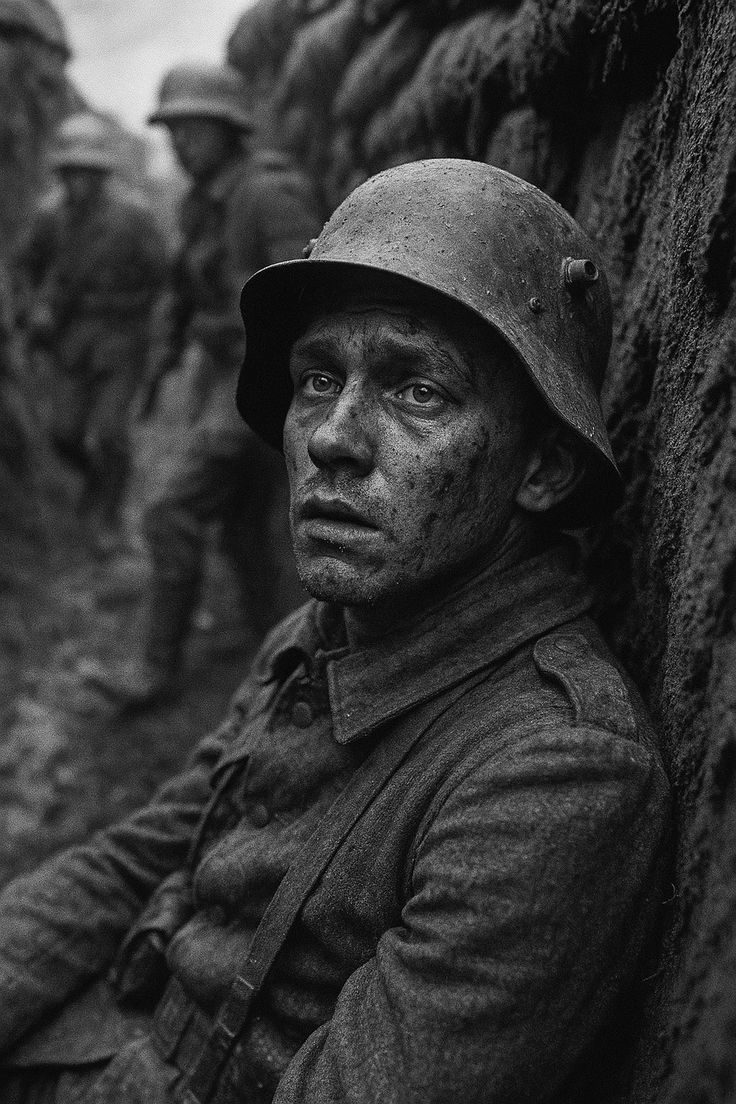
His name was Thomas Edward Calloway and he was nineteen years old and he was thinking about his mother’s kitchen.
Not the war. Not the mud that had worked itself so completely into every seam and fold of his uniform that he had stopped being able to remember what dry felt like. Not the sound that the artillery made when it came in close — that particular descending shriek that the body learned to respond to before the mind caught up, dropping you into the earth by pure animal instinct before conscious thought had processed the danger. Not the faces of the men to his left and right in this trench, which stretched in both directions like a wound in the Belgian earth, deep and wet and smelling of things he would never be able to describe to anyone who hadn’t been here.
He was thinking about his mother’s kitchen in Millhaven, Ohio. The yellow curtains she’d made herself from fabric she bought at the dry goods store on Clement Street. The way the morning light came through those curtains and fell across the table in a particular slant that turned the wood grain gold. The sound of the percolator. The smell of biscuits — she made them every Sunday morning, had made them every Sunday morning of his entire life, a ritual so reliable that it had become, in the way of reliable things, invisible until it wasn’t there anymore.
He would give most of what he had left for a biscuit right now.
He had been in France for seven months. He had arrived in the spring of 1918 with the 37th Infantry Division — Ohio boys, most of them, farm kids and factory kids and the occasional college boy who had enlisted for reasons that made more sense in September 1917 than they did in the mud of Flanders in October 1918.
Thomas had enlisted because his best friend Eddie Marsh had enlisted and Thomas had not been able to construct an argument against it that didn’t sound, in the climate of that particular autumn, like cowardice. His father had gripped his shoulder at the train station and said nothing, which was how his father expressed the things that mattered most. His mother had given him three things: a Bible, a photograph of the family taken in front of the house on Maple Street, and a letter in an envelope she had sealed with wax — actual wax, pressed with her thimble, the way her own mother had sealed letters — with the instruction that he was to read it only if he needed to.
He had carried the letter in his breast pocket for seven months, through the Atlantic crossing and the training camp in England and the arrival in France and seven months of this — this particular education in what human beings are capable of doing to each other and to the earth they stand on.
He had not opened it yet.
He was not sure whether this was strength or stubbornness. He suspected it was the thing that lived between them.
The trench was quiet in the particular way of quiet that men here had learned to parse with great attention. There was the quiet that was simply quiet — the guns resting, the artillery pausing for reasons strategic or logistical or random — and there was the quiet that was accumulation, the held-breath silence before something happened. Every man in the 37th had learned to tell the difference. The ones who hadn’t were mostly not telling anything anymore.
This was the first kind of quiet. Thomas could feel it.
He had his back against the trench wall, which was shored up with timber and sandbags and in some places just faith, and he was looking at the strip of gray Belgian sky visible above the trench lip. The sky here was never quite the same as Ohio sky. Ohio sky was open, permissive, the kind of sky that suggests possibility. Belgian sky in October was low and dense and the color of old pewter, and it pressed down on you in a way that was not unkind exactly but was completely indifferent to whether you were okay or not.
He reached into his breast pocket. Not for the letter — not yet — but for the photograph. He did this several times a day now, the way a man touches a bruise. His mother, his father, his sister Ruth who was twelve when he left and would be thirteen now, standing on the porch of the house on Maple Street in their Sunday clothes with the collective squinting of people who have been asked to look into the sun for a photograph.
They looked impossibly clean. Impossibly intact. Like things seen through the wrong end of a telescope.
Private Clemmons appeared around the bend of the trench and dropped down beside him without ceremony, the way soldiers do when ceremony has long since been dispensed with.
“Orders came,” Clemmons said. He was from Dayton, twenty years old, had a habit of cleaning his fingernails with a stick when he talked that Thomas had stopped noticing sometime in the third month.
“When?”
“Dawn.”
Thomas looked at the gray sky. Dawn was five hours away.
“Where?”
Clemmons named a ridge. Thomas knew the ridge. Everyone in the 37th knew the ridge. The ridge had a reputation that preceded it the way bad weather precedes itself — you felt it before you arrived.
Thomas put the photograph back in his breast pocket. His hand rested there for a moment over the sealed letter.
Not yet. He wasn’t there yet.
But he looked at the gray sky and did the accounting that men do before difficult things — the private, honest accounting of what you have in you and what the coming hours will cost — and he decided that what he wanted, before dawn, was to write to his mother.
Not the careful letters he had been writing for seven months — the ones that selected and arranged the truth into something survivable for a woman in Ohio. A real one. As real as he could make it.
He reached into his pack for paper that was damp at the edges and a pencil worn to two inches and pressed his back against the Belgian earth and began.
Dear Mama,
I am sitting in a ditch in Belgium which is not as romantic as it sounds, though I expect you guessed that. I am cold and I am muddy and I would commit what crimes remain available to me for one of your biscuits, which I think about more than I would ever admit in polite company.
I am going to tell you some true things now. Not because I want to frighten you but because I think you deserve the truth of where your son is and what he is doing and who he is becoming, which is different from who he was at the train station.
I am different, Mama. Not broken — I want to be clear about that, I am not broken — but the way metal is different after it has been through fire. Not weaker. Just different in its grain.
I have seen things I cannot write and done things I cannot write and lost people I cannot write about yet because the writing would make them more gone and I am not ready for them to be more gone. You will understand this, I think, because you are the person who taught me that some things need to sit in you awhile before they can be spoken.
There is a letter in my pocket that you gave me. I have not opened it. I want you to know that I have not opened it — not because I haven’t needed to but because I think I have been saving it. Keeping it as the thing I open when I need it most.
I think tomorrow may be when I need it most.
So I am writing this first. So that you have something from the me that is here, in this ditch, in this mud, in this gray Belgian night, before whatever happens at dawn changes things in whatever direction things get changed.
I love you in a way I don’t think I understood before I left. The way you only understand a thing when it becomes the distance between you and it.
Your son, Thomas
He folded the letter. He addressed it. He put it in the runner’s bag that would go out at midnight.
Then he reached into his breast pocket and took out the sealed letter. The wax impression of his mother’s thimble, pressed into red wax seven months ago in Ohio, in the kitchen with the yellow curtains, while the percolator made its sounds and the morning light came through at its particular angle.
He opened it.
He read it.
He sat in the mud of Flanders for a long time afterward, very still, with the letter in his hands and something moving through him that was not grief and not relief but the complicated territory between them — the place where a person goes when they have been seen, completely and without condition, by someone who loves them.
He put the letter in his breast pocket, against his heart, where it would stay.
Dawn was four hours away.
He was ready.
