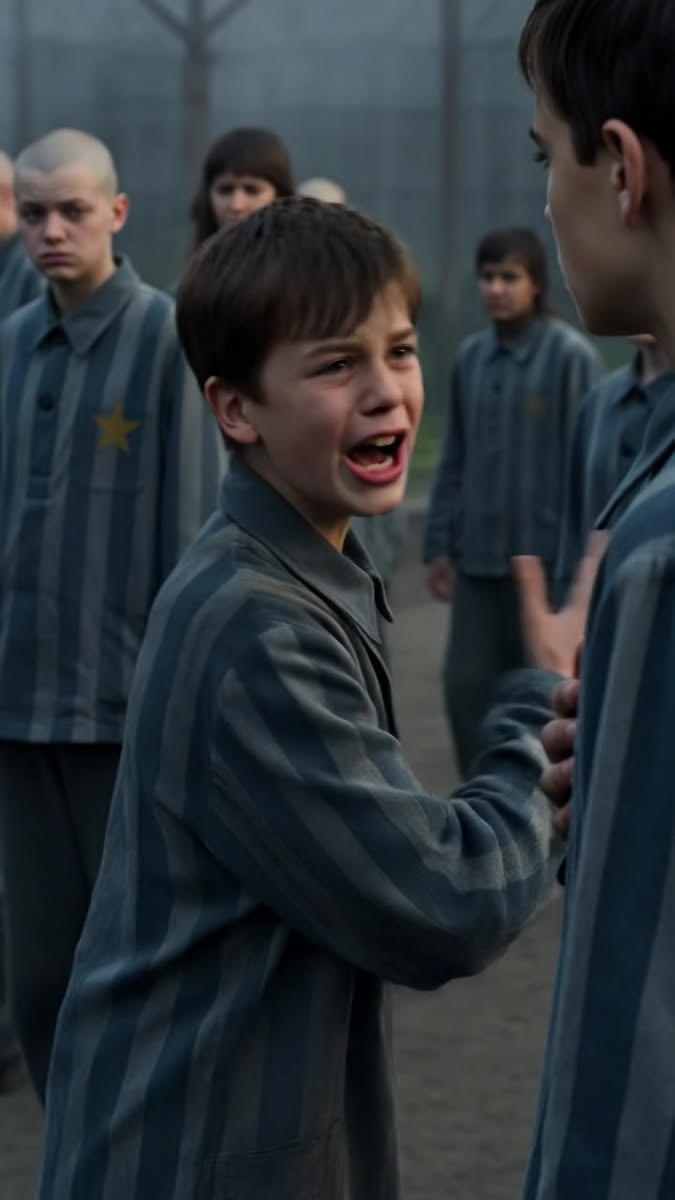
The morning mist still clung to the ground when Bruno first saw him.
He had been wandering along the fence for nearly twenty minutes, kicking at stones and muttering to himself about how unfair everything was — how Father had uprooted the entire family from their beautiful home in Berlin, how he’d left behind his three best friends, how there was absolutely nothing to do in this horrible, flat, empty place. He was nine years old, and he was quite certain that no nine-year-old in the history of the world had ever suffered as deeply as he was suffering right now.
Then he saw Shmuel.
The boy was sitting on the other side of the wire fence, his thin legs folded beneath him, his eyes fixed on something far away that Bruno couldn’t see. He wore the same striped gray uniform as everyone else on that side — a uniform that Bruno had noticed on dozens of people since they’d arrived, though he still didn’t fully understand why they all dressed the same way. The boy had dark circles beneath his eyes, and his wrists, Bruno noticed, were barely thicker than the fence wire itself.
“Hello,” Bruno said, because his mother had raised him to be polite.
The boy blinked and looked up. His eyes were enormous — deep brown, like polished wood — and for a moment he simply stared at Bruno as though he wasn’t sure Bruno was real.
“Hello,” he finally answered.
“My name is Bruno.”
“My name is Shmuel.”
Bruno tilted his head. “That’s a very strange name.”
“So is Bruno,” the boy said quietly, without malice.
Bruno almost smiled. He sat down in the dirt on his side of the fence, and Shmuel sat a little straighter on his. Between them was the wire — hundreds of links of it, stretching endlessly in both directions — but in that moment, it seemed to both of them like something that existed for other people, not for them.
“How old are you?” Bruno asked.
“Nine. My birthday was April fifteenth.”
Bruno’s mouth fell open. “That’s my birthday too.”
They stared at each other through the fence. The mist was beginning to lift, and pale winter sunlight fell across the yard in long, thin strips.
“We were born on the same day,” Shmuel said softly, as though he was working out the mathematics of it.
“In the same year,” Bruno added.
Neither of them said what they were both thinking — that they had entered the world on the same morning, drawn their first breaths within hours of each other, and yet everything, absolutely everything about their lives was different. Bruno had a bedroom with five shelves of books and a tire swing in the backyard. Shmuel slept on a wooden board with fourteen other boys and had not eaten a full meal in longer than he could properly remember.
They began to meet every afternoon.
Bruno told no one — not his sister Gretel, who had become insufferable lately and put up maps on her wall, not his tutor Herr Liszt, who spoke about history as though it were a series of victories rather than a series of people. Certainly not Father, who wore his uniform like a second skin and whose office door was always closed. Bruno simply walked along the fence each day after his lessons, and Shmuel was always there, always waiting, as though their hour together was the only appointment either of them had.
They talked about everything and nothing. About food — Bruno described the chocolate cake their cook Maria used to make in Berlin, and Shmuel listened with his eyes half-closed, and Bruno felt guilty afterward without knowing exactly why. About their fathers — Bruno said his father was very important, which was what he’d always been told, and Shmuel said nothing at all about his father for a very long time, and then one day said only, “He is still here. That is enough.”
Bruno began bringing things. A bread roll wrapped in a napkin. Three pieces of chocolate. A hard-boiled egg. He passed them carefully through a gap at the bottom of the fence, and Shmuel ate them with the focused, deliberate urgency of someone who has learned not to waste a single crumb. Bruno tried not to watch, because watching made something hurt in his chest.
“Why are you all here?” Bruno asked one afternoon. It was the question he had been circling for weeks.
Shmuel looked at him for a long moment. The question was too large, Bruno realized as soon as he’d asked it. It was the kind of question that had no answer a nine-year-old could give or receive.
“I don’t know,” Shmuel finally said. “I used to know. Someone explained it to me. But I don’t understand it anymore.”
Bruno nodded, even though he didn’t understand it either. Father had used words like necessary and historical and a different kind of people, but none of those words explained the fence, or the striped uniforms, or the smoke that rose in the distance every morning and made the air smell strange.
What Bruno understood was simpler than all of it: Shmuel was his best friend. Maybe the best friend he’d ever had, which was remarkable, considering there was a fence between them and he’d only known him for three months.
On the last afternoon — though Bruno didn’t know it was the last afternoon — Shmuel pressed his small fingers through one of the gaps in the wire, and Bruno pressed his fingers back, and they held on like that for a while, two boys born on the same day, standing on opposite sides of something neither of them had built.
“Bruno,” Shmuel said.
“Yes?”
“You are the best person I know on this side of the fence.”
Bruno thought about that. “You’re the best person I know on any side,” he said.
