Walter Hope had exactly one argument with his wife in sixty-one years of marriage.
That wasn’t entirely true — they’d had disagreements, spirited discussions, the occasional cold silence over something one of them had said that needed time to settle before it could be addressed. But a real argument, the kind with raised voices and genuine anger and something at stake — one. And it had happened in the first year, over something so small he couldn’t remember now what it was, and it had ended with Dot sitting on the kitchen floor of their first apartment in Columbus, Ohio, laughing so hard she was crying, and Walter sitting down beside her because her laughing had made him laugh, and that had been the template for the rest of their life together: the conflict always dissolving somehow into the two of them on the same side of it.
He thought about this sometimes. How lucky that was. How many people got that.
He was thinking about it tonight because tonight Dot was yelling at him, and it was a real yell, the genuine article, and he couldn’t hear exactly what she was saying because there was a great deal of noise and heat and the specific chaos of a situation that had, in the space of four minutes, moved from sleeping soundly to something Walter did not yet have adequate words for.
The house was on fire.
He knew this with complete certainty and was surprised to find that his primary response was not fear but focus — the same focus that had served him for thirty-four years as an electrician, the professional brain that assessed and triaged and moved in sequence rather than all at once. The focus that had made him good at his job and that had apparently survived retirement and his seventy-eighth birthday and the slight tremor in his left hand that the doctor called inconsequential and that Walter called annoying.
The bedroom was the last safe room. For now. The hallway was orange and loud.
The window was the option.
He had already established this — had gone to the window, opened it, assessed the drop, determined it was survivable if conducted correctly, returned to the bed for Dot, who had been asleep with the particular profundity of a woman who took a prescribed sleep aid at nine PM and did not surface easily. He had gotten her upright and oriented in under two minutes, which was a personal best.
Now they were at the window.
Biscuit was also at the window, because Biscuit had materialized from wherever beagles go when they sleep — some other dimension, by the evidence — and had inserted himself between them with the specific urgency of a dog who understood the situation with more clarity than anyone was giving him credit for.
“Walter, go first,” Dot said. This was what she was yelling. Her voice was steady under the yell, which was a Dot thing — even scared, she was organized about it.
“You go first,” Walter said.
“You’re taller, you can lower me.”
“You go first and I’ll lower you.”
“That doesn’t make any sense—”
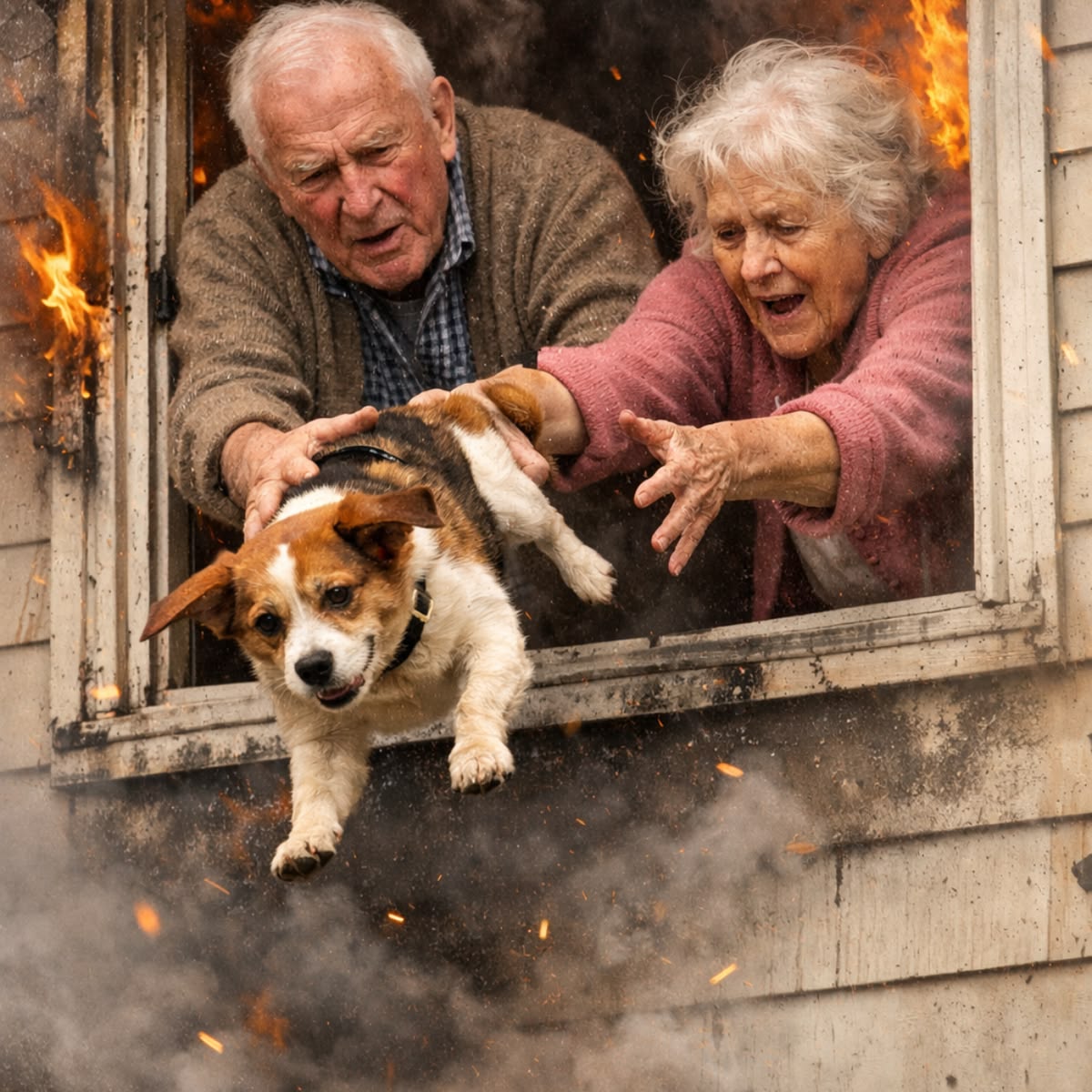
“I’ll go first,” Biscuit indicated, by stepping directly into Walter’s hands, which had been placed on the window sill for structural support and were now functioning as a launch platform for a thirty-pound beagle who had made a unilateral decision.
“Dot!” Walter said, because Dot’s hands were already on Biscuit’s hindquarters and they were jointly performing an action that neither of them had consciously decided to perform.
“He goes first,” Dot said, with the absolute authority of a woman who had raised three children and two previous dogs and understood in her bones the correct order of operations. “He can’t lower himself.”
There was no time to argue and also no argument. Walter got his hands under Biscuit’s chest and Dot guided the back half and together they sent the dog out the window in the least dignified exit of Biscuit’s life, which had included several undignified exits, none quite this dramatic. Biscuit dropped six feet, landed on all four paws with the natural physics of a dog, looked up at them once with an expression that said your turn, and trotted to the safety of the yard.
“Go,” Walter said.
“Together,” Dot said.
“Dot—”
“Walter Eugene Hope, if you think I am going out that window without you, you have not been paying attention for sixty-one years.”
He had been paying attention for sixty-one years. He knew when to argue and when to understand that the argument was already over. He took her hand.
They went out the window together — not gracefully, nothing about it was graceful, Walter going sideways and Dot going forward and both of them making sounds that their children would have been horrified to hear — and they landed in a heap in the flower bed that Dot had planted in April and tended every day since, the one with the black-eyed Susans and the thing she called a coneflower that Walter had never been able to remember the real name of.
They were on the ground. They were outside. The house blazed behind them, orange and enormous, consuming fifty-three years of accumulated life with the total indifference of fire.
Biscuit arrived and put his nose against Dot’s face.
She pushed herself to sitting — her hip would pay for this tomorrow, she knew — and put her arm around the dog and looked at the house.
Walter sat beside her. His left hand was trembling, which it always did under stress, which the doctor had said was inconsequential.
Dot took his left hand in both of hers.
They sat in the flower bed and watched the house burn and somewhere down the street a neighbor had called 911 and the sirens were coming and everything they owned was in there and they were out here in the yard in their pajamas at two in the morning, eighty-two years old, holding hands, the dog warm against them both.
“We need to call the kids,” Dot said.
“Yes,” Walter said.
“David is going to lose his mind.”
“Yes,” Walter said.
“I’m glad we got the dog out first.”
Walter looked at Biscuit, who was sitting squarely between them with the composed dignity of an animal who had handled his first house fire with considerable grace.
“He goes first,” Walter agreed.
The sirens got closer. The fire got louder. The black-eyed Susans around them — the ones Dot had planted in April, the ones that were now going to survive the house they’d grown beside — moved in the hot air the fire was making, their dark centers steady, their yellow petals bright even in the terrible light.
“Walter,” Dot said.
“Yeah.”
“I love you.”
“I know,” he said. “I love you too.”
Biscuit leaned against them both.
They waited for the sirens to arrive.
