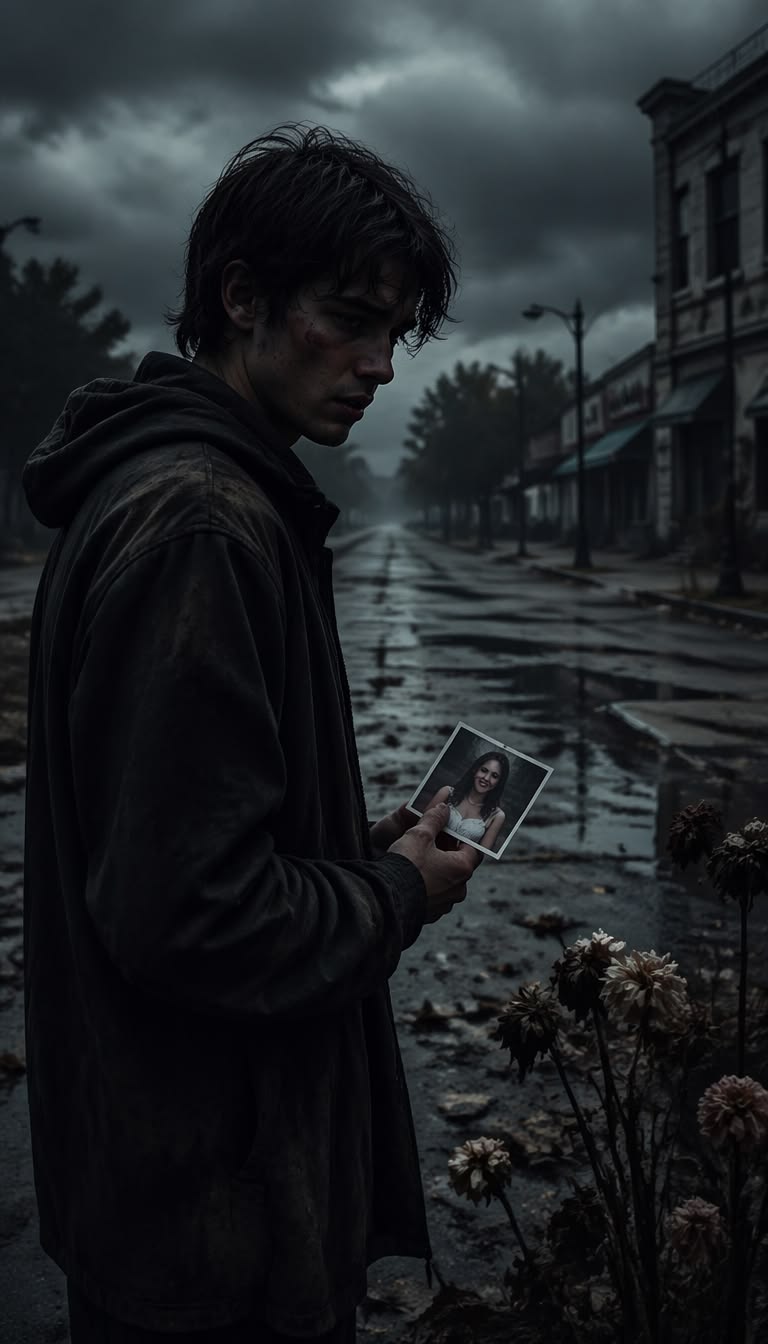
The town of Millhaven, Ohio had been dying long before the storm took what was left of it.
Ethan Cole stood in the middle of what used to be Carpenter Street, his boots sinking slightly into the mud, his dark hoodie soaked through to the skin. Around him, the storefronts were gutted — windows boarded, signs hanging crooked, one roof collapsed entirely under the weight of last week’s rain. The street lamps hadn’t worked in months. The traffic light at the corner blinked a lazy, useless yellow. Nobody drove through Millhaven anymore. There was no reason to.
He didn’t feel the cold. He didn’t feel much of anything.
In his right hand, he held a photograph.
It was a Polaroid, worn soft at the edges from being carried too long in a back pocket. The girl in the photo was laughing — head tilted slightly back, one shoulder raised, the way she always laughed when something caught her off guard. She was wearing a white sundress. Behind her, blurred and bright, was the backyard of the house on Locust Avenue where they had grown up three doors apart. The hydrangeas were in bloom. The sky was the kind of blue that only exists in the past.
Her name was Lily Marsh. And she had been missing for eleven months.
Ethan had been twenty-two when she disappeared. He was twenty-three now, though he felt much older. He had aged the way abandoned towns age — not gracefully, but suddenly, under the weight of something too heavy and too fast.
They had grown up together, the way only small-town kids do — inseparable in the way that doesn’t need explaining because there’s simply nobody else around. They rode bikes down these same streets. They split milkshakes at the diner on Route 9 that had since shut down. They sat on the roof of his parents’ garage on summer nights and talked about leaving Millhaven, about going somewhere that had a future. They made promises. The way young people do, assuming the future is a thing that simply arrives.
Lily left for Columbus in the spring. A job offer, a fresh start, a reason to finally go. Ethan stayed behind — his father was sick, the house needed managing, there was always a reason. They texted every day. Then every few days. Then once a week. Distance does that. Life does that. And then one Tuesday in June, her texts stopped.
Her roommate called the Columbus police. The police filed a report. The report became a case number. The case number went into a system alongside thousands of others, and Millhaven — too small, too forgotten, too far from anywhere that mattered — didn’t have the resources to push it further.
So Ethan pushed it himself.
He had driven to Columbus four times. He had walked her neighborhood, talked to her coworkers, sat across from detectives who spoke to him in the careful, measured tone of people managing expectations. He had made flyers. He had posted online. He had called every number he could find and left messages that nobody returned. He had done everything a person can do when the system moves too slowly and love moves too fast.
And now he was back in Millhaven, standing in the rain, holding her photograph.
He didn’t know why he had come here specifically. Something pulled him back. Some instinct he couldn’t name. People talk about gut feelings the way they talk about luck — casually, dismissively, as if they aren’t sometimes the only honest signal your body sends you. Ethan had learned to listen to his gut. It was the only investigator he had left.
The dead flowers near his feet caught his attention.
They were dahlias — dark pink, now brown and curled at the edges, lying at the base of what looked like a crumbling concrete planter outside the old hardware store. Someone had placed them there. Not long ago, either — the stems still had a little give when he crouched down and touched one. Flowers don’t survive long in Millhaven. Nothing does. These had been left within the last day or two.
He looked up at the hardware store. The windows were dark and boarded. The sign above the door — MILLHAVEN HOME & SUPPLY — was faded almost to white. The store had closed two years ago when the owner, a quiet man named Gerald Pruitt, retired and moved south. Nobody had bought the building. Nobody bought anything in Millhaven anymore.
But the padlock on the side door was new.
Ethan stood slowly. He looked at the padlock. He looked at the flowers. He looked at the photograph in his hand — Lily laughing in the summer sun, completely unaware that someday a version of this moment would be all he had left of her.
Something in his chest tightened.
He had driven past this building a hundred times. He had walked past it as a kid, buying nails with his father on Saturday mornings. He had never once thought about it in connection to Lily. There was no reason to. It was just an old building in a dead town.
But someone was coming here. Someone who left fresh flowers on a street where no one lived.
Ethan took out his phone and photographed the padlock. He photographed the flowers. He photographed the door. Then he stood in the rain for a long moment, the Polaroid still in his hand, and made a decision that he understood — even then, standing in the mud in the town that time forgot — would change everything that came after.
He had come to Millhaven to remember her.
He was leaving with something else entirely.
