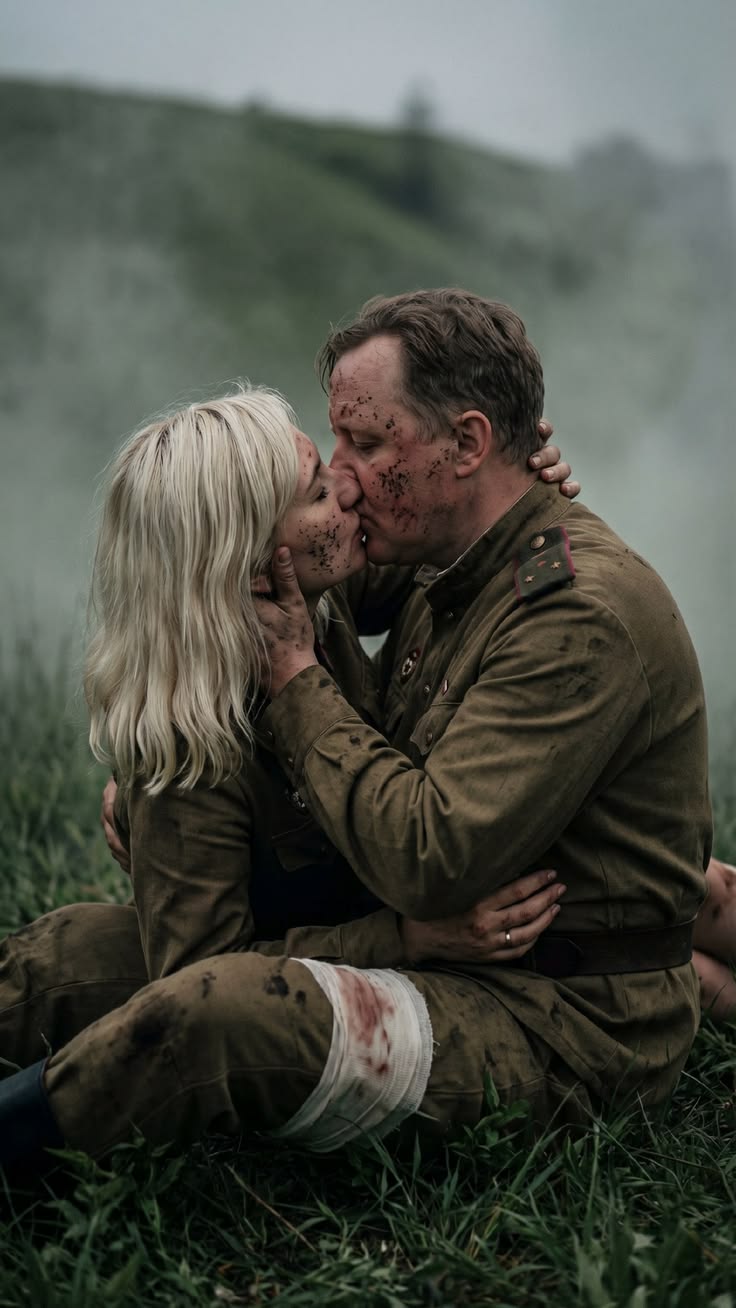
He had promised her he would come back.
That was the thing about promises made in wartime — they were not lies, exactly, and they were not truths, exactly. They were something in between: an act of will dressed as a fact, a statement about what you intended the future to be, offered to another person as a kind of gift that you might not be able to deliver but that you gave anyway because the giving mattered more than the certainty. James Calloway had made that promise on a platform in Virginia in September of 1944, holding Anna’s face in his hands the way you hold something you are terrified of dropping, and she had looked at him with those gray eyes that had never once in three years of knowing her shown him anything other than exactly what she was feeling, and she had said: “I know you will.”
Not I know you’ll try. Not I hope so. I know you will. The confidence of someone who had decided to make it true by believing it, which was its own kind of courage.
He had thought about those words on the transport ship. In the mud of France. In the specific frozen hell of December in the Ardennes, when the cold had become a character in the war, a fifth element that killed as efficiently and indifferently as anything German. He had thought about them in the field hospital in Belgium when the shrapnel had found his leg and the medic had worked on him with hands that were steadier than the situation seemed to warrant and had told him he was going to keep the leg, probably, and James had filed probably away as good enough and held onto Anna’s voice saying I know you will.
He had kept the leg. He had kept his word. Here was the proof of both: he was sitting in a field in the fog with her in his arms, her hands around his neck, her face against his, mud and smoke and blood and the specific impossible fact of her presence after everything that had stood between then and now.
She had come to him. That was the part the story usually left out, because the story people told was always the soldier coming home — train platforms, ticker tape, wives waiting at the door. But Anna had not waited at the door. When the word had come through channels that James’s unit had been cut off and rerouted and was coming through a crossing point forty miles from where he was supposed to arrive, Anna had found a man with a truck going in the right direction and had made him understand, through a combination of English and the universal language of a woman who is not asking, that she was getting in.
She had been there when they came through. Standing at the edge of the road in the November fog, her blond hair visible from a hundred yards, which was how James had seen her before she saw him — had been looking and then there she was, unbelievable, real, standing in the mud and the mist like a thing he had imagined so many times it had stopped feeling like imagination and started feeling like memory.
He had broken formation. His sergeant had said something. He had not heard it.
Now they were in the field beside the road, sitting in the wet grass, the army moving past them with the tactful indifference of men who recognized a moment and knew enough to route around it. James’s leg was bandaged — had been rebandaged three days ago, was holding, was going to be fine, was not the point. Anna’s hands were on his face and his hands were on hers and they were both covered in the accumulated evidence of the distance between September 1944 and today, which was dirt and smoke and the particular hollowness of a face that has been doing hard things for a long time and is only now, in this moment, releasing some of what it has been holding.
He pulled back far enough to look at her.
She looked back.
This was the thing about three years — you changed and you didn’t change. Her face was the same face and not the same face, the way his was, the war having done to both of them what time and difficulty do: adding something without taking the essential thing, whatever the essential thing was that had made him love her on a Tuesday afternoon in a Richmond library when she had reached for the same book and neither of them had moved their hand.
“You’re actually here,” he said.
“I told you I would be,” she said.
He had not remembered her saying that. He thought about it now — if she had said it, when, whether he had heard it the way she’d heard his promise. He decided it didn’t matter. She was here. The accounting could wait.
“Your leg,” she said.
“It’s fine.”
“James.”
“It’s going to be fine. I kept it. That was the goal.” He almost smiled. “I have both of them. Count.”
She looked down and back up. “I’m not going to count your legs on the side of a road in France.”
“Belgium,” he said.
“I don’t care where we are,” she said, with the firmness of someone who means it completely.
He put his forehead against hers. The fog moved around them, thick and gray and indifferent, the kind of fog that obscures everything past ten yards in any direction and leaves you in a world reduced to what is immediate and close, which was right now the most generous thing the landscape had done for him in fourteen months.
He couldn’t see the war from here.
He could see Anna.
“I need you to know,” he said.
“I know,” she said.
“I haven’t told you—”
“You don’t have to tell me,” she said. “I know.”
She always knew. That had been true in the library in Richmond and in the three years after and in the fourteen months of letters and silence and more letters and this — she knew what he meant before he finished meaning it, which was either the most extraordinary thing about her or just the most extraordinary thing about being known by someone, and either way it was the thing he had come back for.
He kissed her. Right there in the field in the fog in Belgium, mud and blood and the war still somewhere just past the edge of visibility, still real, still unfinished.
But not here. Not in this ten yards.
Here was just this.
