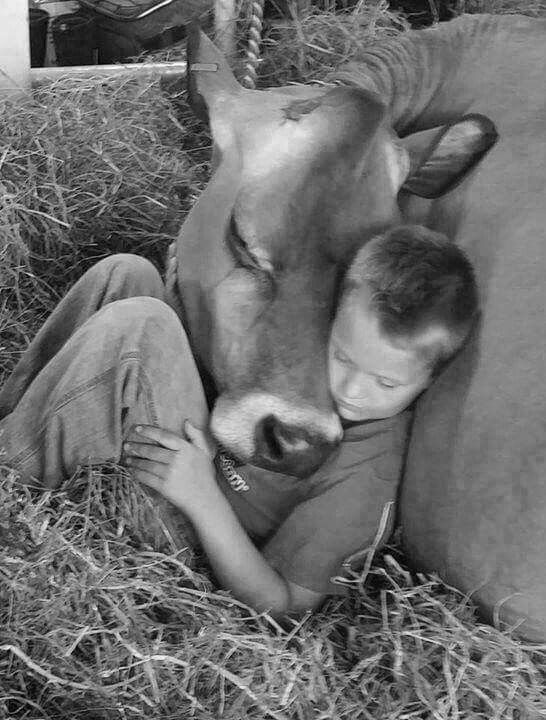
In Grover County, Kansas, a boy and a cow changed each other’s lives. Most people who heard the story later said they weren’t surprised. That’s the kind of place Grover County was — small enough that miracles didn’t need much room to happen, and old enough in its bones to recognize one when it showed up.
The boy’s name was Cody Briggs. He was nine years old, short for his age, with a buzz cut his father gave him every June on the back porch and a gap between his front teeth that made him whistle slightly when he said words with S in them. He didn’t talk much. His second-grade teacher had flagged it, his third-grade teacher had flagged it, and now his fourth-grade teacher, Mrs. Pemberton, had written on his last progress report: Cody is thoughtful and observant but rarely participates verbally. Recommend evaluation.
His parents, Tom and Linda Briggs, had read that note at the kitchen table on a Wednesday evening and exchanged the particular look that parents exchange when they are worried about something they don’t have words for yet.
Cody wasn’t broken. He wasn’t slow. He wasn’t sad, exactly — or not in any way he could have explained. He was just a boy who found the world very loud, and people very unpredictable, and words very slippery things that never quite held the shape of what he actually meant. He was more comfortable with quiet. With animals. With the long, unhurried rhythms of a farm that had been in his family for three generations.
The cow came in April.
She was a Brown Swiss heifer, about eight months old, bought at auction by Tom Briggs as a project animal — something for Cody to raise and show at the county fair in August. It was the kind of thing farm families did with quiet kids: gave them something to be responsible for, something that needed them specifically, something that didn’t require words. Tom had done it himself at Cody’s age, with a goat named Franklin, and he still considered it one of the more important things that had ever happened to him.
Cody named the heifer Rosie, which surprised everyone because he offered the name immediately, without hesitation, the morning after she arrived. He walked into the barn, looked at her for about thirty seconds, and said, “Rosie,” clearly and firmly, and that was that.
It was the most decisive anyone had seen him be in years.
He fed her at six every morning before school and again at four-thirty in the afternoon. He mucked her stall without being asked. He read about Brown Swiss cattle from a library book he checked out and renewed four times, absorbing information about feed ratios and hoof care and the particular sensitivity of the breed to stress and rough handling. He talked to the librarian, Mrs. Cho, more in those first two weeks than he had in the previous two years, asking specific, intelligent questions that made her pull up additional resources she hadn’t thought to offer.
“That boy has woken up,” Mrs. Cho told Linda Briggs at the grocery store. Linda went home and cried quietly in the bathroom, the way mothers cry when relief and love arrive at the same time and there’s no category for the feeling.
Rosie, for her part, had chosen Cody with the same certainty he’d chosen her name.
She was gentle by breed but had been skittish at the auction — eyes rolling, shifting on her hooves, the low-grade panic of an animal in an unfamiliar place surrounded by noise. When Cody walked into her stall that first morning, he did something instinctive and exactly right: he sat down in the hay. Not standing over her, not reaching for her, not making himself the large and unpredictable thing. Just sat down at her level and waited.
She came to him in four minutes. He timed it on his watch.
After that they were inseparable in the way that only a boy and an animal can be — wordlessly, completely, with the total mutual recognition of two creatures who have found the frequency they were both broadcasting on all along. Rosie rested her enormous head in Cody’s lap while he did homework in the barn. She followed him along the fence line when he walked the perimeter of the field. She learned the sound of his particular footstep and would lift her head and turn toward the barn door thirty seconds before he arrived, every single time, with an accuracy that made Tom shake his head in quiet amazement.
By June, Cody was talking more. Not performing — not forcing words out to satisfy adults — but actually talking, in the natural, unself-conscious way of someone who has remembered that communication can be something other than a test he keeps failing. He told his father about feed ratios at dinner. He told his mother about the way Rosie’s ears moved when she was happy versus when she was startled. He explained to his little sister, with patient detail, why you approach a large animal from the side and never from directly behind.
He was teaching. The boy who didn’t participate was teaching.
July was county fair preparation. Early mornings in the training ring, Cody walking Rosie on a lead rope, working on the show halter, practicing standing still and square the way the 4-H handbook described. Rosie was patient with it because Cody was patient with it. They were calibrated to each other now — his stillness became her stillness, his calm became her calm.
Tom watched from the fence one evening, arms folded on the top rail, and felt something loosen in his chest that had been tight for years.
The night before the fair, Cody slept in the barn.
Nobody told him to. Nobody suggested it. He simply took his sleeping bag out there after dinner, and when Linda looked out the kitchen window and saw the barn light still on at ten o’clock, she left it. Tom put his hand over hers on the windowsill. They stood there together without speaking, looking at the lit rectangle of the barn door, and it was one of the best moments of their marriage.
In the morning, Linda went to get him for breakfast. She found him asleep in the hay, curled on his side, one arm wrapped around Rosie’s thick neck, his face pressed against her warm brown side. Rosie had her chin resting on Cody’s hip. Both of them were breathing slow and even in the early morning quiet.
Linda stood in the barn door for a long time.
She did not wake him up. Breakfast could wait.
Some things you just let be.
