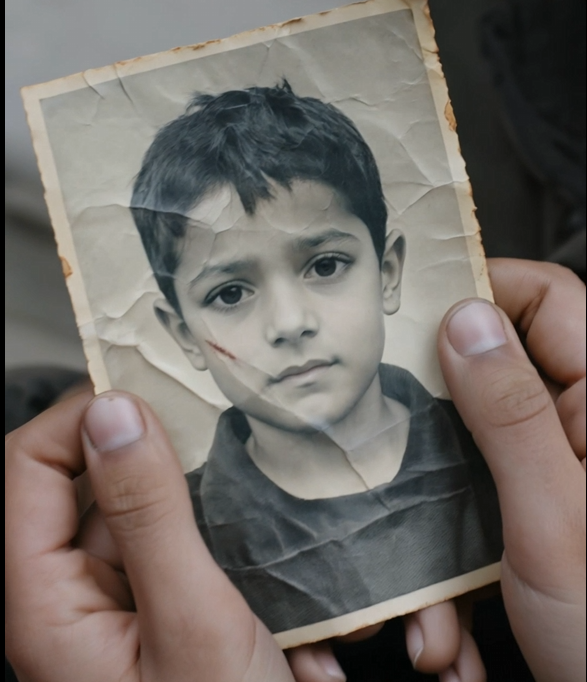
The bread was stale, but it was his.
Maro had found half a loaf wedged behind the garbage bin on Abovyan Street — behind the bin, not in it, which felt important to him, though he could not have said why. He sat on the top step of the underpass entrance and chewed slowly, making it last. Around him, the city moved in its indifferent morning rhythm. Heels clicked against pavement. A cart wheel stuttered over a crack. Someone’s phone played a tinny pop song that disappeared into the noise.
Nobody saw him.
That was the trick of it — to be small enough and still enough that the city forgot you were there. Eleven years of living had taught Maro that the moments you got into trouble were the moments you became visible. You moved wrong, you looked up at the wrong person, you reached for something that wasn’t supposed to be yours. So he had learned to sit like furniture. Like the steps themselves.
He was halfway through the bread when the woman stopped.
He noticed her feet first. Most people walked around him, a slight arc in their path, unconscious, automatic — the way water moves around a stone. She stopped. That was strange. Her shoes were brown leather, worn at the left heel, the kind of shoes a person resolves to replace and never does. He waited for her to move on.
She didn’t.
He looked up.
She was somewhere between forty and old, with dark hair going gray at the temples and a coat that had been good quality once. She was staring at him with an expression he had never seen directed at him before — not pity, not suspicion, not the blank discomfort that made adults look away. This was something else. Something raw and broken open.
Then she made a sound.
It came from deep in her chest, a low, helpless thing, and before he could understand what was happening she had crouched down to his level — a grown woman, on the steps of a Yerevan underpass, simply folding at the knees in her good-bad shoes — and she was crying. Not the polite kind of crying, not the kind you do when you don’t want anyone to notice. She was crying the way people cry when they have stopped caring who sees.
Maro held his bread and stared.
“What—” he started.
She held up one hand, palm out. Wait. She was going through her bag with the other hand, fumbling past keys and a crumpled receipt and a wallet, until she found what she was looking for. A photograph. She held it out to him, and it trembled slightly because her hand was trembling.
He took it.
It was a school photograph — the kind with the blurred blue background, the kind where someone always complained about how their hair looked. The boy in the photo was wearing a dark green sweater. He had Maro’s jaw, Maro’s ears, the small scar above the left eyebrow that Maro had gotten falling off a fence at age six. He was smiling in the way people smile for school photographs: not quite real, but not unhappy.
The photograph had a fold across one corner.
Maro knew the fold. He had made it, years ago, bending the corner back and forth until the paper softened.
This was his school photograph. His. From a drawer he had not opened in over a year.
He turned it over. On the back, someone had written a date in blue pen. A date seven months ago.
“Where did you get this?” he asked.
The woman had pressed her knuckles to her mouth. She was trying to compose herself, building herself back up piece by piece. “It was on a grave,” she said, finally. Her voice was wrecked, waterlogged. “At Yerablur. Someone placed it on a grave. The grave had a marker with a name.” She stopped. “Your name.”
He looked at the photograph again.
“They said you were dead,” she said. “The police came to the house. They showed us — there was paperwork. A certificate.” She shook her head as though she still didn’t understand it herself, even now, even with him sitting here in front of her. “We held a memorial. My sister — your Aunt Narine — she came from Gyumri. We lit candles.” Her voice broke again on the last word. “Eight months, Maro. Eight months.”
He said nothing for a long moment. Somewhere behind him, a metro train hummed through the earth.
“My father,” he said carefully. “Does he know?”
Something moved across her face — a shadow, fast and controlled. “Your father was told first,” she said.
It was the was that he heard. The past tense. The careful choice of it.
He had been living on streets and in stairwells for nearly a year, ever since the night he’d woken to voices in the apartment and understood, with the animal clarity that children sometimes possess, that he was not supposed to hear what was being said. He had taken his shoes and his jacket and he had gone out the window onto the fire escape and he had not gone back. He had not known exactly what he was running from. He had only known that something in those voices — calm, businesslike, arranged — had told him to run.
He understood now.
He looked at this woman — his mother’s cousin, he thought, one of the relatives he’d seen only at holidays, at the edge of tables, a face without much context — and he saw that she was afraid too. She was trying not to show it, but now that she had stopped crying he could see her eyes moving, checking the people who passed, tracking the street behind him the way you did when you thought you might be followed.
“How did you find me?” he asked.
“I didn’t. I was going to work.” She nodded up the block. “I work at the pharmacy on this street. I walk this way every morning.” She laughed — a small, exhausted sound, not quite a laugh. “I almost didn’t look down.”
“You should keep walking,” he said.
She blinked. “What?”
“You should stand up and keep walking and not look back and not tell anyone you saw me.” He folded the photograph along its existing crease. The same crease, his crease. He held it out to her. “Take this.”
She didn’t take it. She was watching him with an expression he couldn’t fully read. “You know,” she said. It wasn’t a question.
“I know enough.”
“Maro—”
“If they put a grave marker with my name on it,” he said slowly, thinking it through as he spoke, “they did it because it was easier than finding me. Or they thought they had found me.” He thought about that night, the fire escape, the dark. There had been another boy, sometimes, in the stairwell two buildings over. A boy about his age who slept there on warm nights. He had not seen that boy since autumn. “It was easier to close the file,” he said. “To make it official. So nobody keeps looking.”
“But you’re here,” she said, and there was an anguish in it, a mother’s anguish borrowed on behalf of his absent mother, a fury at the sheer wrongness of it.
“I know,” he said. “That’s the problem.”
She was quiet. Behind her, a bus sighed to a stop and a crowd pushed through its doors.
“There’s a man,” she said finally, very quietly. “He came to the house after. After the memorial. To offer his condolences to your father, he said. Your father was already—” She stopped. Started again. “There were two of them. They stayed for one hour. They asked questions about who you had known. Who visited. Whether you had ever mentioned anything to us.” She looked at her hands. “We thought it was normal. We thought they were from the school, or social services, something like that. We answered everything.”
Maro nodded. He felt very calm. The calm was familiar — the same stillness that let him become invisible when he needed to be. The city moved around them, bright and ordinary, and somewhere beneath it something else moved too, slower, with purpose.
“Then last week,” she said, “one of them was outside the pharmacy. Just standing. He wasn’t buying anything. He looked at me when I came out.” She paused. “I don’t know if I’m being paranoid.”
“You’re not,” he said.
She looked at him for a long moment. A real look — the kind adults rarely gave children, as though they were actually seeing the person. Then she opened her bag again and took out a pen and a receipt and wrote something down, folded it, and pressed it into his hand.
“My sister’s address,” she said. “Gyumri. She doesn’t know about any of this — the men, none of it. She only knows she mourned a boy who apparently isn’t dead.” She stood, smoothing her coat, becoming again the woman who walked to work on a Tuesday morning. “Her name is Narine. She’ll remember you.”
He looked at the folded receipt.
“Don’t use the train,” she said quietly. “Not Yerevan station.” She adjusted her bag on her shoulder. Her eyes made one last sweep of the street. “And Maro — eat the rest of that bread. You look like you haven’t eaten.”
Then she walked away, her worn heel clicking slightly on every left step, and in a moment she was swallowed by the crowd and the morning light, and he was alone again on the steps.
He looked at the photograph in one hand and the address in the other.
Then he finished the bread.
He had a long way to go.
