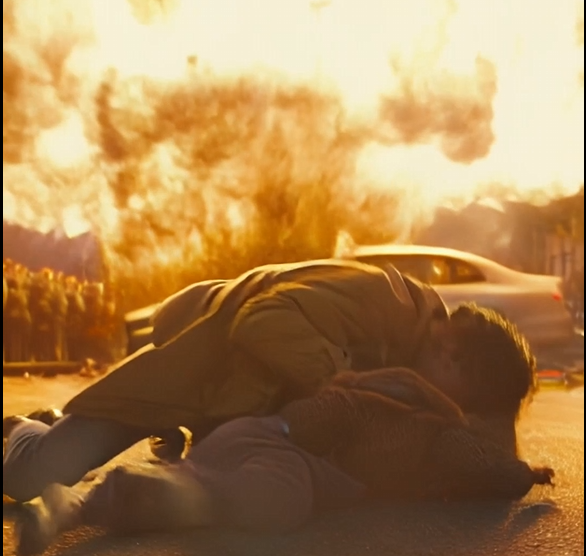
the accident happened at 4:17 in the afternoon, on a Wednesday in October, when the light came low and golden across the intersection of Marsh Street and Route 9. A silver sedan ran the red — nobody could agree later on why, whether the driver had been texting or had suffered some small seizure of the mind, a microsleep, a moment of total vacancy — and was struck on the passenger side by a delivery truck moving at forty miles an hour. The sound was enormous. It was the kind of sound that reached inside you and grabbed something. The sedan spun. It crossed the center line, climbed the shallow curb, and came to rest against the concrete base of a streetlight. Steam rose immediately from the hood. Then, within seconds — impossibly fast, it always seemed impossibly fast to anyone who had not seen it before — came the first tongue of orange from somewhere beneath the chassis. The flame found the fuel. The fuel was generous. There were perhaps thirty people in the vicinity. A bus stop on the southwest corner held seven people waiting. A café with outdoor seating faced the intersection directly. A hardware store, a pharmacy, a nail salon — all had windows, and people pressed themselves to those windows now, or stepped outside, shading their eyes, leaning forward just slightly, as though proximity might satisfy something without requiring anything. The phones came out within ten seconds. This was not cruelty. That is the important thing to understand — it was not cruelty. Most of them did not think: I will film this instead of helping. They simply filmed. The hand went to the pocket, the phone appeared, the little rectangle of screen bloomed to life, and the burning car was immediately framed and centered. The action preceded the thought. Maybe the thought never came at all. ◆ Marcus Hale had been sitting in the doorway of the shuttered electronics store for three hours. He had a sleeping bag rolled tight beside him, a canvas bag that held most of what he owned, and a cup of gas station coffee that had gone cold. He was fifty-one years old but looked older. His beard was the color of ash. His coat was a heavy canvas thing he’d found outside a donation bin two winters ago, army green, several sizes too large. He wore it open despite the October chill, the way a man wears something when it belongs to him and is not merely being worn. He had been watching the intersection without watching it — the way you look at something without recording it, the way the eyes work without the mind participating. He had nearly finished the cold coffee when the sound came. He felt it more than heard it. Then he saw the car against the pole, and the fire beginning, and he was standing before he knew he was standing. He saw the phones. He registered them the way you register weather. He was already moving. The car was sixty feet from the doorway. He crossed it in seconds. The heat came at him in waves, and he raised one arm against it, and he did not stop. Later, people would ask him — in the hospital, in the news interview he gave sitting in a chair with his hands in his lap — whether he had been afraid. He thought about this carefully before answering. He said he didn’t remember fear. He said he had seen a small shoe pressed against the rear passenger window. A child’s shoe, pink, with a velcro strap. And after that there was nothing else. “There was nothing to decide. You see a pink shoe in a burning car, there’s nothing to decide.” The rear door was jammed. He tried the handle twice, then used both hands and his bodyweight, wrenching it sideways, and it gave. The smoke poured over him. He reached inside without seeing clearly and his hands found a car seat, and he worked at the straps — simple straps, the kind with a central red button — and the child came free. A girl. Two years old, perhaps three. She was screaming, which meant she was breathing, which meant everything was going to be all right, or might be. He carried her backward away from the car. Twelve steps. Fifteen. He set her down on the pavement and knelt beside her, and she grabbed his coat with both hands, and he said something to her, nobody could hear what. When the fire reached the fuel line the car made a sound like a cannon shot, and a plume of black smoke punched upward into the October sky, and everyone who had been filming flinched back, and some of them screamed, and a few of them finally put their phones down. ◆ Marcus’s hands were burned. His left forearm, where the metal door had pressed against him in the wrenching, had a long red wound that would scar. His eyebrows were gone. He did not notice any of this until a paramedic told him to sit down, and even then he kept trying to stand. The girl’s name was Mia. The driver of the sedan — her father — was unconscious but alive, evacuated by the time the fuel line went. The delivery truck driver had broken ribs and a dislocated shoulder. He had tried to help too, had stumbled from his cab toward the fire, but his legs had buckled. He wept later when he spoke about it. He said, I couldn’t get up. I kept trying and I couldn’t get up. The paramedic who treated Marcus’s hands asked him what he’d been thinking when he ran toward the car. Marcus looked at her. “I wasn’t thinking,” he said. “That’s not how it works.” She wrapped his hands in gauze. He watched her work. Around them, the intersection was filling with police cruisers and news vans. Someone had already uploaded the video — several someones, from several angles — and the story was already moving through the vast, frictionless pipes of the internet, the algorithm sorting it, lifting it, sending it outward in every direction. By evening it would have millions of views. By morning, Marcus’s name would be known. Donations would come. Offers. A television appearance. None of that had happened yet. For now there was only the gauze, and the cold air, and somewhere behind the ambulance, Mia was being held by a paramedic, still crying, still clutching a fistful of nothing where the green coat had been. ◆ People would argue, afterward, about the bystanders. There was anger in the comment sections, as there always is. Thirty people standing there filming and not one of them helped. Others pushed back: you don’t know what you’d do. You think you’d run into a burning car? You think it’s easy? The argument went on the way such arguments always go, burning steadily, consuming itself. What nobody could quite articulate, though some tried, was the specific texture of what had happened at that intersection. Not evil. Not cowardice, exactly. Something more modern and harder to name. The phones had come out and the fire had been framed and the situation had been converted, somehow, in some essential way, from something happening to something being watched. The recording was a participation of sorts. The watching was a kind of presence. But presence is not help. And there is a distance, thin as glass, between witnessing and doing, and that distance can be the whole world. Marcus Hale had not filmed anything. He did not own a phone. This was not virtue — it was circumstance. He had none of the equipment required to convert the burning car into content, and so there was nothing between him and the burning car. There was only the shoe. The small pink shoe against the glass, and sixty feet of asphalt, and a choice that he would later say was not a choice at all. Maybe that is what the whole thing turned on. Not courage versus cowardice. Not heroism versus selfishness. Something simpler and stranger: the presence or absence of a small glowing screen, and what happens to a human being when there is nothing between them and the thing that is happening. When the distance collapses. When there is only the fire, and the child, and the next step. He took the next step. That’s all. He took it, and then the one after, and the one after that. And the girl came out of the fire screaming, which meant she was alive, and he set her down on the cool October pavement and knelt beside her in his ruined coat and said whatever it was he said. Whatever it was, she stopped crying.
