The Red Crow Bar sat off Route 9 like a bad tooth nobody got around to pulling. Paint the color of old rust. A parking lot full of bikes whose chrome had long since gone dull. The kind of place where the jukebox only played three songs and all of them were sad.
The Devil’s Remnants had been coming here every Thursday for eleven years. That was the deal they made with Dale Ferris, the owner, back when Dale still had two good knees and a wife. You don’t bother us, we don’t bother you, and on Thursdays nobody else comes in. It worked for everybody.
There were eight of them that night — seven men and one woman, Kat, who had a snake tattoo running from her left wrist to her collar and who could out-drink any two of them without trying. They sat in their usual arrangement: the long table near the back, close to the emergency exit, old habit from years of needing to leave fast. Their president, a man called Wraith, sat at the head. His real name had not been spoken out loud in fourteen years. That was how he liked it.
Wraith was not a large man in the way that made people nervous on first glance. He was large in the way that made them nervous on second glance, once they noticed the stillness. He never fidgeted. Never drummed his fingers or bounced his leg. He sat with a kind of absolute patience that felt less like calm and more like the moment before something broke. His hair had gone white at the temples. The scar across his chin was old and pink and shaped like a fishhook.
The drinks were halfway finished when the girl walked in.
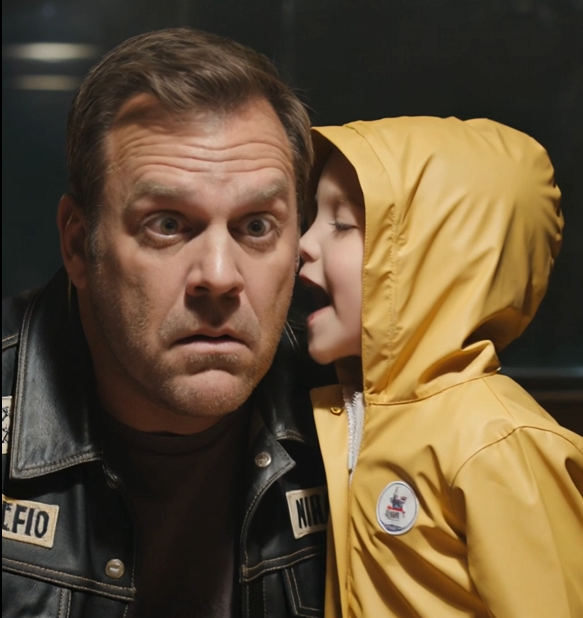
Nobody heard the door open. That was the first strange thing. The second strange thing was that she was alone. She looked about nine years old — maybe ten. Dark hair in two braids. A yellow raincoat, even though it hadn’t rained in three days. White sneakers with a smear of red clay on the left toe. She stood just inside the door for a moment, blinking in the dim light like she was taking inventory.
Kat noticed her first. Her hand moved to the back of her belt before she even thought about it, then stopped. It’s a child, she reminded herself. It is a child in a yellow raincoat.
The girl walked straight to Wraith.
She didn’t look at the others. Not at Deckard, who was 280 pounds and had hands like catcher’s mitts. Not at Priest, who was missing an ear and wore the absence of it like a badge. She walked to Wraith the way you walk to someone you made an appointment with, pulled out the chair beside him without asking, climbed up onto it, and leaned close to his ear.
She whispered something.
Wraith’s hand stopped mid-air. He had been reaching for his glass. His hand simply stopped, suspended, like a frame in a film that had caught and burned.
The glass slipped from his fingers and shattered on the floor.
He went pale. Not the pale of cold or exhaustion. The pale of a man who has just seen something impossible — the face in the window of a house that burned down, the signature on a letter from someone three years dead. His jaw moved once without producing any sound.
“What did you say?” he asked. His voice was barely there.
She looked at him calmly. “Your real name. The one you buried with her.”
The table had gone completely silent. Deckard had put down his beer. Priest had turned in his seat. Nobody spoke. The jukebox played the opening bars of something slow and guitar-heavy and then seemed to think better of it and went quiet too.
Wraith looked at the girl for a long time.
“Who sent you,” he said. It was not a question. It was the tone of a man who had already decided the answer was terrible and was simply confirming it.
“Nobody sent me.” She folded her hands on the table with a precision that seemed too adult for her face. “I came because of the box.”
Kat said, quietly, “Wraith.”
He held up one finger without looking at her. The gesture said: not yet.
“What box,” he said to the girl.
“The metal one. Behind the loose brick in the basement of your house on Ardmore Street. The one with the photographs and the letter and the ring that has the initials J.M.C. on the inside of the band.”
The color did not come back to his face.
“You’ve been in my house,” he said.
“I grew up in your house,” she said. “Before you bought it. Before it was yours.” She tilted her head slightly, studying him the way a child studies something she’s genuinely curious about rather than afraid of. “She hid that box a long time ago. She wanted someone to find it. I’ve been waiting for the right person.”
“She’s been dead for twenty-two years,” Wraith said.
“I know.”
Priest stood up. “That’s enough. Kid, I don’t know how you got in here or what kind of game this is, but—”
“James Michael Cavanaugh,” the girl said, still looking at Wraith. “That’s the name she always used. She said it was the name his mother gave him and that names your mother gives you don’t wash off no matter how many road names you pile on top.”
The sound that came out of Wraith was not quite a laugh and not quite a sob. It was the sound of a door being opened in a house that had been sealed for a long time.
Priest sat back down.
Nobody had called Wraith by that name since Jamie Cavanaugh had crossed the Tennessee state line at nineteen with forty dollars and a motorcycle and the particular determination of someone running from something they knew would catch them eventually. He had spent the next three decades making himself into a different person, layer by layer, the way you build a wall — not to keep others out, but to keep something in. The name Wraith had fit because that’s what he felt like: a ghost wearing a man’s shape, haunting the road, never arriving anywhere that felt like home.
The girl reached into the pocket of her yellow raincoat and placed something on the table.
It was a photograph, creased down the middle, black and white. A young woman — early twenties, laughing at something off-camera, her hair blown sideways by wind. She was sitting on the hood of a car. She was beautiful in the uncomplicated way of people who don’t know yet that they’re about to be hurt.
Wraith looked at the photograph for a very long time.
“Where did you get this,” he said.
“From the box,” she said. “It was on top. I think she put it there on purpose. So whoever opened it would know who she was before they read anything else.”
“Her name was June,” he said. Saying it out loud seemed to cost him something.
“June Marie Cavanaugh,” the girl said. “Your sister.”
Kat made a sound. Even Deckard looked away.
“She didn’t die in an accident,” the girl said. Her voice was even, not cruel, the way a doctor is even when delivering news they have delivered many times. “You know that. You’ve always known that. The letter explains who was responsible. She wrote it so there would be a record. She was very careful.”
Wraith picked up the photograph. His hands, which had broken three men’s noses and rebuilt four motorcycle engines and carried a dead man out of a burning bar in Knoxville in 2004, were shaking.
“Why now,” he said. “It’s been twenty-two years. Why come to me now.”
The girl thought about this the way a child thinks about something they’ve considered many times and are choosing how to explain carefully. “Because the man in the letter got sick. He’s in the hospital in Murfreesboro. He has maybe six weeks. She — I think she didn’t want him to leave without someone knowing. She didn’t want the truth to go with him.”
Wraith set the photograph down on the table, face up. He looked at it. June, laughing at something. Wind in her hair. The hood of an old Buick. The summer she turned twenty-three, which was the last summer she would have.
“Give me the letter,” he said.
The girl reached into her pocket again.
Kat was the one who found the girl an hour later, sitting on the front step of the Red Crow Bar with her raincoat buttoned to the throat, looking at the sky. Kat sat down next to her and offered her a ginger ale from inside, which the girl accepted.
“Where do you live, sweetheart?” Kat asked.
The girl pointed vaguely down the road.
“Somebody’s going to be worried about you.”
“I don’t think so,” the girl said. She said it simply, without self-pity.
They sat in silence for a while. From inside came the sound of voices, low and serious, and then the sound of a chair scraping back.
“Is he going to be okay?” the girl asked.
Kat thought about Wraith’s face when he read the letter. The way he had folded it very precisely and put it in the inside pocket of his jacket, close to his chest. The way he had looked at the ring with the initials J.M.C. for a long time before closing his fist around it.
“He’ll be different,” Kat said. “Okay is a different thing. But he’ll be different.”
The girl nodded like this was the answer she had expected. She drank her ginger ale. A moth circled the yellow light above the bar’s front door, coming back to it again and again no matter how many times it was burned.
“She was kind,” the girl said finally. “June. In case you were wondering. She was one of the kind ones.”
Kat didn’t ask how she knew. She was past asking that question.
When she went back inside twenty minutes later to tell Wraith the girl was still out front and maybe someone should drive her home, the front step was empty. The ginger ale can was there, set neatly on the concrete, and next to it a small stone that had not been there before, pale and smooth, the kind you find at the edge of a river.
Nobody saw her leave.
Nobody heard the door.
