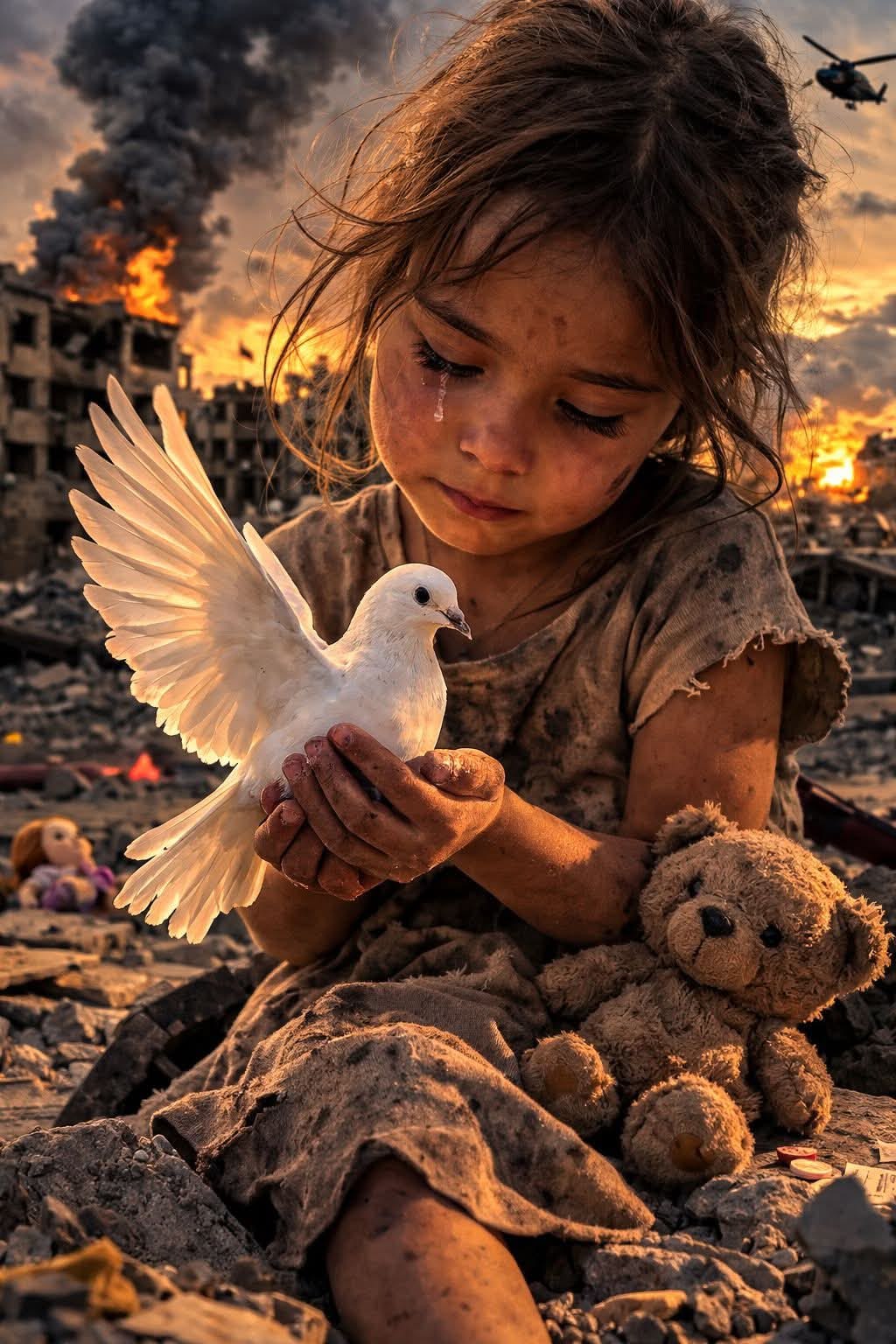
The dove landed in her hands like an answer to a prayer she hadn’t known how to say.
Lena was six years old and she had been sitting in the rubble for what felt like forever, though it had probably been three hours. She knew this because the sky had been orange when the last explosion shook the building on the corner — the one where Mr. Faroud used to sell bread every morning, the one with the blue door that she had walked past every single day of her entire life — and now the sky was a different kind of orange, the sunset kind, which meant the day was ending even though it felt like the day should have stopped the moment everything else did.
She had her bear. She had found him in the dust twelve feet from where she now sat, his left ear torn, his button eyes miraculously intact, looking up at her with the same patient expression he always had, as though nothing that happened in the world could particularly surprise him. She had pressed him to her chest and breathed into his fur and stayed very still, the way her mother had told her to stay when the sounds started. Find a wall, find a corner, make yourself small. She had found a wall. She had made herself small. She was still waiting for the part where her mother came back.
The dove had appeared from nowhere, the way good things sometimes do in the middle of catastrophe — without explanation, without warning, as if the universe occasionally feels obligated to balance its own books.
It had landed on a piece of broken concrete three feet away, its white feathers extraordinary against the grey dust, and it had looked at Lena with one bright eye and stayed there. Most birds, in Lena’s experience, did not stay. Most birds were smarter than people, her father had once told her. They knew when to leave. But this one stayed, and after a long moment of regarding each other across the rubble, Lena had slowly, slowly extended her dusty hands, and the bird had walked onto them as though this had been the arrangement all along.
She could feel its heartbeat against her palms. Fast and light and insistent, like a small urgent argument for continuing.
She held it carefully and looked at its wings and thought about flying — about what it would mean to simply open your wings and rise above all of this, above the smoke and the collapsed buildings and the sound of helicopters that she could never tell, anymore, whether to be afraid of or relieved by. She thought about rising until the fires below looked like birthday candles. Until the city looked like a map. Until the place where her mother had been standing when the world came apart was just a point, a coordinate, something small enough to hold.
She didn’t let the bird go. Not yet. She needed it for a little while longer.
Her name was not actually Lena.
Her name was Leila — Leila Nassar — and she lived, or had lived, in an apartment on the fourth floor of a building that no longer had a fourth floor. She was six years and four months old. Her favorite color was yellow. She could already read, which her teacher said was remarkable, and she knew seventeen animal names in both Arabic and English, which she considered her greatest achievement. She wanted to be a doctor when she grew up, because her father was a doctor and she had decided, with the absolute conviction of a six-year-old who has not yet learned that decisions are complicated, that she would do exactly what her father did.
Her father was at the hospital when it happened. This was the fact she returned to constantly, pressing it like a bruise to make sure it still hurt, to make sure it was still real. He was at the hospital. He was safe. He would come. He knew where they lived, knew where to look, knew all the places she might go if she needed to wait. She was waiting in one of those places now — the corner of what used to be their street, against a wall that still stood even though the building it belonged to didn’t anymore, which seemed both impossible and deeply characteristic of walls in general.
Her mother had gone back inside.
That was the thing Lena — Leila — could not stop replaying. They had been outside, the two of them, when the first sound came. Her mother had grabbed her hand and run three steps before stopping, turning, looking back at the building with an expression Leila had never seen on her face before and could not name.
“My phone,” her mother had said. “The photographs—”
“Mama—”
“Stay here. Right here, against this wall. Don’t move.”
She had gone back inside to get the photographs of Leila’s grandmother, who had died two years ago and existed now only in a phone and in memory. She had gone back inside and the building had — and then there was dust, so much dust, the world going grey and silent for a moment that lasted either one second or one year, Leila could not tell — and then the sounds came back, all at once, too loud, and her mother was not there.
The soldier found her forty minutes after the dove.
He came around the corner of the broken wall carefully, the way people move in places where the ground might not be trustworthy, and he stopped when he saw her. He was young — younger than he probably wanted to look, with dust on his face and tired eyes and a rifle slung across his back that he made no move toward, which Leila noted with the threat-assessment instincts that children in war zones develop whether anyone intends them to or not.
He crouched down so he wasn’t towering over her. This also she noted. Her father did this when he talked to children at the hospital — made himself smaller, less like authority and more like a person.
He said something in a language she didn’t know.
She shook her head.
He tried another. She shook her head again.
He tried Arabic, badly, with an accent that belonged to somewhere very far away. “You — safe? You hurt?”
“I’m waiting for my father,” she said clearly. “He’s a doctor. He knows where I am.”
The soldier looked at her for a moment. Then he sat down on a piece of rubble across from her — just sat down, in the dust, in his uniform, with his equipment, as though he had decided that wherever this child was waiting was exactly where he should be too.
“Okay,” he said, in his bad Arabic. “I wait with you.”
Leila looked at him. She assessed. She had seen enough of the world in her six years to know that people were not simply good or simply bad — that the same species that had done whatever had been done to her street was also the species that sat down in rubble next to a small child and said I wait with you. She had not been taught this. She had simply learned it, the way children learn the things that school does not cover.
She held the dove out toward him.
He looked at it, surprised. Then, carefully, as though understanding that this was a test of some kind, he extended one finger and touched its wing.
The dove accepted this.
“My mother went inside,” Leila said. “To get the photographs of my grandmother.”
The soldier’s face changed in a way that he could not control and probably didn’t know she could read.
“She’ll come out,” Leila said. “She promised she’d come right back.”
He looked at her for a long moment. The helicopters circled. The fires on the horizon shifted color as the last of the sun went down. Somewhere in the rubble nearby, something settled with a low sound like an exhale.
“What is the bird’s name?” the soldier asked carefully.
Leila considered. She had not thought about this yet. She looked down at the dove in her cupped hands, its impossible whiteness, its fast small heartbeat.
“I don’t know yet,” she said. “I’ll know when my father gets here.”
Dr. Omar Nassar arrived at 8:47 in the evening.
He came running, which is how Leila knew it was him before she could see his face — she knew the sound of her father running, the particular rhythm of it, the way it always sounded slightly more desperate than necessary, like he was always running slightly behind where he needed to be and knew it. She knew that sound the way she knew his voice, the way she knew the smell of his coat, the particular constellation of details that made a person into home.
She stood up. The dove spread its wings once, startled, then settled.
“Baba.”
He crossed the last twenty meters at a speed that was not running anymore but something beyond it, and he gathered her against his chest so tightly that the dove had to flutter its wings to maintain balance, and he made a sound against the top of her head that was not a word in any language, just a sound, the sound a person makes when the thing they were most afraid of losing turns out to still be there.
The soldier stood up. He and the doctor looked at each other over Leila’s head — two men, from different places, different sides of something enormous and complicated and ongoing, standing in the ruins of a street at nightfall with a child between them who was holding a white bird.
The doctor said something. The soldier nodded. No translation was necessary.
Later — weeks later, in a different city, in a room that was safe but not home — Leila finally named the dove.
She had kept it. It had shown no particular interest in leaving, which she took as a mutual agreement. It lived in a box lined with an old sweater and ate seed from her palm and regarded the world with the serene certainty of a creature that has decided it is exactly where it should be.
She named it Jidda. Grandmother. Because her mother had gone back for the photographs of her grandmother, and the photographs were gone, and her mother was — her mother was gone too, and Leila was six years old and learning, in the hardest possible way, that some things cannot be recovered. Only carried.
But the dove was here. White and warm and alive, its heart beating against her hands every time she held it — fast and light and insistent, that same small urgent argument it had been making since the first moment it landed.
Keep going. Keep going. Keep going.
She was six years old. She intended to.
Her father enrolled her in school in the new city in October. On the first day, her teacher asked the class to say one thing about themselves.
Leila stood up. She was small for her age and her eyes were too old for her face and she held herself with the particular stillness of a child who has learned that the ground is not always reliable and so you must be your own solid thing.
“My name is Leila,” she said. “I had a mother who loved photographs. I have a father who is a doctor. I have a dove named Jidda.” She paused. “And I am going to be a doctor too. Because there are a lot of broken things in the world that need someone to help fix them.”
She sat down.
The room was very quiet for a moment.
Then her teacher — who had her own history, her own rubble, her own things carried — said: “I think you are going to be extraordinary, Leila.”
Leila nodded, as though this were simply a fact being confirmed rather than a kindness being offered.
She already knew.
