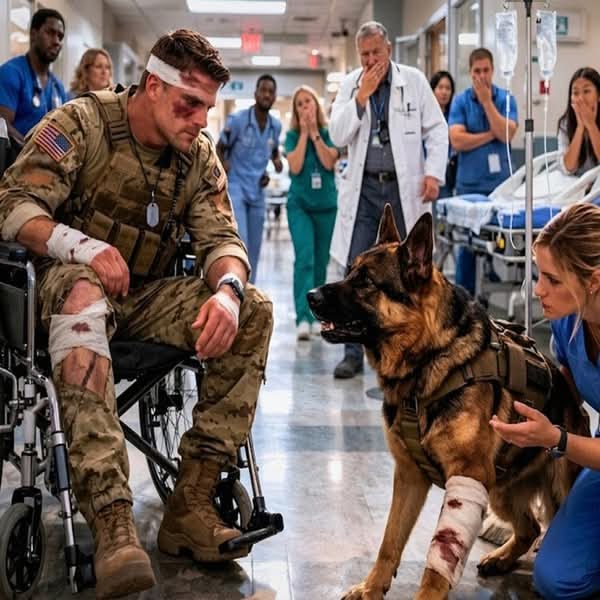
Nobody in the trauma ward of Fort Bragg Medical Center had ever seen anything like it.
Not the nurses who had worked combat casualties for fifteen years. Not the attending physician, Dr. Raymond Chu, who had served two tours in Iraq before trading his rifle for a stethoscope. Not even the hardened orderlies who thought they had processed enough broken soldiers to be immune to the kind of emotion that makes your throat close up without warning.
What they saw, rolling through those corridor doors at 14:23 on a Tuesday afternoon in October, stopped every single one of them cold.
Staff Sergeant Cole Harrington had been in-country for seven months when the ambush hit their convoy outside Kandahar. Three vehicles. Sixteen men. An IED that turned the lead Humvee into a fireball and scattered the unit across two hundred meters of open road before the gunfire even started.
Cole took a round in the left thigh and another that grazed his temple, painting the right side of his face with blood that dried brown in the Afghan heat. He went down in the open, exposed, with no cover and no ability to move, while the firefight cracked and thundered around him like a summer storm that wanted specifically to kill him.
That was when Zeus moved.
Zeus was a five-year-old German Shepherd, a military working dog assigned to Cole’s unit for explosive detection. He weighed eighty-one pounds. He wore a tactical harness and a reputation for being the most decorated MWD in the brigade — eleven confirmed finds, zero handler casualties across four deployments. His previous handler had rotated home six months ago, and Cole had inherited him the way soldiers inherit everything in the field: quickly, without ceremony, with the quiet understanding that this relationship might someday cost one of them everything.
Cole had not expected to love that dog.
He did anyway.
When Cole went down, Zeus was twenty meters away with Corporal Danny Reyes. What happened next was not a command. No one told Zeus to move. No one pointed, no one signaled, no hand gesture broke the chaos of that firefight into something a dog could parse and follow. Zeus simply looked at the spot where Cole had fallen, and something in the ancient architecture of his animal mind made a decision that no amount of training can fully explain or fully take credit for.
He pulled free from Reyes.
He crossed twenty meters of open ground under active fire.
He reached Cole, turned his body perpendicular to the direction of incoming rounds — using his own mass as a physical barrier — and he stayed. He did not cower. He did not run. He pressed himself against Cole’s side and he stayed, his breathing fast and hot against Cole’s neck, his body absorbing the psychological weight of a man who was otherwise completely alone.
Cole would later say, in the debrief he gave through a jaw wired half-shut, that it was the dog that kept him conscious. Not the training. Not the willpower. Not the eleven weeks of SERE school or four years of infantry service. The dog. The specific, irreplaceable warmth of that animal pressed against him, breathing, alive, here — that was the thing that kept the gray edges of unconsciousness from closing in.
The firefight lasted nineteen minutes.
When it was over, when Reyes and the remaining unit had suppressed the ambush and were moving through the casualties, they found Cole where he’d fallen. Zeus was still beside him. Still pressed against him. Still breathing those fast, hot breaths into the side of his neck.
Zeus had taken two rounds.
Both in his front legs.
They medevaced them out together. The flight surgeon on the bird had never treated a dog before, but he treated Zeus that day — field-dressing both wounds with practiced hands while Cole watched from the gurney beside him and said, over and over, with the flat calm of a man running on empty, “He’s okay, right? Tell me he’s okay.”
“He’s okay,” the surgeon said, each time, and he meant it more each time he said it.
The corridor at Fort Bragg Medical Center went quiet the moment they came through the doors side by side — Cole in a wheelchair, bandaged from temple to thigh, still in his combat uniform with the dirt of Kandahar dried into every crease; Zeus walking beside him on four bandaged legs, his tactical harness still on, moving with the slow and deliberate dignity of an animal who has decided that pain is simply not relevant right now.
A nurse put her hand over her mouth.
A doctor stopped walking.
Someone, somewhere behind them, made a sound that was not quite crying and not quite anything else.
Cole looked up at all of them — at their faces, at the way this hallway full of people trained specifically not to show emotion had completely failed at that task — and he reached down from his wheelchair and put his hand on Zeus’s head.
Zeus leaned into it.
“He pulled me out,” Cole said, to no one in particular, to everyone at once. “He just — he came and he stayed.”
His voice broke on the last word, which surprised him, because Staff Sergeant Cole Harrington had not cried since he was nine years old and his father told him that men who cry are men who’ve given up.
He cried now.
And every person in that hallway let him.
