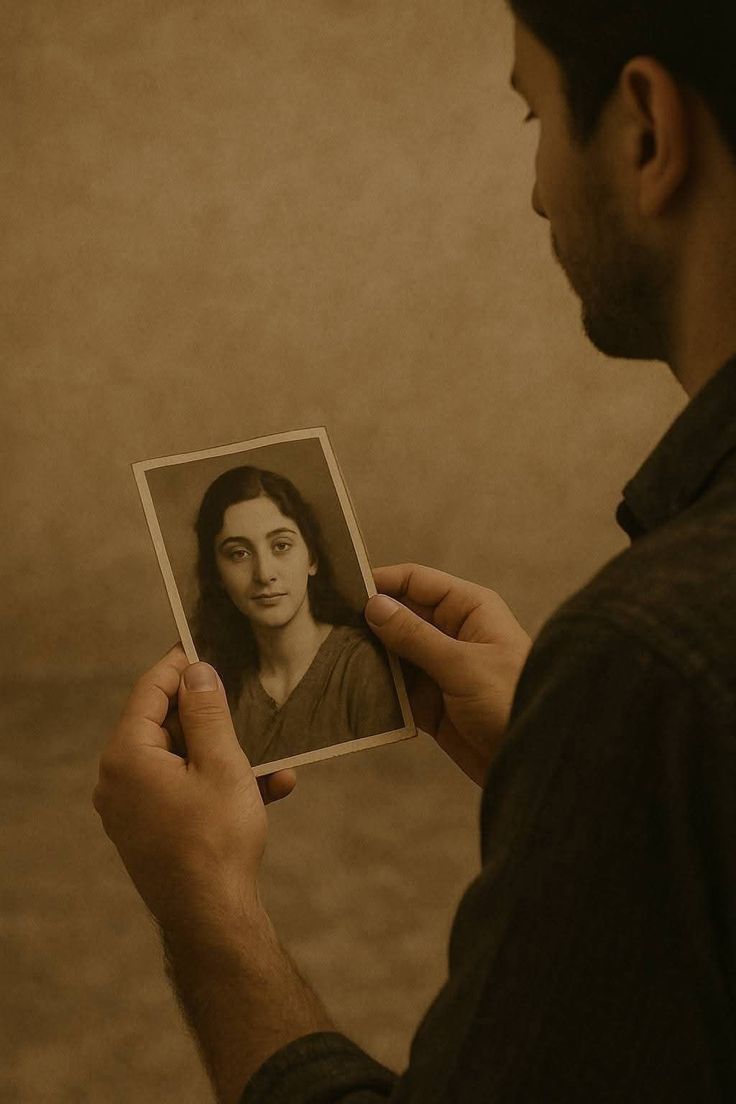
He found her on a Tuesday in March.
Not her — he understood that, intellectually, from the first moment. The woman in the photograph had been dead for decades, maybe longer. The image itself told you this: the sepia toning, the particular quality of stillness that old photographs have, the way the clothing draped suggested a generation that was not his own. She was not alive. She was not findable. Whatever story she had lived was finished long before Daniel Navarro was born in Houston in 1989 and grew up and became the kind of man who spent his Tuesdays off cleaning out his grandmother’s attic in San Antonio rather than doing something more seasonally appropriate with the afternoon.
He understood all of this.
And yet he stood in the low-ceilinged space between the water heater and the boxes of Christmas ornaments, with the March light coming thin and gold through the single small window, and he could not put the photograph down.
His grandmother’s name was Rosa Navarro, and she was eighty-three years old and in the hospital with a hip replacement that had gone as well as these things go at eighty-three, which is to say adequately and with complications. She had asked Daniel — her oldest grandchild, the one she called mijo with a particular warmth she distributed more selectively among the others — to go to the house and find the blue suitcase in the attic, which contained her important documents, which she needed for the insurance matter that her daughter was handling, which was all very straightforward.
He had found the blue suitcase in twenty minutes.
He had found the photograph in the box beside it, in an old cigar box held closed with a rubber band that disintegrated when he touched it, amid a collection of objects that had the particular quality of things kept not for utility but for memory: a man’s watch with a cracked face, a folded letter in Spanish that he didn’t read, a child’s shoe, inexplicably single, and the photograph.
It was small — the size of a playing card, printed on thick stock with a white border. The woman in it was perhaps twenty-five, dark-haired, with large dark eyes that looked at the camera with an expression Daniel could not immediately classify. Not quite sad. Not quite defiant. Something between those things, something that suggested she was aware of the weight of the moment and had decided to meet it with her full face rather than a performance.
She was, in the way that some faces simply are regardless of era or context, extraordinarily beautiful.
Daniel turned the photograph over.
On the back, in faded pencil, in handwriting he did not recognize: Miriam. 1943.
He sat down on a box of Christmas ornaments and thought about 1943.
He was a high school history teacher. He knew what 1943 meant. He knew what it contained. He knew the specific geography of that year — the camps, the roundups, the cattle cars, the systematic and bureaucratic and utterly human machinery of annihilation that had processed six million people through its mechanisms between 1941 and 1945, and which had left, among its wreckage, an uncountable number of photographs just like this one: a face, a name, a year, and then silence.
Miriam. 1943.
He turned the photograph back over and looked at her.
He had the strange and specific feeling — the kind that arrives without warning and resists logical dismissal — that she was looking back. Not in a supernatural way, not in a way he would have been comfortable describing to another adult, but in the way that certain faces in photographs simply demand to be seen, demand the dignity of a witness, demand that the person holding them not look away.
He did not look away.
He thought: who were you?
He thought: how did you end up in my grandmother’s attic in San Antonio, Texas, in a cigar box with a broken rubber band?
He thought: does anyone know your last name?
His grandmother was awake when he arrived at the hospital, propped against pillows in the private room his mother had insisted on, with the television on and the sound off and the particular expression she wore when she was thinking about something she hadn’t decided to share yet.
Daniel sat in the chair beside the bed and put the blue suitcase on the floor and held the cigar box in his lap and looked at his grandmother — at the face he had known his whole life, the face he associated with Sunday dinners and Christmas tamales and the smell of café de olla and the particular safety of being eight years old and allowed to fall asleep on her couch — and he tried to figure out how to ask what he needed to ask.
Rosa looked at the box.
Something moved in her face.
“You found it,” she said. Not a question.
“Abuela—”
“I wondered,” she said. “When I asked you to go, I wondered if you would find it.” She folded her hands on the blanket with the careful deliberateness of a woman organizing herself to say something she has been not-saying for a long time. “I thought about calling you and telling you not to look in the other boxes. And then I thought — ” She paused. “I thought that maybe it was time.”
Daniel opened the box.
He took out the photograph and held it out toward her.
Rosa looked at it for a long moment with an expression he could not read — layered, complex, old in a way that her face didn’t usually look.
“Her name was Miriam Goldstein,” she said. “She was twenty-three years old in that photograph. She was my mother’s closest friend in a village in Poland that no longer exists.” She paused. “She gave that photograph to my mother the last time they saw each other. My mother carried it from Poland to Mexico to Texas. For sixty years.” Another pause. “She wanted someone to remember her name. That was all she asked. Just — remember my name.”
Daniel looked at the photograph.
At the dark eyes. At the face that had asked one thing of the world and entrusted that ask to a photograph the size of a playing card that had traveled across three countries in a cigar box and landed, on a Tuesday in March, in the hands of a history teacher who spent his days telling young people that the past was not past — that it was, in fact, sitting right here, present and asking to be honored.
“Miriam Goldstein,” he said aloud.
His grandmother closed her eyes.
“Thank you,” she said. “She would have — thank you.”
The hospital room was quiet. Outside the window, San Antonio went about its March afternoon, all that ordinary living stacked on top of all that irretrievable loss the way life always stacks itself — carelessly, necessarily, the only way it knows how.
Daniel held the photograph in both hands.
He was a history teacher. He knew what you did with names.
You said them. You wrote them down. You made sure they were not the last thing in a cigar box in an attic waiting to be found by someone who might not have known to look.
He took out his phone.
He began.
