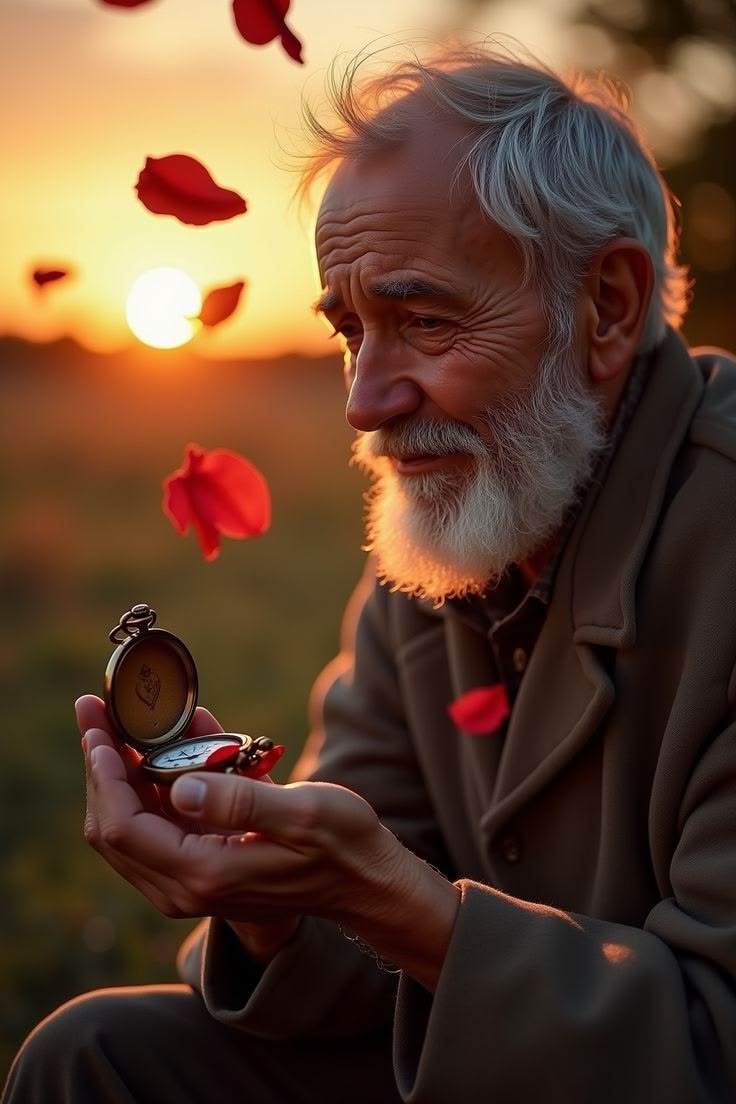
He wound it every evening at sunset.
Not because it needed winding — the watch had a self-winding mechanism, a fact that Edward Calloway had understood since the watchmaker in Savannah explained it to him sixty-two years ago when he bought it with three weeks of a young man’s wages and the absolute conviction that some things were worth the cost of being done properly. He wound it anyway. A deliberate, unnecessary act, repeated every evening for sixty-two years, in the same motion, with the same two fingers on the crown — because the watch had been given a purpose beyond timekeeping on the day he bought it, and the winding was the renewal of that purpose, the daily recommitment to what the watch had always really been about.
It had never been about time.
It had been about Rose.
Edward Calloway was seventy-nine years old and he was sitting in the field behind the house in Beaufort, South Carolina — their field, which they had never planted with anything because Rose had said that a field left alone was a field doing exactly what it wanted, and she had believed in that principle for people and fields alike. The evening light was doing its particular September work, going amber and then gold and then the deep impossible orange that this part of the Carolina coast produced as if it had studied the subject and intended to do it definitively.
Rose petals were moving in the wind around him.
He had scattered them himself, from the last roses of the garden, which Rose had planted thirty years ago along the south fence and which had been, for thirty years, the most alive thing on the property. The petals moved in the warm air with the unhurried, generous drift of something that has completed its purpose and is willing to go anywhere the world sends it.
Edward watched them and held the watch open in his palm and felt the familiar weight of it — small, certain, the temperature of his own skin — and allowed himself to be exactly where he was, which was both here and somewhere else simultaneously, which was where he had been living for the past eight months.
The watch’s story began in a hardware store in Savannah, Georgia, in September of 1963.
Edward had been seventeen years old, working the counter, saving money for a purpose he had not yet clearly defined except that it involved leaving Savannah and seeing something of the world before the world told him where to stop. He had been working there for six weeks when the girl with the dark hair came in for a length of copper pipe that her father needed, and Edward had helped her find it, and she had looked at him the way certain people look at you when they have decided, in the space between one heartbeat and the next, that you are worth paying full attention to.
Her name was Rose Delacroix.
She was sixteen years old and she was the most direct person Edward had ever encountered — direct in the way that some people are when they have decided that life is too short for indirection, that the clock is always running, that the things worth saying should be said now and clearly and without the elaborate social packaging that other people use to protect themselves from the vulnerability of meaning something.
She had looked at him across the hardware counter and said: “You have an interesting face. I think I’d like to know the rest of you.”
Edward had been so startled that he had given her the copper pipe without writing up a ticket, and had to run half a block after her to collect the payment, which she had found extremely funny and which he had not, at the time, and which he had found funnier and funnier as the years went on until it had become one of those stories that defines a couple’s mythology, the one you tell at dinner parties while your wife pretends to be embarrassed.
He had bought the watch three weeks later. He had had the engraving done by the watchmaker on Bull Street — a small rose on the case, simple, just the outline — and he had given it to Rose on the day he left for his first job in Charleston, pressing it into her hands and saying that it would keep time for both of them until he came back, which he intended to do, and which he intended her to understand was not a vague intention but a specific promise.
“A watch is a strange gift for someone you’re leaving,” she had said.
“I’m not leaving,” he had said. “I’m starting the clock on coming back.”
She had kept the watch for two years, winding it every evening — she had told him this in letters, one of which he still had, the one that said I wound your watch tonight at sunset and thought about your face and decided to stop being patient about this, when exactly are you coming home — and he had come home, and she had given it back to him on the day they married, pressing it into his hands the same way he had pressed it into hers, which was a symmetry they had never discussed and never needed to.
Fifty-seven years of marriage.
Three children. Seven grandchildren. Two great-grandchildren who called him Pop-Pop and who had his chin and Rose’s eyes in various combinations that he was still cataloguing.
A house in Beaufort with a field left alone and roses along the south fence.
And then January, which had come the way January comes when you are not ready for it — which is to say the way it always comes, which is suddenly and without negotiation.
He sat in the field with the petals moving around him and the sun going down and the watch open in his palm, and he did what he had been doing every evening for eight months, which was to look at the small rose engraved on the case and say the things that required no audience but had to be said out loud because Rose had believed in the spoken word, in the actual vibration of the air, in the idea that language made things real in a way that thought alone could not manage.
He said: “The roses did well this year. Better than last. I think they knew you weren’t here to see them and decided to make an effort.”
He said: “Danny got the job in Raleigh. He starts in October. He came to tell me in person, which I know you would have wanted. You raised them right. I want you to know I understand that now better than I did before, and I’m sorry it took me longer than it should have.”
He said: “I wound the watch.”
He turned it over in his hand, the familiar weight, the familiar warmth.
The petals moved through the golden air.
The sun touched the edge of the field.
And Edward Calloway, seventy-nine years old, widower, keeper of a watch, scatterer of rose petals, holder of fifty-seven years of love that had not become smaller for having nowhere to go — smiled.
Not despite the grief. Not ignoring it. But the way you smile when you have had something so extraordinary that even its absence carries the evidence of how real it was.
“Still the prettiest sunset I’ve ever seen,” he said.
“Second prettiest,” he corrected. “You know the rules.”
The rules had been established in 1965 on the back porch in Charleston, where Rose had looked at a sunset that stopped conversation entirely and said: “I don’t care what anyone says. Nothing is as beautiful as that.” And Edward had looked at her looking at it and said: “Second prettiest.” And she had understood immediately, because she had always understood immediately, and had kissed him in the specific way that means you impossible man and I love you simultaneously.
He closed the watch.
He held it against his chest.
Around him, the last of the rose petals found the ground.
