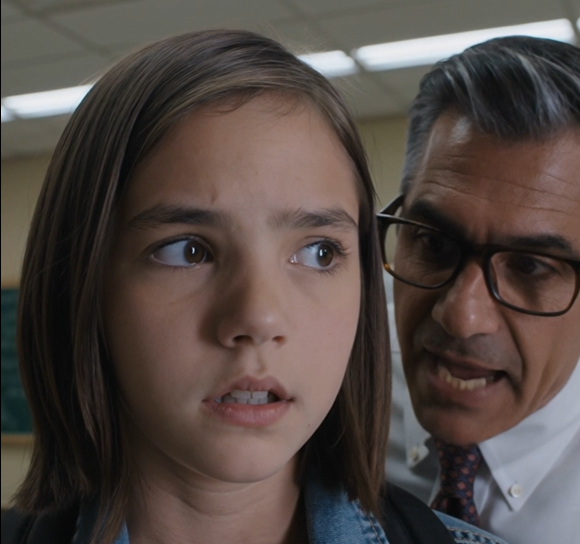
The fluorescent lights in Room 214 had always buzzed at a frequency that made Nadia’s teeth ache. She’d spent three years in Mr. Harlan’s chemistry class learning to tune it out—the hum, the smell of old textbooks and dried reagent, the particular squeak of the third chair from the left that everyone avoided. She knew this room the way you know a place you’ve never really loved but have occupied long enough to memorize.
So when Mr. Harlan asked her to stay after class, she wasn’t alarmed. She’d been distracted lately. Maybe her lab report. Maybe the exam she’d half-finished and handed in like an apology.
The others filed out in their usual clusters—Priya and Devon arguing about the weekend, Marcus with his headphones already on before he hit the doorway. The room emptied the way rooms do, all at once and then completely. Nadia gathered her bag slowly, waiting.
Mr. Harlan was a careful man. Fifties, graying at the temples, the kind of teacher who measured his words the way he measured compounds—precisely, without waste. He had never raised his voice in three years. He had never told a joke that wasn’t also, somehow, instructive. Nadia respected him in the distant way you respect a piece of furniture that has always done exactly what it was supposed to do.
He waited until the last footsteps faded down the hall. Then he looked at her.
Not the way teachers usually looked at students—assessing, evaluating, deciding. He looked at her the way you look at something that shouldn’t be in front of you. Something that defies a previously accepted rule about the world.
“You shouldn’t be alive,” he said quietly.
She laughed. It came out strange—too high, too quick—the laugh that appears when the body doesn’t know what else to do with a sound.
“I saw you die yesterday.”
The fluorescents buzzed.
Nadia stood very still. Her bag strap was digging into her palm and she became suddenly, absurdly aware of it—the pressure, the realness of it, the way it confirmed that she was standing in a room with a floor beneath her feet.
“Mr. Harlan—”
“The intersection of Caldwell and Fifth.” His voice hadn’t changed. Still quiet. Still measured. “A gray sedan ran the light at approximately three-fifteen. You were crossing. You were wearing that jacket.” His eyes dropped briefly to her red jacket, the one with the broken zipper she kept meaning to fix. “You didn’t see it coming. And then—” He stopped.
“And then what?”
He looked at her with something close to pain. “And then there was nothing to see.”
The walk home should have taken twelve minutes. It took forty because Nadia stopped four times—once at a bench, once at the mouth of an alley, once in front of a pharmacy window where she stared at her own reflection for a long time, checking it the way you check a math problem you’re sure you’ve gotten wrong. She looked the same. She felt the same. There was a small coffee stain on her left cuff from this morning that she hadn’t noticed until now, and its ordinariness was either deeply comforting or deeply wrong; she couldn’t decide which.
She had crossed at Caldwell and Fifth yesterday. At approximately three-fifteen. She remembered it precisely because she’d been running late to meet her mother and she’d checked her phone at the corner, seen the time, felt a small contraction of guilt. She’d crossed on the green light.
She had crossed on the green light.
She went home and didn’t tell anyone.
At dinner her mother talked about a coworker named Patricia who had done something mildly offensive involving a shared refrigerator, and her little brother kicked the table leg in a rhythmic, unconscious way, and the rice was slightly undercooked the way it sometimes was when her mother was distracted, and Nadia ate all of it. Every grain. She drank two glasses of water. She felt the cold of it go down and sat with the sensation longer than was normal.
That night she lay in bed and thought about the gray sedan.
Not imagined it—she had no image to work from. Just the concept of it. The vector of it. A gray sedan and a green light and some sliver of a second where one of those facts would have had to give way to the other. She thought about the broken zipper on her jacket and how she’d been meaning to fix it for two months and never had, and how it was a small stupid thing but it was her small stupid thing, a piece of ongoing intention, evidence of a life mid-process.
You don’t fix zippers if you know you’re about to stop needing them.
She hadn’t known. That was the thing. That was what kept snagging, a splinter in her thinking she couldn’t leave alone. She hadn’t known, and she had crossed, and she was here with a coffee stain on her cuff and a zipper still broken, and Mr. Harlan—careful, precise, measured Mr. Harlan who did not make errors—had watched her die.
She went back the next morning before first bell.
He was already there, as he always was, setting up the day’s materials with his usual unhurried concentration. He didn’t seem surprised to see her. She got the impression he had been expecting her, or something like her—some consequence of what he’d said, arriving in the form it would arrive in.
“How?” she asked. She didn’t bother with preamble.
He set down a volumetric flask carefully. “I don’t know how to explain it in a way that will satisfy you.”
“Try.”
He looked at her for a moment. Then he pulled out the chair from behind his desk—not his own chair, the one students sometimes sat in when they came for help—and gestured to it. She sat. He leaned against the lab bench and crossed his arms, not defensively, but like a man organizing his thoughts into a shape.
“It’s been happening since I was roughly your age,” he said. “Occasionally. Not often. I’ll see something—clearly, the way you’re seeing me right now—and then it doesn’t happen. Or it has already happened. Time isn’t always—” He paused, choosing. “The order isn’t always reliable, for me.”
“You see the future.”
“I see a future. Sometimes I see a past that hasn’t finished yet. It’s not useful, most of the time. It’s not—” He searched for the word. “It’s not navigable. I can’t aim it. Yesterday afternoon it simply arrived.”
“And you saw me.”
“Yes.”
“You saw me die.”
He didn’t flinch. She appreciated that. “Yes.”
“But I didn’t.”
“No.” He looked at her with that same expression from the day before—something caught between wonder and the particular exhaustion of a man who has had to hold impossible things for a very long time. “You didn’t.”
Here is what Nadia had understood about death before that week: it was the thing that happened to old people and sometimes, terribly, to people in the news. It was abstract. It was a door she intellectually knew existed in every corridor she walked down, but which she had the ordinary human talent for not seeing. She was seventeen. The door was far away. She was busy with lab reports and broken zippers and her mother’s rice.
Now she understood something different. Not more, exactly. Differently.
She understood that the door was not far away. It was the same distance from her at every moment—right there, at the edge of every step she took, every street she crossed. It had always been. She had just been permitted to forget it, the way all living things are permitted to forget it, because the forgetting is what makes it possible to keep moving.
She had crossed on a green light. The green light had held. That was luck, or fate, or the particular texture of a Tuesday that had gone one way instead of another. Mr. Harlan had seen the way it could have gone, and now she had to carry both versions: the one where she was here, and the one where she wasn’t. Two photographs of the same intersection, one of them undeveloped, folded into her chest like a second heartbeat.
It was heavy. It was also, she was surprised to find, clarifying.
She fixed the zipper that weekend. It took twenty minutes and a YouTube tutorial and two bent fingers and she did it badly, so it still caught if you rushed it, but it closed. She hung the jacket back on its hook and stood looking at it for a moment.
Then she called Priya, whom she hadn’t called in three months for reasons she could no longer exactly reconstruct—some small drift, some mutual failure to try—and they talked for two hours about nothing important, and then about things that were, and by the end of it Nadia was lying on her bedroom floor staring at the ceiling with the pleasant tired feeling of having used a part of herself she’d forgotten was there.
She ate the undercooked rice at dinner and said nothing about it, and watched her brother kick the table, and listened to her mother talk, and felt the specific texture of the evening settle around her—imperfect, ongoing, hers.
She didn’t speak to Mr. Harlan about it again, not directly. But something shifted between them in the small transactional moments of class—the way he’d pause a half-second longer when handing back her work, the way she’d sometimes catch him watching her with the same expression, recalibrating, as though he was still working out the math of her continued presence.
She thought about asking him what it was like—to carry that sight, to see the fraying edges of what might happen and be unable to do anything with it most of the time, to have watched things he could not stop. She decided she didn’t need to ask. She could see it in the careful way he moved through the world, measuring everything, wasting nothing. When you know how close the margins are, you stop being careless with the space inside them.
She understood that now.
At the end of the year, in June, she crossed at Caldwell and Fifth again. She did it most days—it was the shortest route—but this time she stopped at the corner first. Just for a moment. Let the light go red, then green, then red again while someone behind her made an impatient sound and moved around her.
Then she crossed on the green, in the ordinary way, because that was what you did. Because the door was always there and the only answer to it was to keep walking through the world as if you’d earned your place in it—carefully, deliberately, with full knowledge of what it cost.
She got to the other side.
She kept going.
