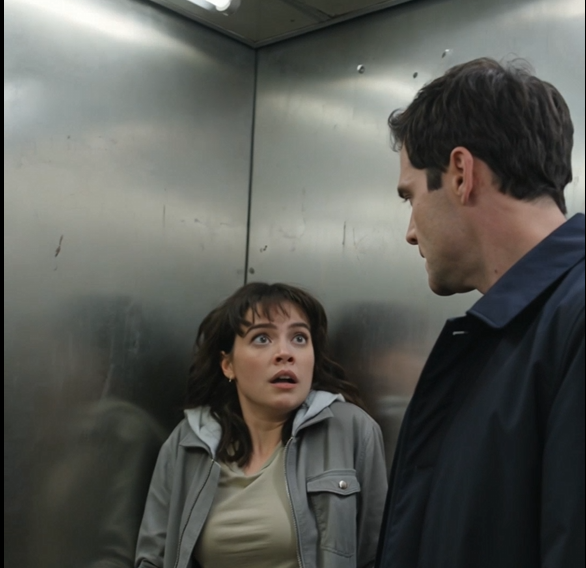
The elevator in the Carver Building was the old-fashioned kind—brass fittings, a floor indicator with an actual needle that swept like a clock hand, walls paneled in wood that had been polished so many times it had forgotten what tree it came from. Miriam had ridden it twice a day for six years. She knew its sounds the way you know the sounds of a house you’ve lived in long enough: the low groan as it woke, the sigh as it settled, the particular shudder it gave between the fourth and fifth floors that maintenance had been about to fix for approximately four years running.
She knew all of this. She was not prepared for it to stop.
Not slow and stop. Not stop with warning. Just—stop. Between three and four, by the needle’s reckoning. A lurch, and then stillness, and then the lights doing something she had never seen them do, which was: consider failing. A flicker. Two. The brass fittings going golden-dark-golden in a rhythm like a pulse.
Miriam pressed the door-open button. Nothing. The emergency call button. A distant, unconvincing buzz somewhere deep in the building’s infrastructure, the sound of a phone ringing in an empty house.
She exhaled slowly and turned around.
She had not been alone in the elevator. She knew this—had registered it the way you register all shared-small-space occupants, with peripheral politeness, eyes forward, the unspoken urban contract of mutual non-acknowledgment. A man. Middle-aged or past it, in a coat that had been expensive once, carrying a leather briefcase with a broken clasp that he held shut with his hand. She had noticed the clasp the way you notice small failures on strangers. It had made her feel something she hadn’t examined.
He was looking at her now. Had been, she realized, since before they stopped. Something patient in his eyes. Something that knew.
“Only one of us gets out alive,” he said.
His voice was conversational. Not theatrical, not low and dramatic, not the voice of someone performing a threat. The voice of someone reading aloud a fact they’d confirmed earlier and were now simply reporting.
Miriam was a woman who had, over the course of her life, developed a practical relationship with fear. She had learned that it was loudest in the first three seconds and that if you could get past those, you could usually think. She counted—involuntarily, a reflex—one, two, three.
“That’s an unusual thing to say,” she said.
“I know.”
“Are you threatening me?”
He looked almost surprised. “No.”
“Then what are you doing?”
He looked down at his briefcase, at the hand he was using to hold it shut, as if he’d forgotten it was there. “Being honest,” he said. “Perhaps too soon. I’ve always had trouble with the timing of things.”
The lights steadied. Held. The elevator remained stopped.
His name was Edmund. She didn’t ask; he offered it after a silence that had stretched long enough to require punctuation. Edmund Farris, he said, as though that might mean something, and when it clearly didn’t, he accepted this with a small nod and didn’t explain further.
“What do you mean,” Miriam said, “one of us gets out alive.”
“Exactly what it sounds like.”
“One of us is going to die in this elevator.”
“No.” He glanced up at the needle, still frozen between floors. “Not in it.”
“When it opens.”
He said nothing, which was an answer.
Miriam looked at the doors. Closed, brass-framed, impassive. She had a meeting on four. Quarterly review, Henderson from compliance, the particular slow agony of projected figures on a screen in a room with bad air circulation. She had been mildly dreading it for two days. The smallness of that dread struck her now, the cozy manageable scale of it, how neatly it fit into a life where the worst thing on a Thursday was a meeting about numbers.
“How do you know?” she asked.
“I’ve been here before.”
“In this elevator.”
“In this moment.” He said it simply. “I’ve spent a long time trying to find my way back to it.”
She studied him—the coat, the broken clasp, the patience in his face that was not the patience of a calm man but of one who has waited so long that the waiting has become structural, load-bearing, the thing his whole self was built around.
“You’re going to need to explain that,” she said.
“I know,” he said. “We have time.”
He explained it the way you explain something you’ve rehearsed—not smoothly, but with the roughness of something practiced so many times it has worn down to the essential shape. He had been in this elevator before. Not literally, not in any way that left physical evidence, but in the way that mattered. He had seen it. Lived through it. And on the other side of it—on the other side of those doors opening into whatever waited beyond them—one person had walked out and one had not, and he had spent the intervening years trying to understand which was which and whether it could be changed.
“You’re saying you’ve seen the future,” Miriam said.
“I’m saying I’ve seen a future. I’ve seen this moment, from the other side of it, and I couldn’t see—” He paused. “It was dark when the doors opened. I couldn’t see what happened in the dark.”
“But you came back.”
“I’ve been trying to get back to this elevator for nine years.”
Miriam looked at him. The fluorescent flickered once, gently, like a thought.
“Why?” she said. “If you don’t know which of us it is—why come back?”
He was quiet for long enough that she thought he might not answer. Then: “Because I was there. When the doors opened. And I walked out.” He looked at his hands. “And I’ve never been certain I was the one who should have.”
The darkness on the other side of the doors, when they finally opened, was complete.
Not dim. Not the soft darkness of a power outage where shapes still resolve and eyes still adjust. A darkness that felt material—thick, total, the kind that presses back. Miriam stood at the threshold and felt it the way you feel weather, as a thing with weight and temperature, and the temperature was wrong, too close, too specific, like the breath of something large.
Edmund had moved to stand beside her. Shoulder to shoulder, which was strange because they had spent the whole conversation on opposite walls, maintaining the distance that strangers maintain, and yet here they were, close enough that she could hear him breathing.
“This is it,” he said.
“Yes,” she agreed, because there was nothing else to say.
“I still don’t know.”
“I know.”
She stared into the dark. Somewhere beyond it was the third floor—the accounting department, the potted plant that Sandra from receivables had named Gerald, the water cooler with the persistent air bubble that made it gulp when you weren’t expecting it. Ordinary, specific, real things. The dark had swallowed them without noise.
“Did you ever consider,” Miriam said, “that you came back to the wrong moment?”
Edmund turned to look at her.
“Nine years,” she said. “You’ve been trying to get back here. To this elevator, this stop, this exact in-between. But what if the moment that mattered wasn’t this one?” She kept her eyes on the dark. “What if the moment that mattered was every other one? All the ones you spent getting back here instead of forward from there?”
He was very still.
“You said you walked out.” She finally looked at him. “You walked out, Edmund. Whatever happened in the dark—you walked through it. That’s not guilt you’re carrying. That’s the weight of the thing you survived.” A pause. “Those are different.”
The dark breathed.
“You can’t unknow what you know,” she said. “You can’t go back to before the doors opened and be a person who didn’t walk out. You walked out. So did something awful happen, or did something ordinary happen—did someone simply die—and you’ve spent nine years making it mean more than it did because the alternative is that it meant nothing, that it was just chance, and chance is harder to live with than guilt?”
Edmund said nothing. His hand had tightened on the briefcase.
“Chance means it could have been you,” she said. “For no reason. Just the arbitrary mechanics of a bad moment. And we don’t like that. We want it to have been a choice, a purpose, a weight we earned. We want the dark to have been fair.”
The needle on the floor indicator trembled.
“Was there someone else in the elevator?” she asked. “The first time.”
A long pause. Then, very quietly: “My wife.”
Miriam closed her eyes briefly.
“She was going to file for divorce,” he said. “We’d argued that morning. I didn’t know that was—I didn’t know it was the last—” He stopped. “The doors opened. There was the dark. And then I was on the third floor and she wasn’t anywhere, and they found her—” He stopped again. “Later.”
“Edmund.”
“I’ve thought about what I could have done differently every day for nine years.”
“I know,” she said softly. “I know you have. But you came back here to find out which of you was supposed to walk out, and there’s no answer to that question. There’s no ledger. There’s no version of this where the dark sorts the deserving from the undeserving.” She looked at the darkness waiting beyond the doors. “She died. You didn’t. There’s no supposed to in that. There’s only what happened.”
The elevator gave a small, preparatory shudder.
“She wouldn’t have sent you back here,” Miriam said. “If she could have seen you—nine years trying to get back to an elevator—she wouldn’t have wanted that.”
“You didn’t know her.”
“No. But I know you spent years carrying the wrong question.” She turned back to the dark. “The question isn’t which of us gets out alive. The question is what you do with the getting out. What you’ve done with it. What you do with it now.”
Edmund was quiet for a long time.
Then he said: “You’re very calm.”
“I’m terrified,” she said. “But calm and terrified aren’t mutually exclusive. I’ve had a lot of practice.”
A sound from somewhere below—machinery waking, a cable re-tensioning, the building remembering its obligations. The needle trembled and began, slowly, to move.
The darkness beyond the doors began to change—not light, not yet, but the quality of it shifting, thinning, becoming merely the ordinary low light of a hallway where the overheads had failed and the emergency strips hadn’t fully kicked on. Gerald the potted plant materialized from the murk. The water cooler. The familiar geography of the ordinary world, returned from wherever it had briefly gone.
Edmund stepped forward first. Then Miriam.
They stood together in the dim hallway, and nothing happened. The building existed around them, indifferent, full of its own sounds. Somewhere above, Henderson from compliance was probably fussing with a projector.
“She would have argued with me about that,” Edmund said eventually. “What you said. She would have had three counterpoints ready before I finished the sentence.”
“She sounds like she was good at arguing.”
“She was good at everything she decided to be good at.”
Miriam nodded. She adjusted her bag strap and thought about the meeting waiting for her, and the strange durable fact that she was going to go attend it—that she was going to spend the next hour in a chair looking at projected numbers in a room with bad air, and that this was not a small thing, not beneath dignity, not a waste of a life rescued from a stopped elevator.
It was the whole point. The ordinary accumulation of ordinary hours. The meeting and the water cooler and Gerald the plant. The continued improbable fact of a day in progress.
“Will you be alright?” she asked.
Edmund stood in the dim hallway with his briefcase and his broken clasp and considered the question as though it was the first time anyone had put it to him directly.
“I think,” he said slowly, “I might work on that.”
Miriam nodded. She turned and walked toward the stairwell, because she had decided she was done with that elevator for today, and also because sometimes the only way to answer an impossible question is to start walking and see what the next floor looks like.
She went up.
