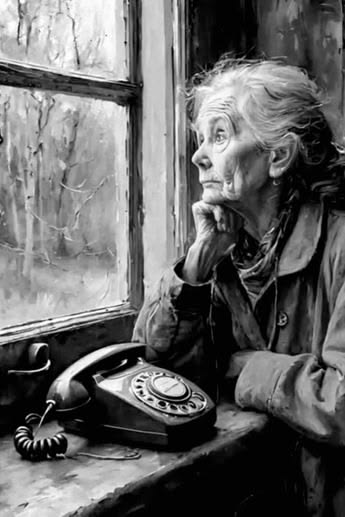
She still kept it plugged in.
Her daughter had offered, gently and more than once, to replace it with something modern — something cordless, something with large buttons and a bright screen that announced who was calling before you had to commit to answering. Edna had declined each time with the same patience she brought to most suggestions that involved changing things she had decided to keep. The rotary phone had been on that windowsill since 1967. It had been there when her husband was alive and it had been there after, and the particular black weight of it and the sound it made — that genuine, unhurried ring, nothing like the electronic imitations — was so thoroughly woven into the fabric of what this house sounded like that removing it would have been like removing a word from a sentence. The sentence would still exist but it would mean something slightly different and she was not interested in different.
What she was interested in, this Tuesday morning in November, was the rain.
It was coming down the way it came down in this part of western Pennsylvania in the gray middle of autumn — steadily, without drama, without any particular intention of stopping. It darkened the trees at the edge of the yard and collected in the low place near the fence where the ground had always been poor at draining and probably always would be. She had watched that low place collect water for fifty-three years. She knew exactly how full it would get before it began to recede, and she found this knowledge privately satisfying in the way that all long familiarity is satisfying — the comfort of a world behaving as expected.
She rested her chin in her hand and watched the rain.
Her name was Edna Calloway. She was seventy-nine years old, which was an age she had arrived at with the mild surprise she imagined most people felt at that particular number — not because she felt it, exactly, but because the arithmetic of it was startling when she bothered to do it. Seventy-nine years. She had been alive for a very long time. She had filled those years with the ordinary materials of an ordinary life — marriage, children, the long slow work of maintaining a house and a garden and a set of relationships — and she did not find the ordinariness diminishing, had never found it so. She had watched people chase extraordinary things and return from them looking tired, and she had concluded early on that what most people were actually chasing was the thing ordinary life contained if you paid sufficient attention to it, and that the chasing was simply what you did when the paying attention had gotten away from you.
She had three children. Carol in Pittsburgh, forty-five minutes away. David in Seattle, which might as well have been another country in practical terms. And James.
The phone was on the windowsill because James had given it to her.
Not this phone — not this exact phone, which had been on the windowsill already when James was born in 1961 and which James had therefore grown up alongside. What James had given her was the habit of sitting beside it. He had called her every Sunday for thirty-one years — every Sunday, without exception, from college in Ohio and his first apartment in Chicago and his house in Denver where he had lived for the last nineteen years with his partner Michael and a yellow Labrador named Chester who had died three years ago and whose absence James had mourned with a sincerity that had only made Edna love him more. Every Sunday. Eleven o’clock her time because of the time difference, because James had always been careful about the time difference, careful in the ways that matter.
The last Sunday had been fourteen weeks ago.
He had not died. She wanted to be precise about this, because people assumed, and the assumption — however kindly meant — was a different kind of hard than the actual thing. James was alive. He was in a hospital in Denver where the doctors used words she had written down carefully in the small notebook she kept by the phone — the same notebook where she had always written things she needed to remember, grocery lists and appointment times and the birthdays of people who might feel forgotten. She had written the medical words in her careful cursive and then looked them up one by one on the computer Carol had set up for her two years ago, learning what each one meant with the slow diligence of a woman who believes that understanding a hard thing is better than not understanding it, even when the understanding is itself hard.
She understood the situation. She did not understand how to be inside it.
He could not call. Not yet. The doctor — a woman named Dr. Reyes who had the careful voice of someone who has delivered difficult information enough times to have learned how to carry people through it — had explained that this was temporary, that James was improving, that Michael was with him every day, that Edna would hear her son’s voice again. Dr. Reyes had been specific about this in the way Edna had asked her to be specific, because Edna was not a woman who found comfort in vagueness. She had found comfort in the specificity. She returned to it regularly, the way you return to a reliable text — touching it to confirm it is still there, still true.
She would hear his voice again.
She held this.
In the meantime, the Sunday silences had taken on a new quality.
She had not moved from the windowsill at eleven o’clock any Sunday since the last call. She could not have explained this to Carol, who would have said something compassionate and practical about not torturing herself, about doing something else with that hour, about not sitting beside a phone that wasn’t going to ring. Carol was a good daughter and a practical thinker and these were related qualities that Edna admired while also understanding that they were not her own qualities and never had been.
She sat because sitting felt like keeping the appointment. Because James had never missed a Sunday and she was not going to miss one either, on her end, regardless of whether the call came. Because the hour had belonged to him for thirty-one years and she was not going to reclaim it for dishes or television or anything else. It was still his hour. She would wait in it.
She watched the rain on the glass. She watched it run in the particular patterns it always ran, following the same paths it had followed every rainy November, the channels worn into the old glazing by decades of weather. She thought about James at seven years old coming in from the rain with his shoes soaked through, laughing about it, which was characteristic — James had always laughed at the things that got him, the minor indignities, the small disasters. He had his father’s laugh. She had told him this once and he had gone quiet in a pleased way and said tell me something else about him and she had sat with him at this very table and talked about his father for two hours, more than she had talked about him since the funeral, and it had been — she searched for the word and found it — replenishing. He had given her that.
He gave her things. He had always given her things, without making a production of the giving, which was the best way.
The rain kept coming down.
Eleven o’clock came and went.
She sat.
She put her hand on the phone. Not lifting it — just resting her palm on the cool black surface of it, the way you rest your hand on the shoulder of something you are keeping company.
Outside, the low place near the fence was filling up the way it always filled.
She knew exactly how long before it would begin to recede.
She was good at waiting. She had had a long time to get good at it and she had done the work.
She kept her hand on the phone and watched the rain and waited for the Sunday that would be different from this one, which she believed in with the same patient, evidence-based certainty with which she believed in the low place draining and the trees coming back in spring and all the other things that had always, eventually, returned.
