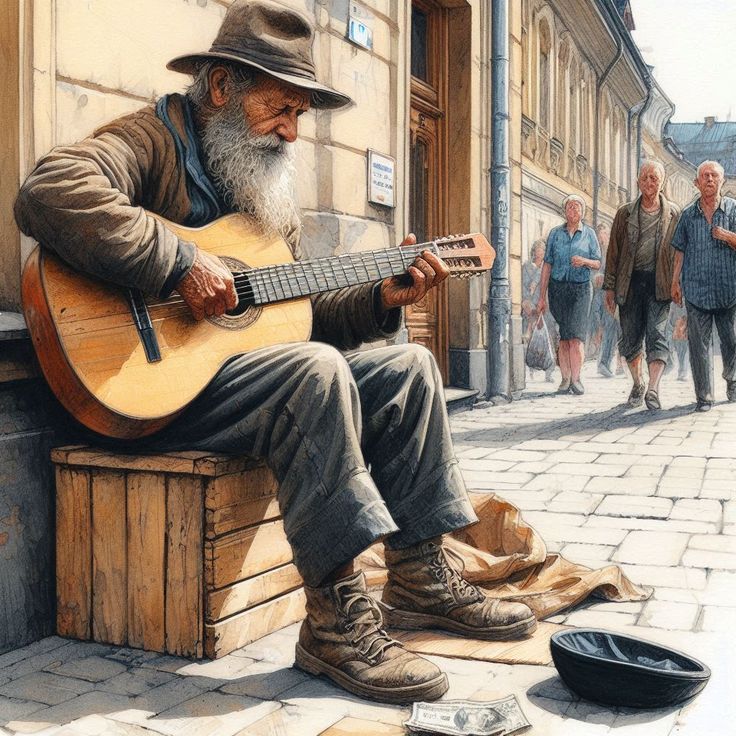
Most people walked past him like he was part of the sidewalk.
That’s the honest truth of it. In a city like Nashville, where music bleeds out of every doorway and the air itself seems tuned to something, a man playing guitar on a wooden crate outside the old Harmon building was just scenery. Background. The kind of thing your eyes register and your brain discards before you’ve taken your next step. People had places to be. People had earbuds in. People had the particular forward lean of those who have decided, somewhere along the way, that looking too long at certain things costs more than they’re willing to pay.
His name was Vincent Coal, though nobody on Mercer Street knew that.
He was seventy-three years old, with a beard gone fully white and hands that told the whole story of a life if you knew how to read hands — the thickened knuckles, the calluses in the specific places that only come from decades of strings, the faint scar along the right thumb from a knife fight in Memphis in 1974 that he’d never once regretted because the other man had needed the lesson. He wore a brown felt hat that had been good once, a long time ago, and boots that had walked more American miles than most cars. His coat was too heavy for September, but he wore it anyway because a man who sleeps outside learns quickly that the morning comes cold no matter what the afternoon promises.
The guitar was the one thing he owned that was still whole.
It was a 1961 classical, spruce top, Brazilian rosewood back and sides, the kind of instrument that had no business being on a sidewalk and knew it. He had carried it through thirty years of touring, two marriages, one flood, and the specific wilderness of a man who had everything and then, through a series of choices that made sense one at a time, had nothing. The guitar had outlasted all of it. He kept it in a case lined with the remnants of a blue dress shirt that had once been worn to a Grammy ceremony, though he would not have told you that unless you asked, and even then maybe not.
He played every morning from seven until the heat got too much or the donations got enough, whichever came first.
Mostly it was the heat.
On the morning that changed things, he was working through a fingerpicking arrangement he’d been building in his head for three weeks — a song about a river town he’d played in 1989, the name of which he could no longer remember but the feeling of which had never left him. The melody kept almost arriving and then stepping back, like a shy thing that wasn’t sure of its welcome. He was chasing it with his eyes closed, the way you have to chase the things that matter, when he heard the footsteps stop.
Most footsteps didn’t stop.
He opened one eye.
She was maybe eleven, twelve. Red backpack, school shoes, the look of a child who is late for something and has decided to be late anyway. She was standing on the sidewalk with her head tilted slightly, the way people tilt their head when they’re actually listening, which was different from the way people looked when they were being polite.
“What’s that song?” she said.
“Don’t have a name yet,” Vincent said.
“Is it yours?”
“Getting there.”
She thought about that. Then she sat down on the sidewalk, cross-legged, backpack in her lap, and looked at him with the direct, unself-conscious attention that children have before the world teaches them it’s rude to stare at people who are different from them.
“I’m going to be late,” she announced, as though informing the universe of a fact it should note.
“Probably,” he agreed, and kept playing.
Her name was Iris, and she was in sixth grade at Clement Middle, and she was late because she had stopped to listen and she had stopped to listen because the melody had reached her across the noise of Mercer Street and grabbed her by something she couldn’t name. She told him all of this in the practical, unsentimental way of children who haven’t yet learned to be embarrassed by honesty.
“Why are you out here?” she asked. “You’re really good.”
Vincent smiled into his guitar. “Being good doesn’t mean much without being lucky,” he said. “And I used up my luck early.”
“That’s sad.”
“Some days,” he said. “Other days it just is what it is.”
She put two dollars from her lunch money in his hat. It was the most intentional two dollars he’d received in longer than he could remember — not the distracted fumble of guilt money, not the performance of generosity, but a transaction between equals, a fair exchange for something of value. He nodded at her the way he used to nod at musicians who played something true.
She came back the next morning. And the next.
By the end of the second week she was bringing a notebook, writing down the words he sometimes sang under his breath, fragments of things he’d never finished. By the end of the third week she had told him about her mother, who had died two years ago, and the way the house had gone quiet afterward in a way that regular noise couldn’t fix. He had told her, in return, about the river town he couldn’t name, and the feeling it gave him, and how the song was still not finished.
“Maybe,” Iris said one morning, notebook open on her knees, “it’s not finished because you haven’t figured out the ending yet.”
Vincent stopped playing.
He looked at this twelve-year-old child sitting cross-legged on a Nashville sidewalk with a red backpack and her mother’s absence and her father’s worried eyes, and he thought: there it is. The thing the song was waiting for.
He played the opening again, and this time the melody arrived all the way. Didn’t step back. Stayed.
He played it through to the end, and when he was done, Iris wrote one word in her notebook.
She showed it to him.
Home.
He didn’t say anything. He didn’t need to. He just set his hand flat against the strings, the way you quiet something that has finally said what it came to say, and sat in the particular silence that only comes after a true thing has been spoken out loud for the very first time.
That afternoon, for the first time in eleven years, Vincent Coal called his son.
